
A Telegram zero-day vulnerability could be worth up to $4 million to an exploit broker. In March 2025, Russian broker Operation Zero advertised that maximum for a full chain, alongside lower ceilings for one-click and zero-click remote code execution. The contemporaneous report of its March 20 announcement documents an offer to acquire exploits, not a completed payment or proof that a working chain had been delivered.
That distinction does not make the offer harmless. It signals an incentive to find valuable weaknesses and sell them privately rather than help the developer fix them. For journalists, activists, government staff and cybersecurity professionals, the prospect of a communications flaw becoming an exclusive surveillance tool deserves attention.
Telegram has more than 900 million monthly active users. Its adoption spans everyday consumers, journalists, activists, politicians and military personnel. Yet reputation and popularity do not establish confidentiality. Telegram’s explanation of Cloud Chats and Secret Chats makes a crucial distinction: ordinary Cloud Chats are not end-to-end encrypted, while the separate Secret Chat mode is. Understanding that design choice matters independently of whether a particular zero-day exists.
This article examines the exploit offer, Telegram’s privacy defaults, its historical security findings and five risks that follow when messaging weaknesses are acquired for offensive use. It also explains what users can do to reduce exposure without confusing account protection, encryption and device security.

Key Takeaways
- Operation Zero advertised up to $4 million for a Telegram full chain. The offer does not establish a sale, deployment or confirmed compromise.
- A zero-day is not necessarily a zero-click attack. The announcement listed different acquisition categories.
- Telegram Cloud Chats require trust in the provider; Secret Chats use end-to-end encryption and are device-specific.
- Cloud delivery and multiple devices do not inherently prevent end-to-end encryption. Telegram’s Cloud Chat model is a design choice.
- Private exploit acquisition creates a serious tension between offensive access and public remediation.
- Secret Chats, Two-Step Verification and updates address different risks. None guarantees safety after a device compromise.
What Is a Telegram Zero-Day Vulnerability?
A Telegram zero-day vulnerability is a security weakness for which defenders do not yet have an available fix, often because it is unknown to the developer when attackers discover or use it. A vulnerability is the flaw; an exploit is the means of taking advantage of it. Those terms are related, but they do not mean that every flaw automatically gives an attacker complete control.
In high-risk communications platforms, messaging app vulnerabilities can be valuable economically and strategically. They may expose conversations, permit impersonation or provide a starting point for a wider device compromise. The actual consequence depends on the affected component, the permissions reached and the protections an attacker can bypass.
Defining Zero-Day Vulnerabilities
The phrase “zero-day” describes the defender’s lack of an available patch, not an absence of every possible defense. Device protections, reduced exposure and other controls may still limit a particular attack. Nor does the term establish that an exploit works without interaction: a previously unknown flaw can still require someone to open a file or approve an action.
The distinction matters when reading an acquisition offer. A request for a reliable exploit is evidence of demand. It is not itself evidence that the requested capability exists, has been purchased or is being used against a named population. Treating those stages as interchangeable exaggerates what an announcement proves and makes the genuine policy problem harder to assess.
How Zero-Days Apply to Messaging Apps
Messaging apps carry communications between journalists and sources, dissidents and organizers, or diplomats and government staff. Depending on the vulnerability and attack conditions, a compromise could enable:
- Remote code execution: running malicious code within an affected application or another reachable component.
- Account hijacking: impersonation or access to conversations and files available through a compromised account.
- Data theft: extraction of messages, photos, contacts or other information within the attacker’s reach.
These are different outcomes, not a guaranteed bundle. An account takeover does not necessarily compromise the operating system. Code execution in one restricted app does not necessarily bypass the device’s other security boundaries. Access to Cloud Chat history and access to a device-specific Secret Chat also present different requirements.
Telegram’s provider-trusted cloud model raises questions about service-side access as well as endpoint security. It does not establish that the March offer sought a server breach or that breaching any one server would expose every user’s messages. The advertised capability and the architecture’s privacy properties need to be considered separately.
Telegram’s Exposure to Zero-Click Attacks

In a zero-click attack, the victim does not need to click, tap or open anything for the relevant exploit to work. Processing an incoming message or attachment can be an attack surface if a suitable flaw exists. This is a particularly serious prospect for people who cannot control who attempts to contact them.
Operation Zero advertised up to $1.5 million for zero-click remote code execution. Its separate $4 million full-chain line did not itself specify zero-click. A full chain generally links weaknesses to move beyond an initial foothold, but the precise access and interaction requirements depend on its components.
For a surveillance operator, avoiding user interaction could make an attack less conspicuous and remove a major obstacle. For a potential target, careful clicking alone would not address that category of vulnerability. The offer nevertheless remains a solicitation: it does not demonstrate a Telegram zero-click campaign or establish that every user was exposed to one.
The $4M Bounty: What It Means and Who Offered It
Operation Zero’s public announcement put a substantial acquisition ceiling on Telegram exploits. Its significance lies in the incentive it creates: researchers with a useful finding may face a choice between helping the vendor remediate it and selling offensive access privately.
The illustration above represents that market incentive. A broker’s willingness to solicit these capabilities gives researchers a financial reason to look for weaknesses whose value depends on secrecy.
Who Is Operation Zero?
Operation Zero is an exploit broker, rather than Telegram’s own vulnerability-remediation program. The relevant contrast is what happens to a finding. A vendor bounty aims to bring a flaw to the developer so it can be assessed and fixed. An offensive acquisition can instead preserve its usefulness for a purchaser while other users remain unaware of it.
That difference creates serious geopolitical stakes even without proof of a particular intelligence buyer. The March announcement does not identify a completed Telegram sale or establish which agency, company or individual obtained an exploit. Claims about specific purchasers should not outrun the available evidence.
The comparison with vendor rewards also needs care. In its July 2022 Lockdown Mode announcement, Apple described doubled bounties of up to $2 million for qualifying findings. Operation Zero’s $4 million ceiling was larger, but the programs had different purposes and qualification terms. It is not a like-for-like comparison of actual payments for an equivalent vulnerability.
Bounty Structure and Exploit Categories
The advertised Telegram categories were:
- Up to $500,000 for one-click remote code execution: a category requiring user interaction.
- Up to $1.5 million for zero-click remote code execution: a category requiring no user interaction.
- Up to $4 million for a full chain: a linked capability whose value depends on the access achieved and other conditions.
The distinction between the categories matters: one concerns a user-assisted entry point, another removes that interaction, and the full-chain category concerns linked access. The eventual price and capabilities would depend on what a researcher could actually deliver.
The political concern remains substantial. Messaging exploits can become instruments of surveillance rather than fixes that benefit the people relying on the service. The incentive to keep a weakness exclusive can conflict directly with the public interest in timely remediation.
State-Level Buyers and Espionage Value
Telegram’s use for sensitive communications makes potential compromise a national-security concern as well as a personal privacy issue. A relevant historical example is Ukraine’s September 2024 official-device restriction. It covered government officials, military personnel, security and defense employees, and critical-infrastructure operators, with an exception where official duties required the messenger.
The announcement attributed concerns about Russian access to intelligence chief Kyrylo Budanov and described hostile uses including phishing, malware and geolocation. That is an attributed security assessment and policy decision, not a published technical demonstration of the exploit sought in March 2025.
For a state surveillance operation, a communications exploit could provide access to relationships, plans and sources that are valuable far beyond the app itself. Exclusive access may also preserve an advantage over other actors while denying defenders information they could use to close the weakness.
For a broader discussion of the institutional stakes, our coverage of AI-powered cyberwarfare in 2025 examines how military and intelligence actors use emerging technologies across digital fronts.
How Telegram’s Architecture Affects Privacy
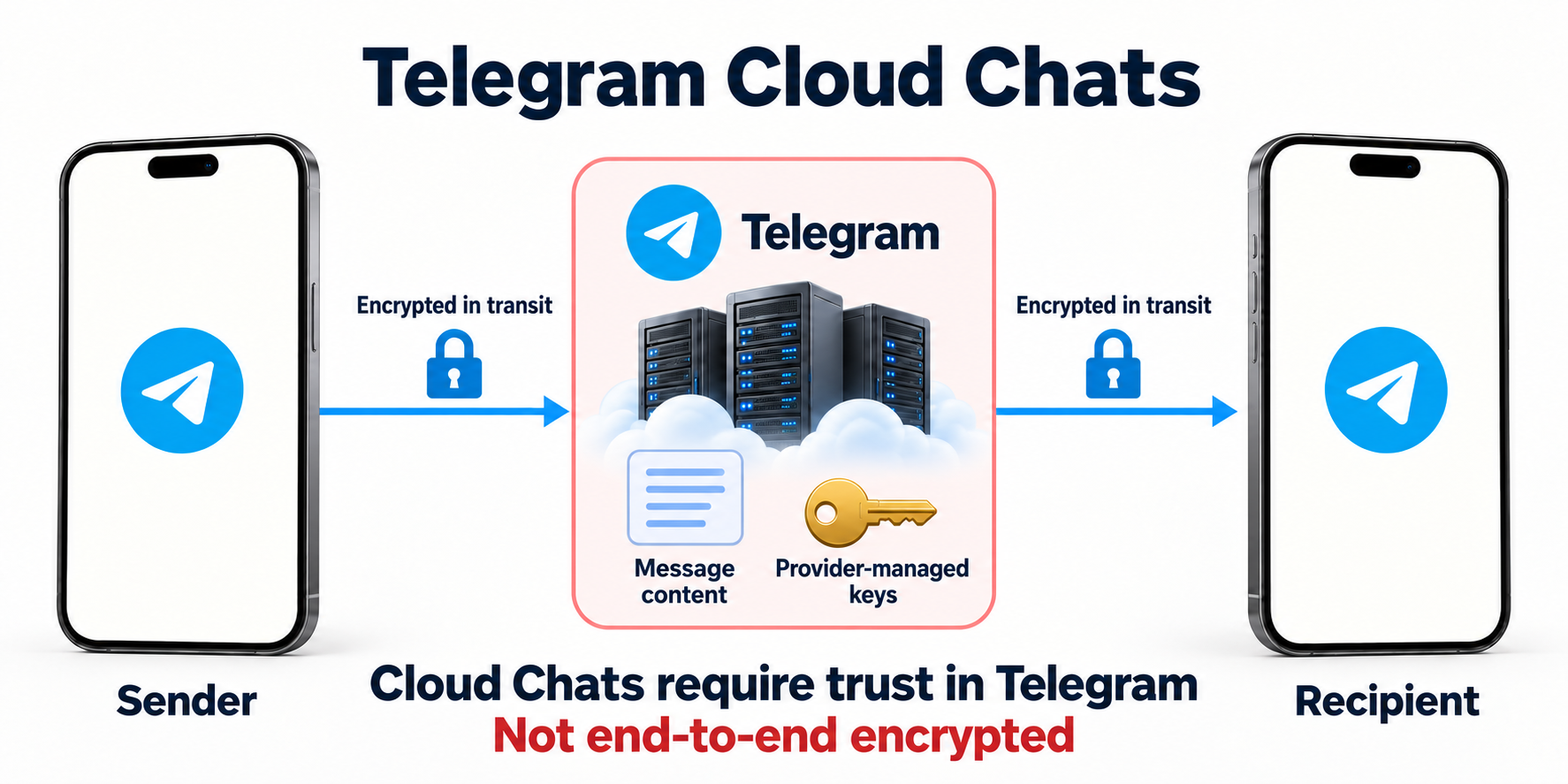
Telegram’s encryption policies, server structure and chat configuration deserve scrutiny. They determine which parties must be trusted with message confidentiality. They do not, by themselves, measure how frequently Telegram suffers exploitable bugs compared with another service.
The architecture illustration concerns Cloud Chats. Secret Chats use a separate end-to-end mode; treating both as one security model would obscure the most important distinction for users.
Centralized Cloud Servers and Default Encryption Gaps
Ordinary Telegram Cloud Chats use encryption between the client and the service, with histories stored for cloud access. That is different from end-to-end encryption, where message confidentiality is designed to hold against the messaging provider itself. Cloud Chats therefore require trust in Telegram’s handling of data and keys.
Only one-to-one Secret Chats provide Telegram’s end-to-end messaging mode. Users must deliberately start one, and its history does not become the ordinary synced cloud history. Group chats and channels do not acquire Secret Chat protection merely because the app describes its communications as encrypted.
This model raises legitimate questions about internal access, legal pressure and service-side security. But the statement that a service is trusted is not proof that an attacker has breached it. The number of histories accessible in any compromise would depend on the access obtained and the surrounding controls, not simply on the word “cloud.”
For someone communicating with a confidential source, the practical issue is straightforward: which parties does this conversation require you to trust? That decision should be made before sharing sensitive material, rather than inferred from a privacy slogan after the fact.
MTProto 2.0: Formal Analysis Has a Defined Scope
Telegram’s technical documentation describes its MTProto protocol and distinguishes Cloud Chats from Secret Chats. Its client code is open source and the protocol is documented; its server code is not published. Calling the protocol “proprietary” without those distinctions incorrectly suggests that researchers cannot inspect its design or the clients.
An April 2021 formal analysis of MTProto 2.0 modeled several mechanisms and security properties. Its Cloud Chat confidentiality result assumes a trusted server, while its Secret Chat and rekeying analysis also considers malicious servers. Those results must be read within their respective models and assumptions.
Verification of a protocol does not guarantee secure implementation. A model does not establish that every deployed client and server is free of bugs, that every message has every property analyzed, or that a device cannot be compromised. Conversely, the Cloud Chat trust assumption should not be presented as the threat model for every Telegram conversation.
Lack of End-to-End Encryption for Groups and Synced History
Telegram lets users access Cloud Chat history across multiple devices. The privacy tradeoff is its provider-trusted implementation, not a universal impossibility of combining multiple devices with end-to-end encryption.
Signal’s 2017 Sesame specification for encrypted multi-device sessions provides a historical counterexample. Server-mediated delivery can carry encrypted messages for multiple devices without giving the service the message plaintext. Cloud infrastructure and end-to-end encryption are not mutually exclusive concepts.
Telegram’s flexibility and usability should therefore be assessed as design choices with consequences. Users may value readily available history, large groups and broad access, but those conveniences do not make ordinary Cloud Chats confidential against the provider. High-risk communications require that distinction to be explicit.
5 Risks Behind the Exploit Offer
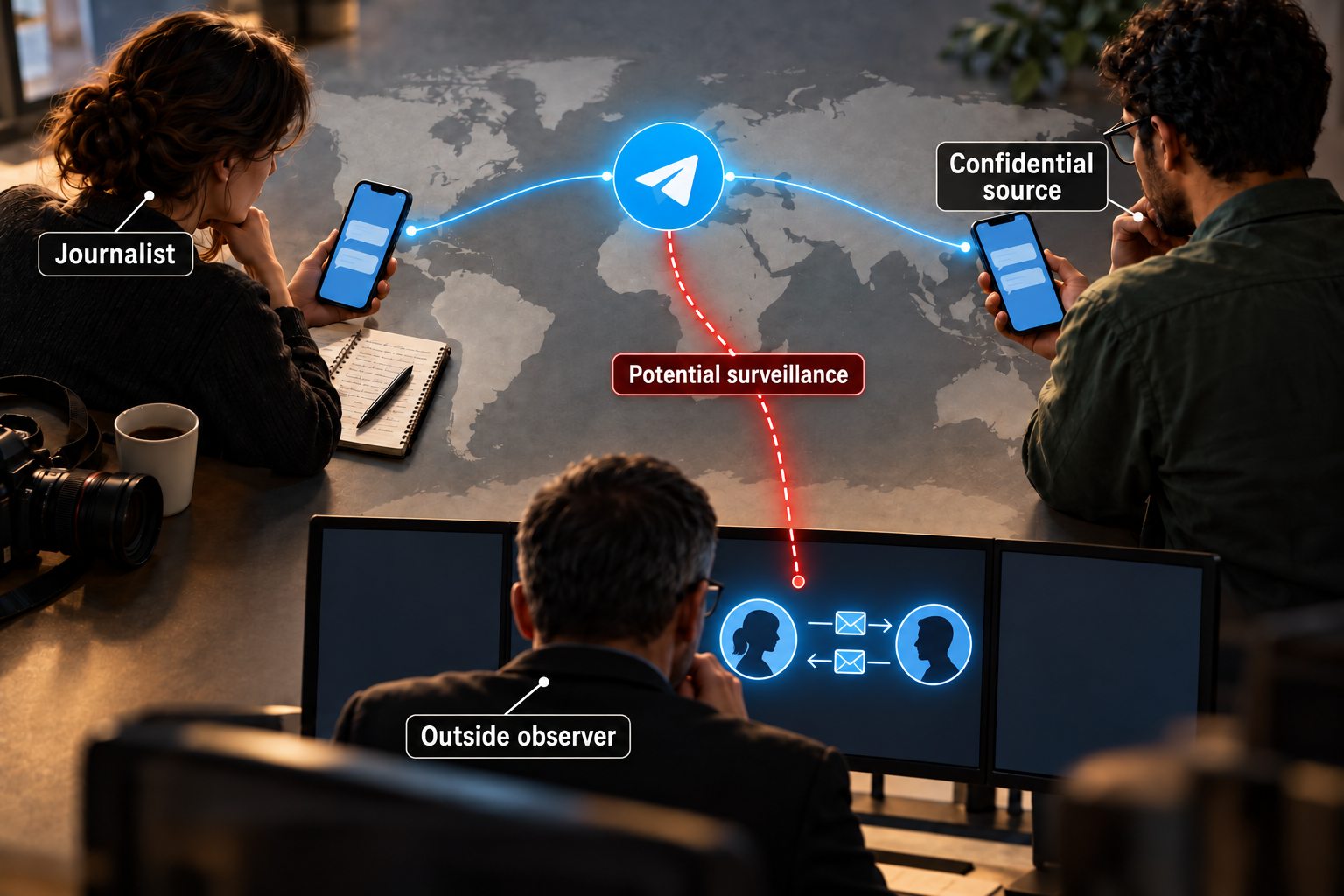
The bounty raises risks to privacy, journalism and organizational trust. The map is conceptual art, not a measured country risk ranking or evidence of campaign locations. These five categories explain why offensive access matters; the announcement alone does not establish that each outcome occurred.
1. Surveillance of Journalists and Activists
For journalists, the implications of a successful device exploit could be serious. A reporter covering corruption or war crimes may hold source identities, documents and conversations that place other people at risk. Similar concerns apply to human rights defenders, whistleblowers and foreign service personnel.
The relevant risk is not limited to one stolen message. Communications reveal relationships and plans, and compromised access can undermine the confidence on which confidential work depends. Ukraine’s restriction illustrates the institutional concern without proving a particular Telegram zero-day campaign.
The distinction between provider access and endpoint compromise remains important. Secret Chats address the former in their defined model, but encryption cannot promise secrecy from an attacker who has already obtained sufficient access to the device displaying the conversation.
2. Device Compromise and Malware Delivery
A full chain can link an initial application weakness with other weaknesses to cross additional security boundaries. Depending on the achieved privileges, an attacker might reach sensitive files, communications or device functions beyond the first app. That possibility explains the attraction of a capability that goes further than account access alone.
It does not follow that every chain captures biometric secrets, activates every sensor or survives a reboot. Those claims require evidence about a particular exploit and device. The March offer supplied no such demonstration.
Malware delivery also has different paths. A deceptive file that persuades someone to install an app is a serious problem, but it is not the same as code executing automatically on receipt. Confusing those routes weakens both the technical account and the advice offered to users.
3. Hijacked Accounts for Disinformation Campaigns
When Telegram accounts are compromised, attackers can hijack the identity of the user. For influencers, journalists or activists, this opens the door to coordinated disinformation attacks. A compromised account could be used to:
- Spread false political statements or endorsements.
- Leak fabricated documents under the user’s name.
- Disrupt organizing efforts by sending fake messages in group chats.
- Undermine trust between real users in activist networks.
The reputational harm can extend beyond the initial victim when recipients act on a message they believe came from a familiar person. Our discussion of mobile data privacy risks considers the wider importance of information held on and around a phone.
4. Undermining Trust in Messaging Apps
For people who depend on communications tools for safety or professional confidentiality, unclear security claims can be damaging. “Encrypted,” “end-to-end encrypted” and “safe from device compromise” describe different things. Treating them as interchangeable creates a false sense of protection.
Private acquisition adds another difficulty: users may have no useful information about a weakness while an offensive purchaser retains access. A popularity-based decision can therefore leave a gap between the protection someone expects and what the tool actually provides.
This erosion of trust is especially dangerous in authoritarian contexts, where switching to less accessible apps may not be feasible. In those environments, Telegram’s perceived security can become a false shield. Clear explanations of its protection and limitations are essential for people making consequential communications decisions.
5. Incentives to Keep Vulnerabilities Secret
The offer makes the economics of offensive access visible. A private purchaser may value a flaw precisely because it remains unknown and unpatched. The developer and the users would generally benefit from disclosure and remediation instead.
By incentivizing developers to sell messaging app vulnerabilities privately, these programs can:
- Shift research away from public disclosure and toward exclusive offensive use.
- Deny defenders information they could use to patch a flaw.
- Preserve an information advantage for the purchaser while other users remain exposed.
The broader relationship between new capabilities and defensive pressure is discussed in our 2025 coverage of AI cyberattacks and security tools. Here, the specific issue is an acquisition incentive that can reward secrecy over repair.
Telegram’s Track Record on Privacy and Security
Historical security findings are useful when their scope and remediation are reported accurately. They show why scrutiny matters, but they should not be turned into evidence that the same bugs remained exploitable in June 2025 or that the March solicitation had already produced a new attack.
Past Vulnerabilities in MTProto
In 2021, researchers at ETH Zurich and Royal Holloway examined MTProto 2.0 and official clients. ETH’s account of the four cryptographic findings describes weaknesses including message-ordering and key-negotiation issues, alongside theoretical attacks with major practical limits. It did not rule out plaintext-recovery implications altogether.
The researchers’ disclosure and remediation account records client fixes and server mitigations. The immediate risk was considered low for most users. Reporting those limits does not erase the findings; it explains what they actually established and why coordinated research and repair matter.
The useful lesson is that protocol design, its analysis and the deployed implementation all deserve scrutiny. The existence of research does not certify every implementation, and a historical vulnerability does not establish a current compromise.
Account Hijacking and the Additional Password
Phone-number access and account security are separate from an application zero-day. Telegram’s 2015 announcement of Two-Step Verification and Active Sessions explains an additional password required alongside a login code when signing in on a new device. It also describes optional recovery email and session controls.
An attacker who gains control of a number may be better placed to obtain a login code, but that does not make account access automatic where the additional password is required. Protecting the account and recovery channel still matters, even though those measures do not patch a device exploit.
Account takeover, deceptive installation and exploitation of a software flaw require different protections. A strong account password can obstruct a new login without repairing a flaw in the app, just as a patched app does not replace control of the account’s recovery channel.
Malware Distributed Through a Deceptive Video
ESET’s July 2024 EvilVideo research concerned malicious Android applications presented as videos in Telegram for Android 10.14.4 and older. The attack involved a user attempting playback and approving installation of a purported external app. Automatic downloading of a file did not mean automatic execution of its malware.
Telegram fixed the issue in version 10.14.5, released July 11, 2024. This was a concrete example of deceptive content and the value of remediation, not proof of zero-click execution or a regional espionage campaign. It also did not establish that Telegram’s cloud architecture caused the flaw.
The distinction changes the advice: refusing an unexpected installation request could interrupt that route, while it would not necessarily stop a genuine zero-click exploit. Users need the correct account of what happened to understand which precaution helps.
Transparency and Audit Concerns
Telegram’s documented protocol and open-source clients permit external scrutiny of important parts of the system. Its unpublished server code limits what outsiders can inspect on that side. Both facts belong in an assessment of transparency.
Publishing code can support examination, but it does not by itself prove that a deployed service exactly matches the published version or that its implementation is bug-free. Closed code is a limitation on independent inspection; it is not proof of a hidden vulnerability or malicious access.
The criticism that remains is substantial: users of ordinary Cloud Chats must trust the provider with confidentiality. That trust should be clearly explained rather than concealed behind a general reputation for privacy.
What You Can Do to Protect Yourself
The offer does not establish that every Telegram user is being targeted. People handling sensitive communications nevertheless have reason to examine their choices. Useful precautions address the risk they actually control, rather than promising a universal defense against unknown exploits.
Enable Secret Chats Where Their Model Fits
Secret Chats provide end-to-end protection for one-to-one conversations, separate from ordinary Cloud Chats. They must be deliberately started, are device-specific and do not provide the same synced history. They are not supported by every client and do not turn groups or channels into end-to-end encrypted conversations.
For a supported client, start a Secret Chat with the intended contact rather than assuming an existing ordinary conversation has that protection. Check which mode you are actually using before sending sensitive material.
The limitation is equally important: Secret Chats cannot guarantee confidentiality after sufficient endpoint compromise. They reduce provider-access exposure within their model; they do not make either participant’s device immune to malicious software or an operating-system exploit.
Enable Two-Step Verification and Review Sessions
Use Telegram’s additional account password, choose a strong unique value and protect the recovery email if you configure one. The extra password supplements the login-code process; it does not remove the phone number from the account or convert the account into a hardware-key system.
Review active sessions and end unfamiliar ones. Keep control of the recovery channel and treat unexpected login requests seriously. These actions address account access, which can be harmful even without a sophisticated exploit.
Do not mistake the second password for an exploit defense. A device-level attacker and someone trying to sign into the account from a new device are different threats. The control is valuable because it addresses a defined risk, not because it solves every risk described in the article.
Keep Apps and Systems Updated
Install Telegram and operating-system updates through trusted sources. Use automatic updates where practical, and check versions if you install software outside the usual store process. Avoid modified packages whose maintenance or origin you cannot establish.
Updates close known weaknesses once fixes are available. EvilVideo’s July 2024 remediation is a concrete historical example. Remaining on an affected version can preserve exposure to a bug even after the developer has repaired it.
An update cannot promise protection against every unknown flaw. Its practical value is removing avoidable exposure to fixed problems and maintaining the protections supplied by the app and operating system. That is a meaningful precaution without an exaggerated guarantee.
Evaluate Alternatives for Sensitive Communications
If you work in journalism, activism, government or another sensitive role, assess whether the conversation needs default end-to-end encryption, group confidentiality or protection from provider access. Signal’s encrypted multi-device model demonstrates that those choices need not be framed as privacy versus all device convenience.
The same scrutiny should apply to WhatsApp or any other alternative under consideration. Determine which communications are protected, what happens on linked devices and what information remains outside message-content encryption. A familiar brand is not a substitute for understanding the relevant model.
Changing apps also requires the other participants to use the intended channel correctly. No messaging choice can repair an already compromised endpoint by itself. Select the tool for the communications need while maintaining account and device protections alongside it.
The Bigger Picture: What This Says About Messaging App Security
The offer reflects a deeper problem in how secure communication is evaluated: design choices matter more than branding. A service can encrypt traffic and still require users to trust it with the contents. An exploit broker can advertise a dramatic sum without proving a successful compromise.
Those distinctions should strengthen the policy discussion. They allow the serious questions about offensive markets, transparency and user protection to stand on evidence instead of on an unsupported claim of universal failure.
The Economic Incentives Behind Messaging Exploits
Vendor remediation and offensive acquisition reward different outcomes. One seeks information needed to repair a weakness; the other may value a period of exclusive access. Publicly advertised ceilings help illustrate that competition for findings, even where actual purchases remain undisclosed.
The Telegram offer does not prove that every researcher chooses secrecy or that all vulnerabilities are hoarded rather than fixed. It raises a narrower and important issue: a substantial private incentive can work against disclosure that protects the wider user population.
For policymakers, the question is how to reduce the harm created when security knowledge is retained for offensive use. That requires distinguishing the developer’s patching incentives, the researcher’s choices and the purchaser’s intended access, rather than treating every bounty program as equivalent.
Why Architecture Matters More Than Marketing
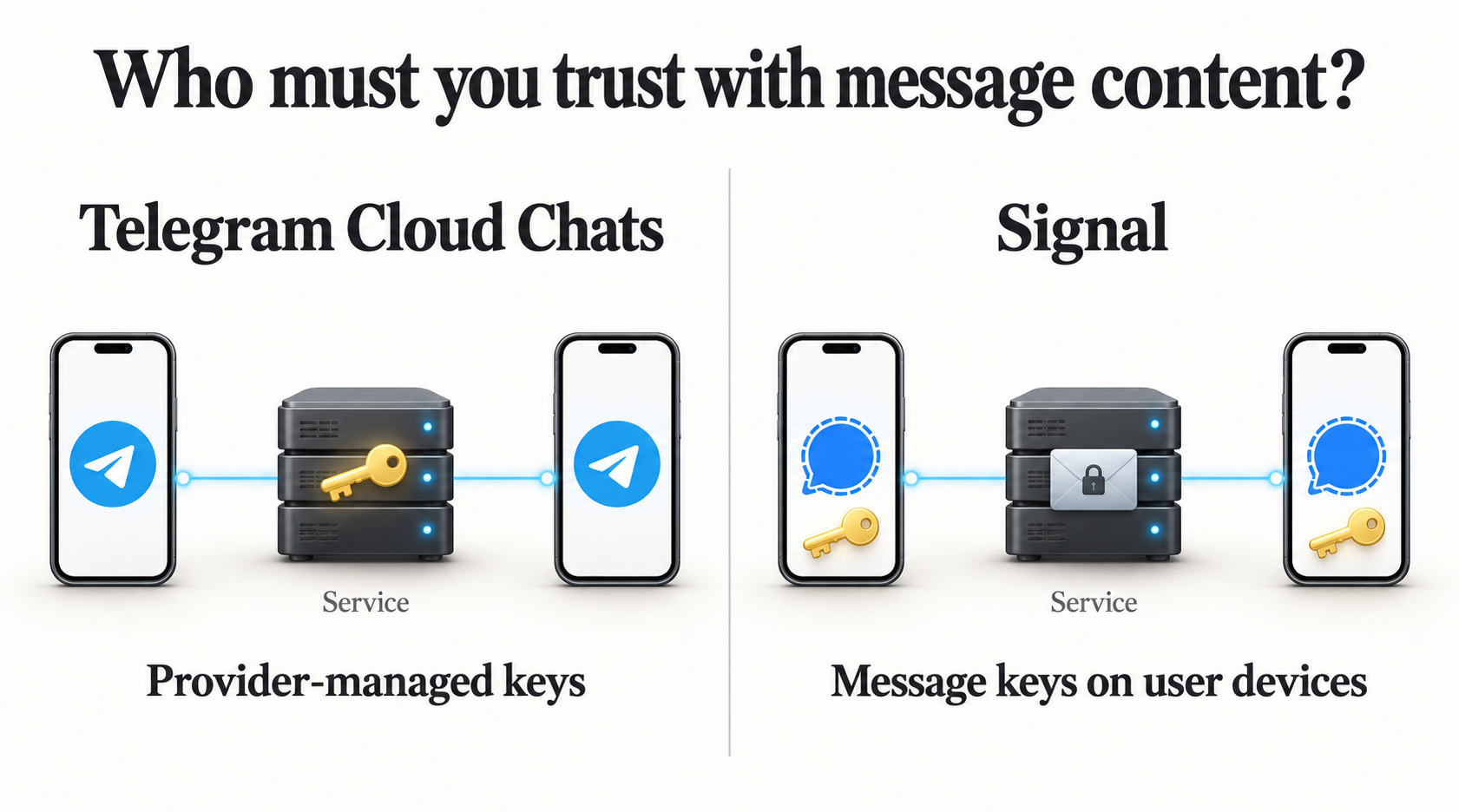
Telegram’s ordinary Cloud Chats require provider trust; Signal’s end-to-end model is designed to keep message content confidential from the service. That architectural difference is consequential for people whose concern includes provider access or pressure on the service.
It does not establish a comparative zero-day rate or make any endpoint invulnerable. Encryption defaults and implementation vulnerabilities are related parts of a security assessment, but one cannot be used as an automatic measurement of the other.
The meaningful criticism is therefore about the protection users actually receive. Convenience, synced history and broad accessibility should not be allowed to blur the difference between a provider-trusted conversation and an end-to-end encrypted one.
Lessons for Signal, WhatsApp and Future Platforms
Even apps with strong encryption protocols can become compromised if their implementations contain exploitable flaws. Encryption and software maintenance must be considered together, rather than asking one to compensate for failure in the other.
Platforms should make confidentiality properties clear, minimize unnecessary retained information, and support independent examination of their designs and code. Where end-to-end encryption is offered, the limitations should be understandable before users rely on it for a sensitive conversation.
For any new messaging platform entering the market, privacy and security cannot be bolted on later. They must be built into system design, defaults and maintenance. Public claims should describe the actual protection instead of relying on the broad label “encrypted.”
Calls for Regulatory and Transparency Standards
A coordinated response is needed. This could include:
- Requiring clearer descriptions of encryption defaults, provider trust and data retention.
- Requiring disclosure of known breaches, especially those exploited at scale.
- Establishing international norms around zero-day exploit sales and bounty transparency.
Requiring clearer security claims would help users distinguish provider trust from end-to-end confidentiality. Supporting responsible disclosure and remediation would address a different problem: the interval in which a useful weakness remains unknown to those defending the system.
Developers, journalists, activists and institutions need enough information to make informed decisions. The March offer illustrates why the interests of an offensive purchaser and the people relying on a messaging app may diverge sharply.
Conclusion & Future Outlook
Operation Zero’s offer of up to $4 million for a Telegram full chain should prompt scrutiny of both exploit-market incentives and the protection users expect from messaging apps. It is a serious solicitation, not evidence that an exploit was purchased or millions of devices were compromised.
Telegram’s Cloud Chat model creates a real provider-trust issue. Popularity and encryption in transit do not establish end-to-end confidentiality, and a formal protocol analysis does not certify every deployed implementation. Security is a function of architectural design, encryption protocols and transparency in implementation, not a marketing promise.
Protecting users requires action at several levels. Platforms need clear defaults and accurate security claims. Researchers and developers need routes that reward remediation. Policymakers should examine the incentives created by private offensive acquisition. Users handling sensitive material should understand their communications model and maintain account and device security alongside it.
If you work in policy, cybersecurity, journalism or high-risk activism, do not assume the apps you use are safe simply because they are popular. Scrutinize the infrastructure, follow the exploit markets and demand accountability from developers whose tools carry sensitive conversations.
For more analysis of cyberwarfare, AI surveillance and digital privacy, subscribe to the Quantum Cyber AI newsletter.
FAQ
Does the bounty prove Telegram is targeted more than Signal?
No. One advertised acquisition offer cannot establish a comparative targeting or vulnerability rate. Telegram Cloud Chats and Signal have materially different confidentiality models, but that distinction does not prove which app has more undiscovered exploitable bugs.
What’s a full-chain exploit?
A full chain links weaknesses to move beyond an initial compromise and reach additional access. Its interaction requirements, privileges and persistence depend on the actual chain. The $4 million category did not itself establish every possible device capability or say that all qualifying chains were zero-click.
Are Secret Chats in Telegram actually secure?
Secret Chats use end-to-end encryption for device-specific, one-to-one conversations. They do not provide group functionality or ordinary cloud-history syncing, and not every client supports them. Their confidentiality model does not guarantee protection if an endpoint has already been compromised.
Has Telegram responded to the $4 million bounty?
A Telegram spokesperson had already commented publicly in March 2025. A response does not independently establish whether a particular exploit exists or what it could do.
Should I stop using Telegram altogether?
If your communications require confidentiality from the provider, ordinary Cloud Chats do not meet that requirement. Consider an end-to-end encrypted service or a suitable Secret Chat for the specific conversation, while accounting for device security, participant access and organizational requirements. Casual use and high-risk confidential work do not require the same decision.