
A finance worker in Hong Kong authorized transfers totaling about HK$200 million after a fraudulent video conference in January 2024. The apparent chief financial officer gave instructions, then the exchange continued through messaging. The Hong Kong government’s account of the investigation explains an important detail: the conference was prerecorded, with no interaction between the worker and the impersonator during the video. Publicly available recordings were believed to have supplied the material. A convincing appearance of authority was enough to help move real money.
AI cybercrime is not confined to an individual with a laptop. Organized fraud also depends on physical premises, workers, stolen information, communications equipment, and ways to collect and launder payments. Generative tools can support parts of that operation, including translation and impersonation. They did not create the underlying business of deception.
For enterprises and policymakers, the useful question is where those tools change the risk and where established controls still apply. This article examines the industrial organization of scam centers, the delivery mechanisms behind SMS phishing, synthetic content, human decision-making, and the defensive and policy choices these developments raise.

Key Takeaways
- Scam centers combine organized fraud with a serious trafficking and forced-labor problem. The people sending fraudulent messages may themselves be victims of coercion.
- SMS blasters are a radio-delivery technique, not an AI system. Some use weaknesses in older cellular protocols to inject messages outside normal carrier filtering.
- Generative tools can make impersonation and multilingual content easier to produce. A polished message does not establish who sent it or whether the request is authorized.
- Deepfake audio and video add another reason to verify high-risk instructions independently. Recognizing a face or voice is insufficient authorization for a payment.
- Strong authentication, controlled payment changes, independent verification, and reporting procedures address different parts of the problem. No single detector replaces them.
The Rise of Industrialized Scam Centers
Southeast Asia’s Scam Compounds as Global Hubs
Some scam operations resemble call centers, but their business is organized deception. UNODC’s October 2024 regional report describes the consolidation of cyber-enabled fraud into larger operations, alongside a specialized criminal service economy. The report connects physical compounds, online gambling, underground banking, money laundering, and suppliers of technical services. These are mutually supporting activities rather than a collection of unrelated phishing emails.
That structure matters to defenders. Blocking one sender or taking down one website may interrupt a contact point without removing the operation behind it. A supplier, rented facility, payment channel, or pool of compromised accounts can serve more than one scheme. The appropriate model is an organized adversary with dependencies, rather than a succession of unrelated mistakes by individual recipients.
The call-center comparison is useful for understanding division of labor, but it has limits. It should not make the operation sound legitimate or imply that every compound uses the same technology. A group selling fraudulent investment services does not automatically run SMS transmitters or stage executive video calls. Evidence about one part of the criminal ecosystem is not proof that all its components form a single attack pipeline.
For a security team, this suggests a broader incident question: what did the criminal operation need the organization to do? The answer may involve an account login, a payment, a banking-detail change, or disclosure of useful business information. Mapping that intended outcome helps finance, IT, and legal teams identify the relevant controls without needing to attribute every message to a particular compound.
Forced Labor and Human Trafficking in Cybercrime
Behind these operations is a humanitarian crisis. In their May 2025 joint statement on forced criminality, UN human rights experts described people deceived into recruitment, confined, abused, and forced to conduct online fraud. They called for victim-centered protection, rehabilitation, and application of the non-punishment principle to offenses committed as a direct result of trafficking.
The distinction between an organizer and a person compelled to send messages is essential. Treating all workers as willing offenders can hide the coercion that sustains the operation. Conversely, recognizing forced criminality does not diminish the financial and emotional harm suffered by the people targeted by the scams. A serious response must account for both sets of victims.
This changes the policy discussion. Website blocking and fraud prevention cannot, on their own, protect someone held in a compound. Anti-trafficking work and financial investigations belong alongside technical disruption. Organizations contributing information to an investigation should avoid public identification of suspected coerced workers or improvised attempts to contact people inside a compound. Decisions about safety and victim protection need appropriate expertise.
SMS Blasters and the Mass Production of Phishing
How SMS Blasters Work
SMS phishing, often called smishing, uses text messages to steer recipients toward a fraudulent action. An SMS blaster changes the delivery mechanism. Google’s August 2024 technical explanation describes false base stations that advertise a fake LTE or 5G network, downgrade a susceptible phone to 2G, then exploit weaknesses in that older protocol to inject messages. For this method, the messages bypass the legitimate carrier network and its network-based filtering. Google also describes device-level protections, including disabling 2G on supported Android devices.
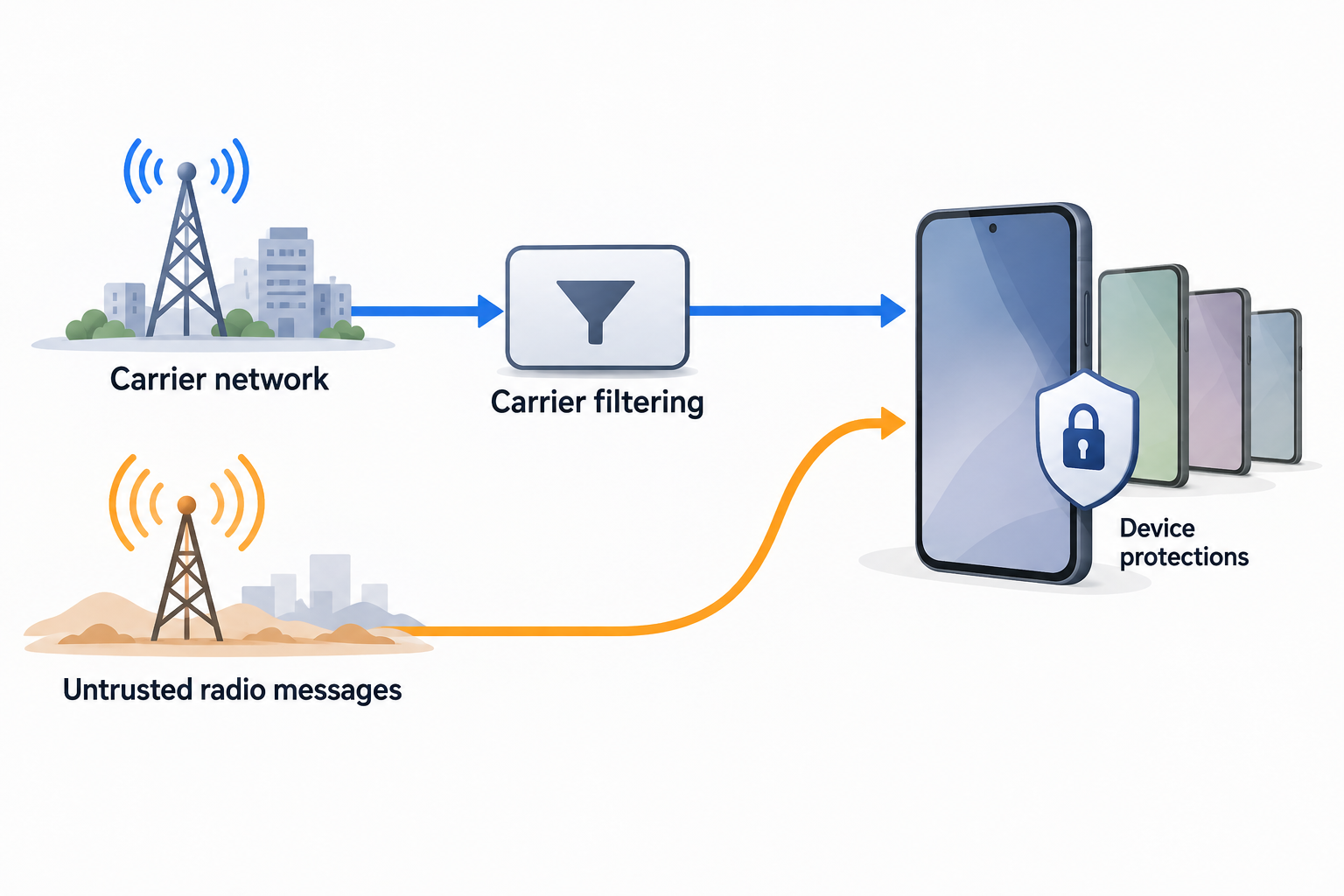
The important qualification is “for this method.” It does not follow that every suspicious text bypasses the carrier, that every phone can be forced to connect, or that all network and device defenses are ineffective. The hardware, protocol, device support, and configuration matter. Nor does the radio technique require generative AI. A transmitter could distribute a conventional fraudulent message; a message produced with AI could arrive through an ordinary delivery service.
Keeping content and delivery separate makes the threat easier to assess. Content is the claim being made: a tax refund, delivery problem, banking alert, or another pretext. Delivery is how that claim reached the recipient. The requested action is a third issue. An organization should respond to a request for credentials or money according to its own rules, regardless of how convincingly the text arrived.
This is why the displayed sender name is a weak basis for approval. Even a familiar-looking thread should not become the place where staff authorize a financial change or disclose a login code. For everyday examples of suspicious requests, our guide to spotting AI text scams explains the practical warning signs without requiring readers to identify the underlying radio equipment.
Why Traditional Defenses Need Support
Carrier filtering remains useful, but an organization should not assume that it will stop every message before an employee sees it. Equally, the existence of a filtering bypass is not a reason to abandon filtering. The sensible response is to avoid making one delivery-layer control responsible for every subsequent decision.
Mobile security teams can assess available protections across their actual device fleet. Finance teams can keep account-number changes out of text-message approvals. Help desks can refuse to treat possession of a phone number as sufficient evidence for a sensitive account reset. These are different controls with different owners; describing them as “AI protection” can obscure what each one is supposed to accomplish.
Reporting also needs to be practical. The UK NCSC’s phishing guidance explains how to identify and report suspicious communications. An employer should translate that principle into a known internal route, with clear instructions about where to send the message and when to contact finance or security urgently. A reporting channel provides little value if employees fear punishment or do not know whether anyone monitors it.
AI as a Criminal Accelerator
Generative AI for Fraud at Scale
Generative tools can make convincing content faster and easier to produce across languages. The FBI’s May 2024 warning to individuals and businesses described targeted phishing and voice or video impersonation, including messages with correct grammar and spelling. The warning supports a practical change in expectations: poor language is not a necessary feature of a fraudulent request.

Europol’s 2025 Serious and Organised Crime Threat Assessment similarly identifies AI as a tool for criminal efficiency and social engineering. It describes multilingual content, realistic narratives, and automation as part of a wider technological shift. That assessment does not establish a universal success rate, or show that every well-written lure was generated by AI.
The operational implication is straightforward. Do not design a payment rule around how clumsy the criminal’s writing is expected to be. Good grammar, the right job title, and familiar terminology can all appear in an unauthorized request. Those details may justify closer attention to the context, but they should not replace a check against an approved business process.
AI also should not become an explanation for every part of a crime that investigators have not established. A fraudulent website may use generated text while its payments are handled manually. A convincing message may have been written by a person with stolen business correspondence. The security decision often does not require resolving that distinction. The incident record, however, should distinguish confirmed use of synthetic content from a suspicion that it was involved.
Lowering the Skill Barrier for Attackers
The FBI’s December 2024 advisory on generative-AI financial fraud describes uses spanning text, images, audio, and video. Examples include translation, fictitious profiles, fraudulent website content, and impersonation. The agency explains that these tools can reduce the time and effort needed to deceive targets. That is a narrower and more useful claim than saying AI makes every attacker technically sophisticated.
Producing persuasive content and operating a successful fraud are different tasks. Criminals still need a way to reach someone, maintain the deception, receive money, or exploit information. An organization can disrupt those stages even if it cannot reliably identify which sentences were generated. The aim is to prevent an unauthorized outcome, rather than win a contest over the origin of every image or paragraph.
For leaders, this means examining the complete request. Who is being asked to act? What information or access would be exposed? Does the action fit the person’s authority? What independent record should exist? Those questions remain useful when the lure is polished, translated, or personalized. Our AI Fraud & Deepfakes hub connects this organizational context to more specific forms of impersonation.
Deepfake Fraud and Identity Impersonation
Voice Cloning Technology
A familiar voice can support an impostor’s story without proving who is speaking. The FTC’s April 2024 discussion of harmful voice cloning describes how a short recording may be enough to imitate someone and recommends contacting the person through a number already known to be theirs. Voice-cloning quality varies; recording length alone does not guarantee a convincing imitation.
For an enterprise, the central question is authority rather than resemblance. A voice that sounds like the chief financial officer does not independently authorize an exception to procurement or payment controls. A video appearance does not establish that a supplier’s bank account has changed. Even a genuine executive should have to use the approved process.
Independent verification must actually be independent. Calling a number supplied in the suspicious request may return the employee to the same impostor. Asking a second participant on the same untrusted call for confirmation may add apparent consensus without adding reliable evidence. Staff need a contact route established before the request, plus an approved place to record the result.
What Real Cases Establish
The Hong Kong example shows why the mechanics matter. A phishing email led to prerecorded video, followed by payment instructions through messaging. There was no interaction with the impersonator during the video. This sequence still created a convincing appearance of authority and points to ordinary opportunities to verify a transaction outside the exchange.

Another documented pattern appeared in the FBI’s May 2025 warning about impersonated senior US officials. The agency described malicious text and AI-generated voice messages used to establish trust and, in some cases, move targets to another messaging platform. The alert illustrates how an apparent identity can be carried across channels. It does not establish that a scam center or an SMS blaster was involved in that campaign.
These distinctions are useful in exercises and incident reporting. A team can test a plausible combination of messages and calls without claiming it reconstructs a specific crime. It should identify where a payment, disclosure, or access request would be stopped, who could approve an exception, and how that exception would be recorded. Otherwise, an impressive simulated deepfake can distract from an unchanged approval failure.
Why Even Professionals Can Be Deceived
Business email compromise remains relevant whether or not a particular scheme uses AI. The FBI’s 2024 Internet Crime Report recorded about $16.6 billion in total reported internet-crime losses, including approximately $2.77 billion attributed to business email compromise. These are reported-loss figures for those categories, not a measurement of losses caused by AI. They also do not describe every loss worldwide.
The scale helps explain why enterprises should take payment verification seriously. It does not justify blaming an employee for failing to detect synthetic media. Professionals often work within expectations of urgency, hierarchy, and responsiveness. An organizational rule that says “verify independently” is undermined if managers regularly pressure staff to skip it for important clients or senior executives.
Training should therefore practice the decision, not just recognition of a fake. For example, an accounts-payable exercise could involve an otherwise plausible request to change a supplier’s bank details. The meaningful result is whether the employee uses the approved contact record, obtains the necessary authorization, and records the check. Detecting an unusual visual artifact may be helpful, but it is not a dependable substitute for that process.
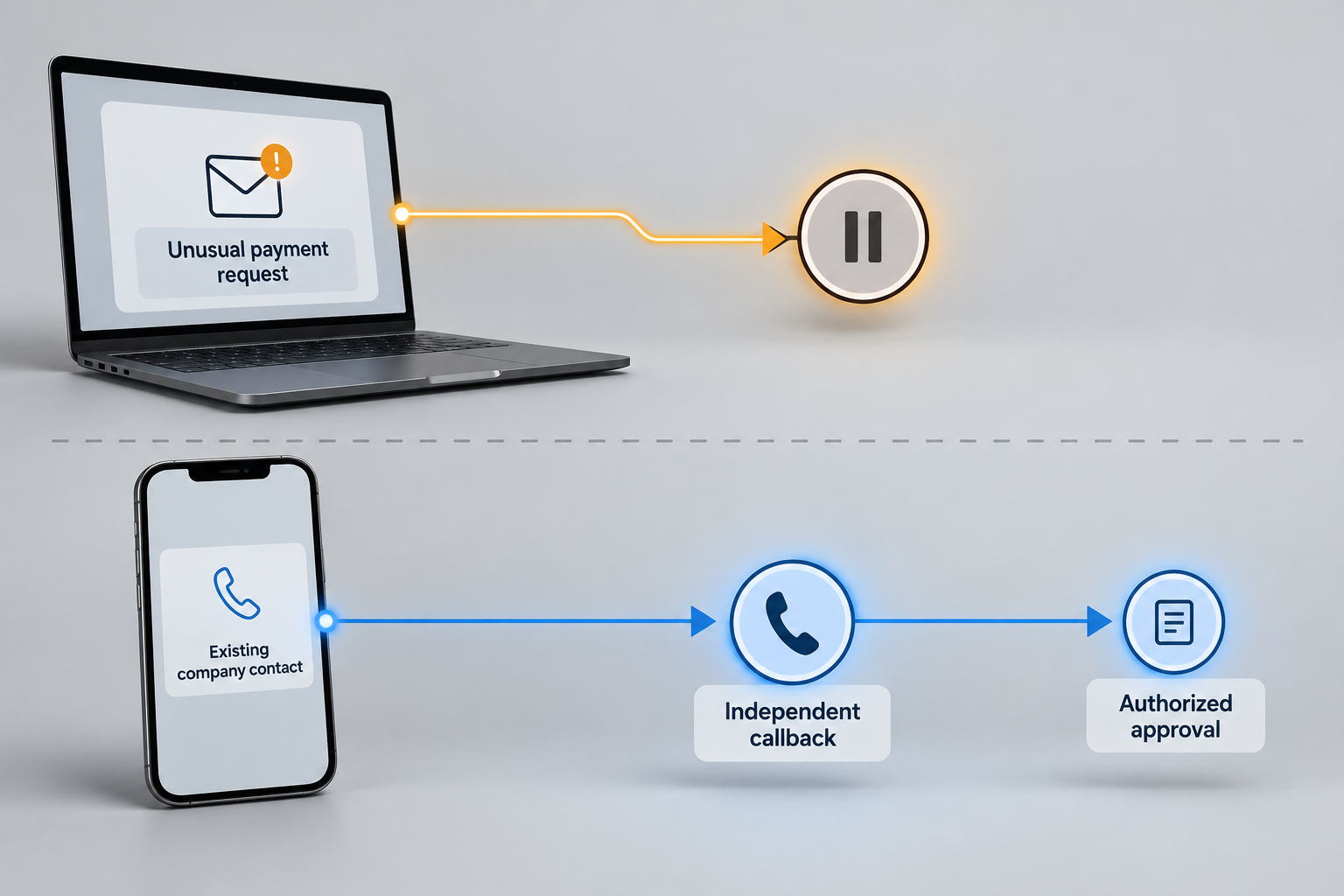
The FBI’s business email compromise guidance recommends independently verifying payment requests and changes to account numbers or payment procedures. It also advises immediate contact with the financial institution when money has been transferred. Those steps address the requested transaction directly, regardless of whether a criminal used a cloned voice, a compromised mailbox, or a simple impersonation.
Organizations should make a pause for verification normal. Two-person approval is useful only when the second person performs a meaningful check; forwarding the same suspect email for a rubber stamp adds little. A callback is useful only when it reaches a trusted contact. These are management responsibilities as well as individual habits, because employees need time, records, and authority to carry them out.
The Global Implications of AI-Powered Cybercrime
Expansion Beyond Southeast Asia
UNODC’s April 2025 Inflection Point report describes the expansion of Southeast Asia-linked fraud networks and related services beyond the region. It discusses overseas operations, trafficking and recruitment connections, illicit marketplaces, and money laundering. It also notes the use of translation and deepfake tools while recognizing the continuing importance of workers who understand a target market’s language and culture.
In a June 2025 update on scam centers, INTERPOL reported that identified trafficking victims came from 66 countries as of March that year. It described emerging operations outside Southeast Asia and observed AI use in fake recruitment advertisements and fraudulent profiles. These are dated findings about a developing criminal economy, not a claim that every country or operation has the same exposure.
For enterprises, the cross-border element complicates responsibility. The company targeted, the person contacting it, the account receiving funds, and the facility running a scheme may be in different jurisdictions. An incident report should preserve those distinctions rather than assume the location suggested by a phone number identifies the organizers. For policymakers, cooperation needs to connect financial evidence with trafficking investigations and victim protection.
Finance, Politics, and National Security
Europol’s 2025 assessment also warns about relationships between organized criminal networks and actors pursuing hybrid threats. That supports attention to possible overlaps between profit-seeking crime and wider destabilization. It does not establish that a particular scam compound is state-directed, or that every fraudulent message serves a political objective.
The distinction matters for risk decisions. A finance team can strengthen payment controls without resolving a national-security attribution question. Public authorities may need a broader investigation into financing, infrastructure, or influence activity. Combining the two prematurely can obscure what the evidence actually shows and make a routine fraud warning needlessly speculative.
Stolen information is another connection between schemes. Europol’s June 2025 IOCTA summary describes credentials and personal data being sold, resold, and repackaged in criminal markets. This helps explain why preventing a payment is not always the end of an incident. If business correspondence or account access was exposed, the organization should establish what was taken and what other processes may rely on it.
Defensive Strategies for Organizations and Policymakers
What Organizations Can Do Now
Layered controls should assume some suspicious communications will reach staff. CISA’s phishing-resistant MFA guidance explains why methods such as FIDO/WebAuthn resist credential phishing more effectively than methods that require reusable or relayable secrets. Prioritize high-risk accounts and plan for applications that cannot yet support the stronger method. Strong authentication protects logins; it does not determine whether an authenticated employee should approve a fraudulent invoice.

Pair account controls with strict change management for supplier banking details and meaningful approval of large transfers. Define which requests require an independent callback, where the trusted contact information comes from, and who can authorize an exception. Apply the same rule when the request appears to come from senior management. An exception process should provide additional scrutiny, not simply rename the bypass.
Keep technical detection in its proper role. Email filtering, mobile protections, account alerts, and synthetic-media analysis can provide useful signals. They should support a decision process rather than make a familiar face, a clean scan, or the absence of an alert equivalent to authorization. For background on the authentication choices, see Passwords, Passkeys, and 2FA Explained.
Finally, measure the basics. Track whether suspicious messages reach the right team, whether payment-detail changes receive the required independent check, and whether staff can stop a transaction without being penalized for slowing it down. Examine failed attempts as well as losses. The point is to find a specific control that needs attention, not to claim that awareness training has eliminated fraud.
Policy and Regulatory Actions
The FTC’s February 2024 announcement on impersonation distinguished its finalized government and business impersonation rule from a proposed expansion covering impersonation of individuals. A proposal is not an enacted requirement, and that historical announcement should not be read as a statement that every suggested provision became law. In an April 2025 enforcement update, the agency described actions under the government and business rule after its April 2024 effective date.
Security leaders should have legal and compliance teams assess the rules applicable to their organization and jurisdiction. A general discussion of US impersonation policy is not a substitute for that assessment. Internal incident definitions can explicitly include synthetic audio and video without waiting for a special AI offense to cover every possible form of deception.
Policy responses also need to preserve the distinction between disrupting fraud and protecting trafficking victims. Prosecution, financial tracing, platform cooperation, and survivor support address different parts of the problem. A successful takedown should not be assumed to have resolved a person’s safety, immigration position, or need for rehabilitation. The human-rights concerns raised by the UN experts belong in the evaluation of a response, rather than an afterthought to its arrest count.
Conclusion
AI cybercrime is part of a broader organized-fraud economy. The 2024 and 2025 records discussed here show industrialized scam operations, forced criminality, alternative text-message delivery, and synthetic impersonation. They do not show that every scheme uses every tool, or that AI accounts for all reported fraud losses.
The practical lesson for enterprises is to connect security controls to the action an attacker wants. Protect logins with strong authentication. Verify sensitive requests through an established independent route. Control payment changes, support prompt reporting, and make exceptions visible. Policymakers must also address the financial and human infrastructure behind the communications, including the protection of people compelled to commit fraud.
Convincing content raises the importance of these processes. It does not make them obsolete. The aim is to prevent an unauthorized action while keeping the explanation of the threat accurate enough to guide that work.
Subscribe to Quantum Cyber AI for practical cybersecurity explanations and policy context.
FAQ
How does AI change phishing risk for enterprises?
It can reduce the effort required to produce polished, translated, or personalized content and can support voice or video impersonation. That makes language quality and apparent familiarity weaker grounds for trust. The organization still needs to establish whether the requested action is legitimate and authorized.
Is an SMS blaster an AI tool?
No. It is radio equipment used to inject text messages into nearby susceptible devices. The technique described here exploits older cellular-protocol weaknesses. AI could help create a message, but that is separate from how it is delivered. Ordinary smishing does not require a blaster.
Why is a familiar executive’s voice insufficient approval?
A familiar voice may be imitated, and even a genuine conversation may not satisfy the organization’s approval requirements. Use the established transaction process and verify unusual requests through independently maintained contact details. Do not let the caller supply both the instruction and the only way to confirm it.
What should a mid-size firm prioritize?
Identify the accounts and workflows that could expose sensitive information or move money. Improve authentication, independently verify banking-detail changes, and make reporting straightforward. Test whether staff can use those procedures under pressure. Select priorities from the organization’s actual gaps rather than buy a tool simply because it is marketed as an AI defense.
Are people working in scam centers always willing criminals?
No. The UN and INTERPOL accounts discussed above document trafficking and forced criminality. Some people are confined and coerced into targeting others. Identifying organizers and protecting trafficked people require attention to the circumstances of each person; neither status should be assumed from the fact that someone sent a fraudulent message.