
A fitness tracker can make an invisible pattern easier to see. It can show that your sleep changed, your usual walk became a little faster, or your recovery looks different from last week. The same usefulness depends on a growing record. Wearable data may include readings from your body, details you enter, workout locations, daily routines, connected-app information, and conclusions produced from all of them.
The privacy question is therefore larger than the watch or ring. It includes the phone permission that lets an app read location, the cloud account that keeps years of history, the fitness service that displays a route, and the AI feature that combines health signals with goals or conversations. A private-looking screen does not tell you how many copies of that information exist or which service controls each one.
You do not have to reject every wearable to take this seriously. The practical goal is to understand the exchange, keep the features that earn their access, and reduce the rest. This guide shows how to map wearable data, ask better questions before buying, reset an existing account, and respond if sensitive information was exposed or shared unexpectedly.

Key Takeaways
- Wearable data can include activity, sleep, heart rate, body measurements, location, profile details, connected-app information, and AI-generated insights, depending on the product and settings.
- Repeated readings can reveal routines and changes that a single reading would not.
- Revoking a connected app can stop future access without deleting the copy the app already made.
- HIPAA does not automatically protect wearable data held by a direct-to-consumer fitness tracker or wellness app.
- Controls for route visibility, activity visibility, AI coaching, research, advertising choices, and health-store permissions are separate settings.
- A readiness or sleep score is wearable data and can be sensitive even when it is not a medical diagnosis.
- A short privacy reset can reduce unnecessary wearable data exposure without giving up the features you actually use.
Need the action steps first? Jump to Before You Buy, Give an Existing Wearable a Privacy Reset, or If Your Wearable Data Was Exposed or Shared Unexpectedly.
What Wearable Data Can Include
Direct readings and details you add
Steps are only the familiar starting point. Depending on the device and features, wearable data may include distance, pace, heart rate, sleep times, sleep stages, calories, weight, body measurements, skin temperature, blood oxygen estimates, stress-related signals, cycle information, food, symptoms, exercise history, and precise location. It may also include profile details such as age, height, weight, and sex because those inputs help the service create estimates or a personal baseline.
A current Google Health explanation of the information used with Fitbit and Google devices lists steps, distance, calories, weight, heart rate, sleep stages, active minutes, manually entered information, information from connected services, and location when the required permission is enabled. That list is a product-specific example, not a universal inventory for every fitness tracker. It demonstrates why a buyer should check the exact model, app, and optional features instead of assuming the wearable data record stops at exercise.
Device capability and enabled collection are not always the same. A watch may contain a sensor you never activate. An app may ask for location only when you record an outdoor workout. A health platform may be able to store cycle information even if you never enter it. Your real wearable data footprint comes from the features you turn on, the permissions you grant, and the services you connect.
Derived scores are new wearable data
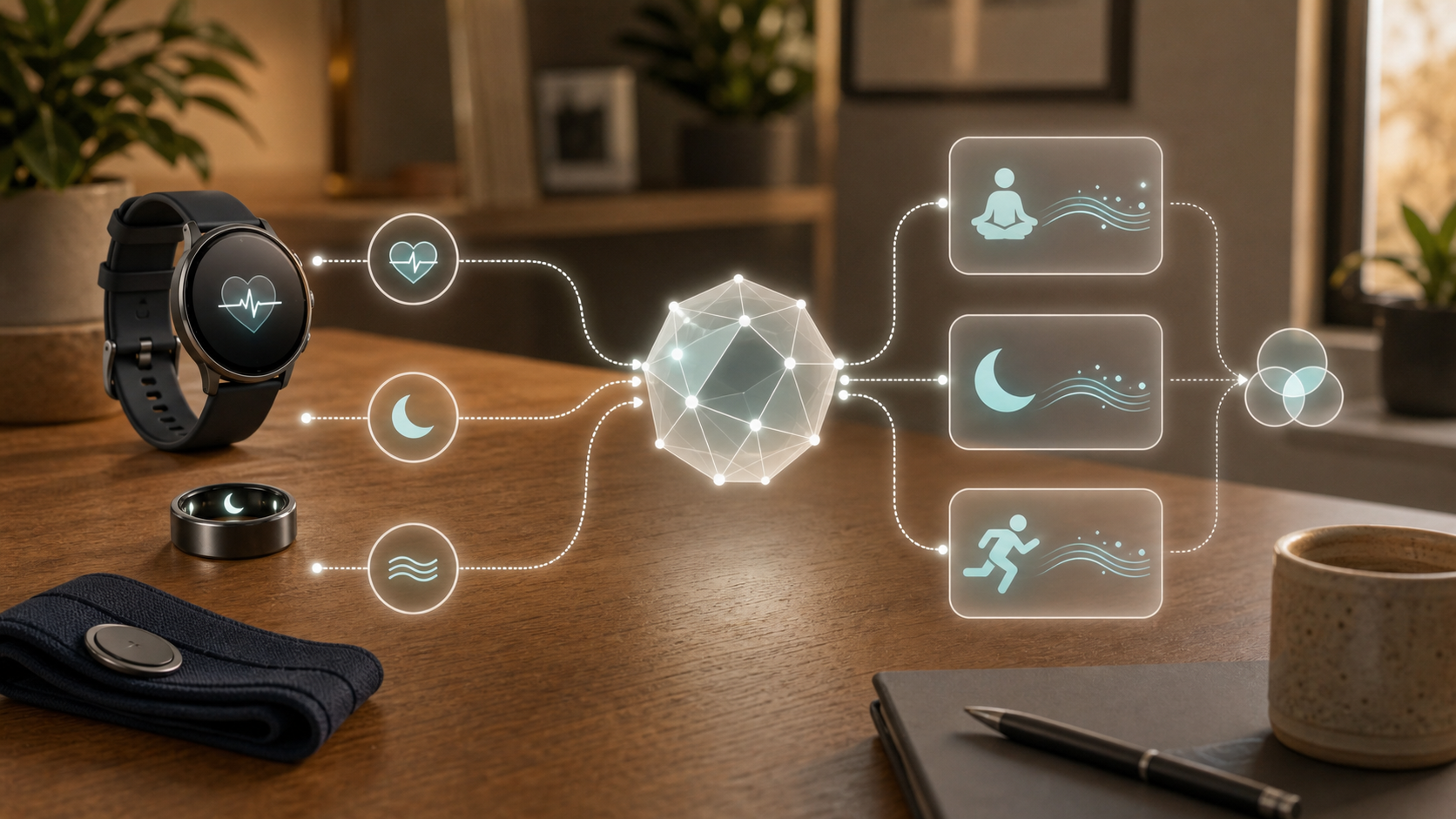
The device does not merely display measurements. It can combine them into a new conclusion. A sleep score, recovery estimate, stress summary, fitness trend, or coaching recommendation is derived wearable data. It describes what the system thinks the underlying readings mean.
For example, the Google Health readiness-score documentation says its current score uses heart-rate variability, recent sleep, and resting heart rate compared with a personal baseline. The system turns several data streams into a single judgment about recovery. That judgment may be easier to act on than a chart of raw values, which is precisely why it can feel personal.
The distinction matters for privacy. Deleting one raw workout does not necessarily answer what happens to a score or trend built from a longer history. Turning off a coaching feature may stop new advice without removing old conversations or derived records. When a service offers granular deletion, look for controls covering both the source readings and the insights created from them.
A timeline can reveal a routine
One bedtime says little. Months of bedtimes can show a schedule. One route is a workout. A repeated route can suggest where someone lives, works, studies, worships, receives care, or spends time with family. A wearable data timeline of resting heart rate, sleep disruption, travel, and inactivity may show a period of change even if the system cannot explain why it happened.
This is why wearable data should be judged as a timeline, not as a list of harmless fields. Ask what a stranger, a data recipient, or an intruder could learn from the pattern rather than from one number. The answer may still be acceptable, but it should be an informed choice.
What AI Changes About Fitness Tracker Privacy
More context can make advice feel more personal
AI coaching can use wearable data together with context that does not come directly from a sensor. A current Google Health Coach data and personalization page says the feature can use information from paired devices, an account profile, linked third-party apps, exercise history, sleep, body metrics, location when enabled, and conversations with the coach. It also says enabling the coach gives it access to health and activity information already associated with the account, although particular data sources may require separate consent before they enter the account.
That is a useful example of the privacy tradeoff. The advice becomes more tailored because the feature sees more context. The same context can produce a richer record that includes not only what a sensor measured, but also what you told the coach, what goal you set, and how the system interpreted a change.
Before enabling an AI feature, ask three questions:
- What additional wearable data, account history, location, or conversation information can the feature use?
- What useful result does the feature produce from wearable data that the basic tracker does not?
- Can you delete its history or turn it off without closing the entire account?
The Is This AI Tool Safe? practical checklist offers a broader way to evaluate permissions, retention, sensitive inputs, and account controls. Apply the same logic inside a wearable app. An AI coach, a research program, a social challenge, and a product-improvement option are separate decisions even when the setup screen places them close together.
A useful score can still be uncertain
A wellness score can help someone notice a pattern without proving what caused it. The underlying wearable data may look different because of illness, stress, travel, medication, a loose sensor, movement, or an algorithmic error. A low readiness score is not automatically a diagnosis, and a normal-looking score is not medical reassurance.
The FDA’s current general-wellness guidance explains that certain non-invasive products may estimate or infer physiologic parameters for general-wellness uses when they are not intended for diagnosis, treatment, clinical management, or substitution for an authorized medical device. Some wearable functions are regulated medical-device features, while others are positioned as general wellness. Read the exact claim for the feature you are using.
Privacy and accuracy are different questions. An uncertain inference can still be sensitive. A system’s guess about stress, fertility, recovery, sleep, or health may influence how a user feels or what a recipient assumes. Treat derived wearable data with the same care as the signals behind it.
Where Wearable Data Can Travel
Think of the wearable as a pipeline
A simple model is:
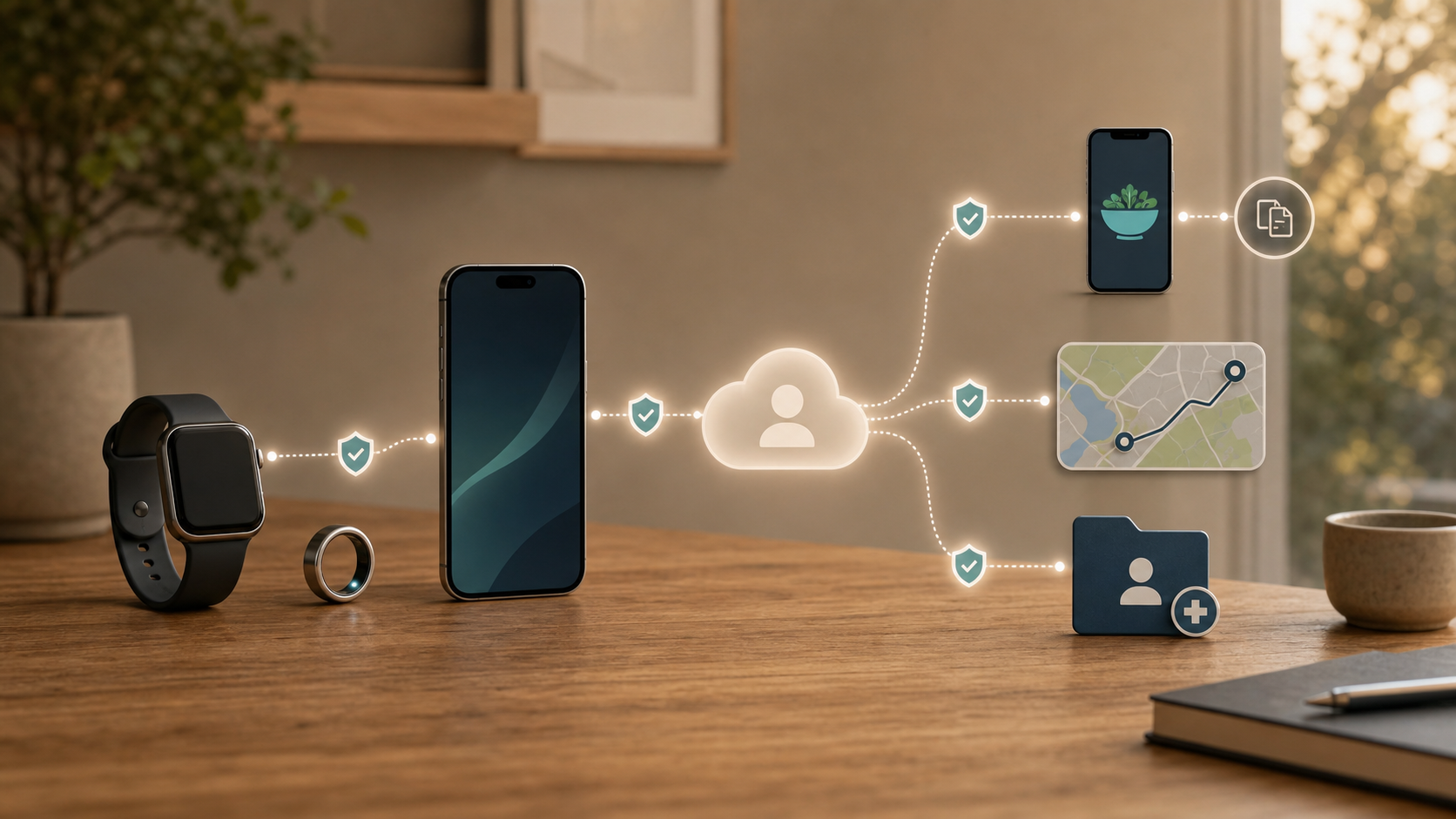
body and movement -> wearable -> phone or companion app -> vendor account or cloud -> connected services -> reports, social posts, or exports
Not every product uses every step. Some processing may remain on the device or phone. Other features may require an account, internet connection, or cloud history. The important point is that each transfer creates a new privacy boundary. A protection at one layer does not automatically govern a copy at the next.
On Android, Health Connect can store and share health, fitness, and medical information among authorized apps. Google explains that the central database is stored on the device, but also warns that another app or device may retain a copy. Deleting wearable data from Health Connect may therefore leave information already copied into a nutrition app, training service, or other recipient.
This creates four different actions that are easy to confuse:
- Revoke an app’s permission to read or write new wearable data.
- Delete information from the phone’s central health store.
- Delete the recipient app’s stored copy.
- Close or delete the cloud account if you no longer want the service.
One action may be enough for your goal, but none should be mistaken for all four.
On-device protections do not follow every copy
Apple describes a different set of design choices in its Consumer Health Personal Data Privacy Policy. The company cites data minimization, on-device processing, user control, and encryption, including end-to-end encryption for Health app data under specified device, passcode, software, and account conditions.
Those protections matter, but their scope matters too. They do not automatically cover a workout exported to a file, a route sent to a social fitness service, a record shared with a provider, or information copied by a third-party app. Review Health permissions by data category, review location separately, and protect exported archives as sensitive files.
The Privacy & Identity Protection hub can help with the broader habit of limiting data collection and following copies across accounts. For a wearable, the highest-value question is often not “Is this device private?” It is “Which part of the wearable data system holds this particular record now?”
Workplace programs require a separate decision
A personal fitness-tracker account and its wearable data do not automatically report to an employer. The context changes when a workplace directs employees to use a fitness tracker, offers one through a wellness program, or connects rewards to submitted activity or health information.
According to the EEOC’s 2020-2024 history of wearable-technology guidance, federal employment-discrimination laws apply when employers collect and use information from wearable devices, and accommodations may be required for some employees. That does not mean a particular workplace program is improper, but it does make the program’s purpose, access, and consent terms worth reviewing.
Before joining a program, ask what the wearable vendor receives, what the program administrator receives, and what the employer receives. Ask whether the employer sees individual wearable data or only aggregate results, whether participation is voluntary, what incentive or penalty applies, how long the information remains, and what happens when employment ends. Save the program notice and your consent choices.
Why Wearable Location Data Deserves Extra Care
A route can point back to a sensitive place
Wearable data from outdoor workouts can contain a precise line through space and a timestamp. Repeated start and finish points may suggest a home or workplace. A route can pass a school, clinic, faith community, shelter, or another place whose meaning depends on the person. A regular time pattern can show when someone is usually away.
This does not mean every route should remain secret. Public training logs and community features can be motivating. The decision should reflect the route, the audience, and the consequence of linking the activity to an identifiable profile.

Hiding one layer may not hide another
The Strava Privacy Controls FAQ shows why one toggle is not enough. Activity visibility, map visibility, hidden details, connected-app permissions, and Flyby visibility are separate. Strava also warns that map portions hidden inside its service may still be visible to an authorized third-party service and that remaining information may allow someone to infer a hidden detail.
A calm route-privacy review should include both old and new activities:
- Set the default audience for future activities.
- Review whether full maps, start and finish points, and start times need to be visible.
- Check old public activities because a safer default may not repair earlier uploads.
- Review followers, group features, photos, and connected services.
- Hide the entire map when partial masking would not provide enough protection.
- Record a workout without publishing it when sharing adds little value.
Route masking reduces exposure. It does not guarantee that a familiar place cannot be inferred from repeated geometry, surrounding photos, timing, or a copy held elsewhere.
HIPAA Does Not Cover Every Fitness Tracker
Wearable data does not become protected by HIPAA simply because it is personal, medically useful, or collected from the body. HIPAA applies mainly according to who holds the information and the role that organization is performing. It covers health plans, many health care providers, health care clearinghouses, and companies acting as their business associates.
That leaves many consumer wearables outside HIPAA. According to HHS guidance on health information stored in personal devices and apps, data entered into or downloaded to an app for personal use usually is not protected by HIPAA unless the app is provided by a covered entity or its business associate. Buying a fitness tracker, opening an account with its manufacturer, and creating wearable data through the consumer app generally establishes a direct consumer relationship. It does not automatically turn the wearable company into a HIPAA-covered organization.
The answer can change when a doctor, hospital, insurer, or health program provides the device and the developer handles health information on that organization’s behalf. The same app company may operate outside HIPAA for retail customers while acting as a business associate in a separate clinical program. Look at the relationship, not just the product name or a “health” label.
Connecting a medical record to an independent fitness app does not necessarily extend HIPAA protection into that app. HHS explains in its guidance on health apps and access to electronic medical records that when a person directs a provider to send information to an app that is neither a covered entity nor a business associate, the information is no longer protected by HIPAA after the app receives it. If the app was developed for or provided on behalf of the provider, the result may be different.
Health data privacy outside HIPAA can involve the FTC
Being outside HIPAA does not mean a company can make false privacy promises or ignore every federal obligation. The FTC Act prohibits unfair or deceptive practices. The FTC also enforces a more specific Health Breach Notification Rule for certain non-HIPAA vendors of personal health records, related entities, and service providers.
The FTC’s current compliance guidance explains that the rule can apply to some health apps and connected-device services outside HIPAA. For example, an app that accepts information from you and syncs with a fitness tracker may qualify as a personal health record vendor because it combines health information from more than one source. Coverage remains fact-specific, so the consumer takeaway is to check what the app collects, what it imports, and where it sends the combined record.
The 2024 amendments to the Health Breach Notification Rule clarified its application to health apps and similar technologies and clarified that a covered breach can include unauthorized disclosure or acquisition, not only an outside hack. The rule is principally a notification requirement. It does not ban every data use, cover every wearable, or create a universal federal deletion right.
FTC enforcement shows why recipient lists matter. In the GoodRx matter, the agency alleged that the company disclosed medications, health conditions, contact information, and identifiers to advertising and technology companies without authorization and failed to provide required notices. A stipulated court order imposed a $1.5 million civil penalty and restrictions on future sharing. This was not a fitness-tracker case, and the allegations were resolved through an order rather than trial findings. The practical lesson is to ask who receives wearable data after it leaves the product you can see.
Some state laws may provide additional rights. The Washington Attorney General describes its My Health My Data Act as protecting consumer health data outside HIPAA and setting requirements for collection, sharing, privacy notices, consent, and consumer requests. The law is one example of additional rights that may cover wearable data. State coverage varies, so look for a company’s consumer-health privacy notice and state-specific request process rather than assuming one national deletion rule.
Before You Buy an AI Fitness Tracker
The best privacy decision often happens before an account exists. Start with the result you want, then look for the smallest set of sensors, online services, and connected apps that can provide it. A wearable that supports every possible feature may create a larger wearable data record than someone who only wants step counts, basic workout tracking, or a morning alarm actually needs.
Check the minimum useful feature set
Write down the two or three jobs you expect the wearable to perform. These might include tracking activity, recording sleep, mapping outdoor workouts, providing safety alerts, or offering personalized coaching. Then separate essential features from interesting extras.
For each extra feature, ask what additional wearable data or context it requires. Route maps need location. Social challenges need some form of profile and sharing. AI coaching may use a longer history of workouts, sleep, goals, body metrics, linked-app information, or conversations. Research programs and workplace wellness services may introduce another recipient.
This does not make those features automatically unacceptable. It makes them separate choices. Avoid buying a larger data ecosystem simply because it appears on the product comparison chart.
Ask seven privacy and security questions
The NIST consumer IoT cybersecurity profile treats data protection, secure updates, deletion, access control, and clear security information as product-wide responsibilities. Translate those principles into questions that a retailer, support page, or privacy notice should be able to answer:
- Which sensors and wearable data categories does the product use? Look beyond steps and heart rate. Check for location, sleep, temperature, microphone access, body measurements, cycle information, manually entered symptoms, and information imported from other services. Device capability and enabled collection are not always the same, so confirm which features can remain off.
- Which features work without location or a long cloud history? Find out whether basic activity tracking requires an online account, whether workouts can be recorded without a public map, and whether useful summaries are available without retaining months or years of detailed readings.
- Can optional uses be declined separately? AI coaching, research participation, advertising personalization, product improvement, social sharing, and workplace programs should not be treated as one decision. Check whether refusing one option disables the entire product or only that feature.
- Can you review connected apps, devices, and active sessions? A clear dashboard should show which services can read or write information, which phones and wearables are linked, and where the account is signed in.
- Can wearable data be exported and deleted? Look for both selective deletion and full account deletion. Ask whether deleting a workout, route, conversation, or health category removes it from the main service, and whether the company explains backups, retention periods, and copies held by connected services.
- Can the wearable be erased before it leaves your possession? A resale, trade-in, gift, repair, or recycling process should include unpairing, removing payment credentials, disconnecting the device from the account, and performing a documented reset.
- How long will the product receive security updates? Look for a stated support period, an update method, and a way to learn about serious security problems. A discounted older device may be a poor bargain if its companion app or firmware is approaching the end of support.
Treat account security as health privacy
A private profile still depends on whoever can sign in. Use a unique password or a passkey if the service offers one, enable the strongest additional authentication available, and do not reuse a password from email, shopping, or social accounts. Review recovery phone numbers and email addresses so an old contact method cannot become the easiest way into the account.
If the terminology feels confusing, Passwords, Passkeys, and 2FA Explained provides a practical comparison. The goal is straightforward: make the wearable account difficult to enter with a stolen password and easy for you to recover without weakening its protection.
Give an Existing Wearable a Privacy Reset
You do not need to abandon a useful tracker to reduce unnecessary exposure. A privacy reset is a layer-by-layer review of what the wearable collects, where copies may exist, and which features still earn access to wearable data. Allow about 20 minutes for the first pass and keep a short note of anything that needs a separate deletion request.
1. Map every layer
Begin with a simple inventory: the wearable, phone permissions, companion app, vendor account, cloud storage, phone health store, AI coach, social fitness profile, and connected apps. Add any research study, medical-record connection, workplace program, nutrition service, or training platform that receives information.
Do not assume that the companion app is the whole system. A single workout can appear on the watch, in the phone’s health store, in the vendor account, and in a connected service. The reset needs to address each place separately.
2. Reduce permissions to what current features need
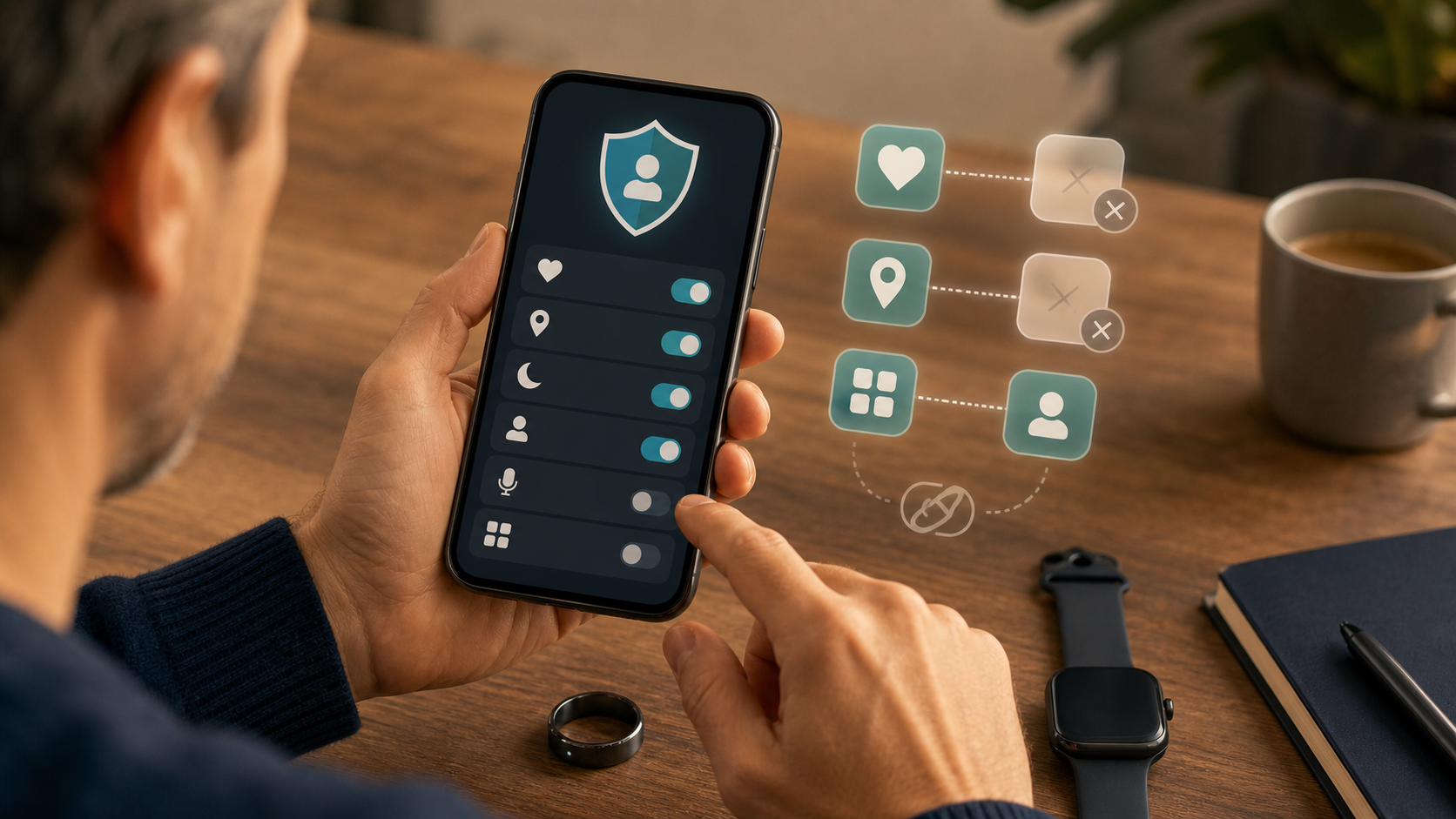
Open the phone’s privacy settings and review the companion app’s access to location, contacts, calendar, microphone, notifications, nearby devices, background activity, and health categories. Keep a permission when it supports a feature you actively use. Remove it when the purpose is unclear or the related feature is off.
Pay special attention to health read and write permissions. An app that needs to read workouts may not need every sleep, nutrition, cycle, or medical-record category. After changing access, test the features you want to keep instead of restoring broad permissions at the first inconvenience.
3. Audit connected apps and social visibility
Remove services you no longer use, then inspect the audience for your profile, activities, photos, leaderboards, and route maps. Review old uploads as well as the default for new ones. A safer new setting does not necessarily change years of earlier activity.
These controls can be separate. Activity visibility, map visibility, hidden details, and connected-app access may each have their own setting. An authorized third party may still retain wearable data that is hidden from the public view. Check followers and connected services instead of relying on one privacy toggle.
4. Review retention, export, and deletion
Export information you genuinely need before removing it. This might include a training history, a record requested by a clinician, or data needed to move to another service. Then decide what can be deleted from the wearable account, phone health store, AI feature, social platform, and each connected app.
Order matters. Revoke future access, delete wearable data from the central store, and then visit recipient apps to remove their copies. Deleting information from a central health database does not necessarily delete information another app or device already copied.
Treat uninstalling as removing software from the phone, not as verified account deletion. Use the service’s account and privacy controls, save confirmation messages, and note any stated retention period.
5. Secure and update the product
Install available wearable firmware, phone operating-system updates, and companion-app updates. Review active sessions, linked devices, recovery details, and account alerts. Sign out sessions you do not recognize and change the credential if it was reused or may have been exposed.
Remove watches or rings you no longer own. Before selling, gifting, trading in, or recycling a device, export anything needed, unpair it, remove it from the vendor account, clear payment credentials, perform the documented erase process, and confirm that it no longer appears in the device list.
6. Repeat the review after meaningful changes
Run a shorter reset whenever you enable AI coaching, medical-record synchronization, research participation, social sharing, a workplace wellness program, or a new connected app. Recheck after a major app redesign or privacy-policy update because a familiar product may gain new data flows without requiring a new wearable.
A privacy reset cannot prove that no copy exists anywhere. It can remove stale connections, narrow future collection, reduce public exposure, and give you a clearer picture of the exchange you are making.
If Your Wearable Data Was Exposed or Shared Unexpectedly
Start by finding out what happened before deciding how broad the response should be. A compromised fitness account might expose only an email address, or it might reveal heart rate, sleep patterns, exercise routes, precise location, reproductive information, device identifiers, insurance details, or health conclusions derived from several data points.
Preserve the record
Save the breach notice, privacy policy, relevant settings, and messages from the company. Record the dates. If the notice names outside recipients or affected data categories, note those too. This evidence will help if you need to explain the incident to the company, a regulator, an insurer, or a health care provider.
Contain account and connection risk
- If unauthorized account access or credential exposure is possible, change the account password and enable multifactor authentication if available. If the password was reused, change it on the other accounts as well.
- Sign out unfamiliar sessions and remove devices you no longer own.
- Review every connection between the wearable, companion app, phone health platform, calendar, social account, and third-party wellness services.
- Disconnect anything unnecessary and limit location, contact, microphone, advertising, and background permissions that current features do not need.
- Ask the company which wearable data was involved, when the event occurred, who received the information, and what it is doing to prevent further access.
- Ask how to close the account, delete stored information, and request deletion from recipients. Do not assume uninstalling the app deletes cloud records.
Match the response to the data
An exposed exercise route calls for different precautions than an exposed health insurance identifier. For route exposure, review old public activities, followers, photos, and places that may be inferred. For account compromise, change credentials, review sessions, and watch for unexpected changes. If someone may have used your information to obtain care, prescriptions, or insurance benefits, review medical and insurance records for services you do not recognize.
The Identity Theft Response Checklist provides a broader recovery path when identifying information may have been misused. It can help you document the event, protect related accounts, and decide which records need closer review.
Consumers who suspect deceptive or harmful non-HIPAA health-data practices can report the issue at ReportFraud.ftc.gov.
If the conduct involves a HIPAA-covered entity or business associate, a consumer may also use the HHS Office for Civil Rights health privacy complaint process. HHS says complaints normally must be submitted within 180 days of when the person knew about the conduct, although the agency may extend that period for good cause.
Ten High-Value Wearable Privacy Checks
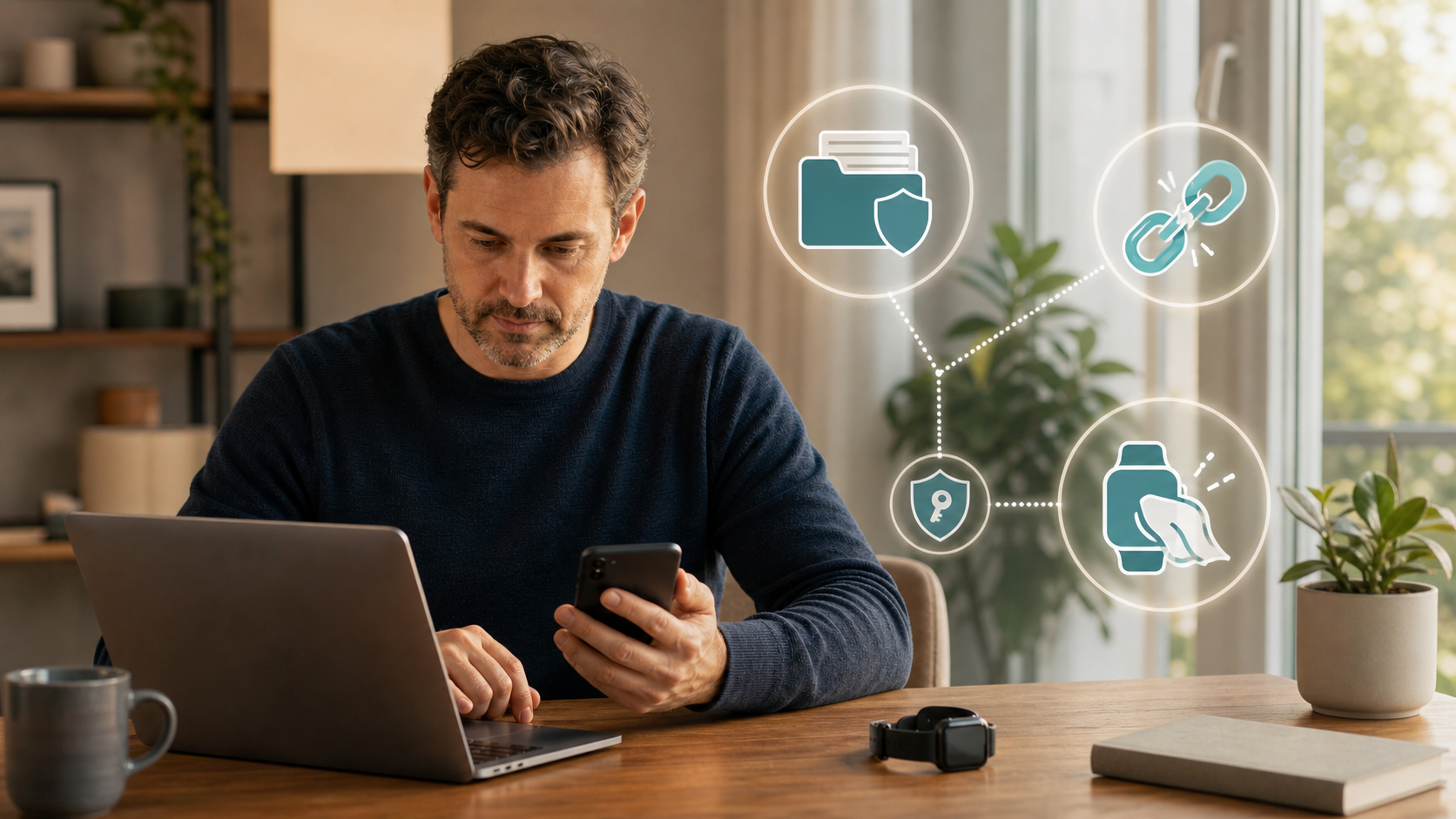
If the full review feels too large, start with the controls most likely to reduce immediate exposure:
- Secure the account. Use a unique credential, enable stronger authentication, and check recovery details.
- Review active sessions and devices. Remove anything old or unfamiliar.
- Check location. Decide whether the wearable app needs precise location, background location, or no location for the features you use.
- Restrict public activity. Review the default audience, old routes, start and finish points, followers, group features, and photos.
- Audit connected apps. Remove stale training, nutrition, social, medical, and workplace connections.
- Review health-store permissions. Limit read and write access by data category where the platform allows it.
- Revisit AI, research, and improvement choices. Keep only the programs whose value is clear to you.
- Check deletion and export tools. Know how to preserve a needed record and how to remove an unwanted one.
- Install updates. Update the wearable, phone, and companion app.
- Remove old hardware. Unpair and erase devices that have been sold, replaced, returned, or given away.
This checklist reduces unnecessary wearable data exposure. It does not prove complete privacy, erase copies held elsewhere, or evaluate every term in a company’s policy. Repeat it after a major feature change or a new integration.
Want more calm, practical guidance for protecting your devices and data? Subscribe to Quantum Cyber AI.
Conclusion
The most useful way to think about a fitness tracker is not as a single sensor, but as a chain of decisions. The device measures something. The phone or cloud account stores it. An algorithm may interpret it. A connected app may copy it. A social feature may reveal it to another audience. Each step can provide real value, and each step deserves its own permission.
Wearable data privacy is not an all-or-nothing choice. You can keep sleep tracking while declining an AI coach. You can record a run without publishing the route. You can use a phone health store while removing an old nutrition app. You can export a useful history before closing an account. You can also decide that a feature asks for more context than the result is worth.
Start with the goal you want the wearable to serve. Map the layers that support that goal, secure the account, remove stale access, and review the system when its features change. The result is not perfect secrecy. It is a smaller, clearer, and more deliberate wearable data footprint.
FAQ
Is fitness tracker data protected by HIPAA?
Not automatically. HIPAA usually applies to covered health plans, covered health care providers, health care clearinghouses, and their business associates. A direct-to-consumer fitness tracker may hold wearable data outside HIPAA when it is used independently. The answer can change if a provider, plan, or employer health program supplies the device and the app handles information on behalf of a covered organization. Look at who provides the service and what role the company performs.
Can a fitness tracker sell or share my health data?
There is no responsible universal answer for every product, feature, state, or data category. Read the service’s current consumer-health notice and privacy policy, then inspect connected apps, advertising choices, research consent, AI settings, and social features. A statement that information is not used for targeted advertising does not necessarily mean the service does not process it for personalization, product operation, research with consent, security, or another stated purpose.
Should I turn off location on my wearable?
Turn it off when the features you use do not need it. Outdoor route maps, navigation, weather context, emergency features, and live sharing may require different levels of location access. Decide whether the benefit requires approximate location, precise location, background access, or only access while recording. If route privacy matters, review both the phone permission and the activity-sharing settings.
Does deleting a fitness app delete wearable data?
Usually, uninstalling removes the app from the phone. It does not prove that the vendor account, phone health store, connected apps, backups, or social service deleted their copies. Use the service’s data and account controls. Revoke future access, delete from the central store, visit connected services to remove copied records, and save confirmation when closing an account.
Are AI readiness and sleep scores medical advice?
Not necessarily. Many scores are general-wellness features that summarize sensor readings and personal baselines. Some wearable functions may be authorized medical-device features, but the status and intended use vary. Do not use a general-wellness score as a diagnosis, as proof that nothing is wrong, or as a substitute for professional care when you have a health concern.
What should I do before selling or giving away a fitness tracker?
Export any history you need, unpair the device, remove it from the vendor account, clear payment credentials, perform the manufacturer’s documented erase or factory-reset process, and confirm that the device no longer appears in your account. Then review cloud data separately. Erasing the hardware and deleting the online account are different actions.