
A credit denial can leave you wondering what went wrong, especially when the answer arrives instantly and the explanation feels mechanical. Start with the notice. It gives you a way to ask about the decision and, when a consumer report was involved, find the information behind it. The CFPB’s explanation of what to do after an application is denied makes the first step clear: get the lender’s main reasons, then investigate information you believe is wrong.
You do not have to solve an artificial-intelligence system before you can take that step. You do need to distinguish a lender’s credit decision from the records it used. A wrong balance in a credit report, an incorrect income figure on an application and an explanation that fails to identify the actual reasons call for different follow-up.
This guide covers U.S. personal-credit applications. It explains how to organize that follow-up without promising a reversal, a particular score increase or access to the lender’s software. Mortgage-specific disclosures, business applications and other screening decisions can involve additional rules.
Key Takeaways
- Save the complete credit notice, its date and the application records you already have.
- Separate the lender’s reasons from any list of factors affecting a credit score.
- Request the consumer report from the company identified in the notice; an app’s score is not a substitute.
- Send a report dispute to the relevant reporting company and information provider. Ask the lender separately about incorrect application information.
- Keep the reasons-request deadline separate from the free-report deadline and the investigation timeline.
- Ask about reconsideration, but do not assume a corrected record automatically approves the application.

An AI label does not tell you why credit was denied
A rapid answer does not establish which technology a lender used. Unless the lender has disclosed the process or you have other evidence, describe the decision as automated only when you actually know that. An unexplained result is a reason to seek an explanation, rather than proof that a particular model made a mistake.
The practical starting point is the same whether the process involved scoring, judgment or a combination. Under current Regulation B’s notification requirements, the reasons must identify the principal factors actually behind an adverse action. Simply invoking internal standards or failure to reach a qualifying score is insufficient. Its official interpretation also distinguishes the lender’s reasons from factors affecting a disclosed score.
That distinction matters when a response sounds technical but tells you little you can investigate. Ask which principal reasons applied to your application. If a reason concerns information you believe was wrong, identify the underlying fact you want checked. You can ask whether the lender offers reconsideration or another review process, while keeping that request separate from the notice rights described here.
Be careful with older search results about AI lending. The CFPB lists its 2022 and 2023 AI-related adverse-action circulars among guidance withdrawn on May 12, 2025. Those documents should not be presented as current guidance. The current regulation is the basis for the requirements explained above; the withdrawal and the regulation are separate facts.
Read the credit notice in separate parts
Keep every page, including the back of a paper letter and any attachment to a secure message. Then identify the action taken, the creditor responsible, the reasons or instructions for requesting them, and any reporting-company information. Make a short note of what is present and what you still need.
The FTC’s explanation of report-based adverse-action notices describes an important division of responsibility. If information from a consumer report contributed to the adverse action, the notice identifies the reporting company, explains that it did not make the lender’s decision, and describes your report and dispute rights. A score disclosure applies when a score was used. The reporting company can address its file; the lender explains its decision.
Do not send the entire problem to whichever company name looks most familiar. First decide what you are asking. A request for the lender’s principal reasons belongs with the creditor. A dispute about an incorrect reported payment belongs in the reporting process. When both problems exist, maintain two clearly described requests.
The sample notification forms in Regulation B’s Appendix C show how these disclosures can appear together. They are examples, not a requirement that your letter have an identical layout. A checklist’s appearance alone does not tell you whether the reasons accurately describe your application.

Read the action itself carefully as well. A denied application, an incomplete application, a counteroffer and credit offered on less favorable terms are not interchangeable situations. If you cannot tell which happened, ask the lender to identify the application’s status before you assume the next step is an appeal.
Put the notice deadlines on separate lines
There are several clocks to track after a credit denial. Write down the event that starts each one, rather than putting a single unexplained deadline in your calendar. Keep the original notice alongside those notes so you can check the wording later.
For an ordinary completed consumer application, the Equal Credit Opportunity Act’s reasons and notification provisions establish the basic sequence: notification within 30 days after receipt of a completed application; a request for reasons within 60 days after the adverse-action notification when reasons were not supplied; and the creditor’s statement within 30 days after receiving that request. Regulation B supplies the applicable details and exceptions. The completed-application trigger matters: submitting something initially does not establish when the creditor obtained everything it normally needs.
Separately, when adverse action is based on a consumer report, request the free credit report from the named company within 60 days after receiving the notice. That is a different request to a different recipient. Asking the lender for reasons does not automatically obtain the report, and obtaining a report does not replace your request for reasons.
Start promptly instead of using the outer deadline as your planned start date. Record when you sent a request, how it was submitted and any confirmation. If you are unsure how a deadline applies to an incomplete application, counteroffer or unusual account action, ask about that specific situation rather than borrowing a timeline from another case.
Find the actual credit report before comparing scores
Use the reporting company’s contact route identified in the notice, checked against its official information. For broader review, the FTC’s free-report guidance points to the authorized annual-report service and warns about lookalike sites. Navigate deliberately. A search advertisement offering an instant fix should not become the place where you provide your identifying information.
Save the credit report you receive and record its source and date. If you review files from more than one company, keep them distinguishable. Your task is to locate the disputed information in a particular file, rather than produce one large pile of pages with no indication of where they came from.
The score shown in a monitoring app may differ from the one used by a lender. The CFPB explains that consumers have multiple credit scores, with differences arising from formulas, reporting sources and lending products. A numerical mismatch alone does not identify an error. Compare the score source and date when those are available, then inspect the reported facts.
Look beyond the headline number. The CFPB’s list of common report errors includes mixed files, accounts belonging to someone else, incorrect account status, payment dates, balances and limits. Review the entries that relate to the lender’s stated reasons, while also checking that the file belongs to you.
Mark the exact item you question in the credit report. Keep the account identifier, reporting company, disputed date or amount and the document that supports your position together. This turns a general objection to a score into a factual question someone can investigate.
Decide where the error lives
Before submitting anything, write one sentence identifying the problem. Keep your conclusion narrow enough that you can support it. You may have found an incorrect fact without knowing whether correcting it will change the lender’s result.
An item in the credit report is inaccurate
If the error appears in a reporting company’s file, use its dispute process and contact the business that supplied the information. The CFPB’s current instructions for disputing report errors explain these two recipients and the information to provide. A furnisher is the business that supplied the entry, such as a bank or card issuer. If the same error appears in several companies’ files, identify each affected file.
Avoid treating the lender’s customer-service conversation as proof that a credit-report dispute has been filed. Ask what process your submission entered and retain its reference number or acknowledgment. Keep the creditor’s application reference separate from the bureau’s dispute reference.
The credit application information is wrong
If the problem is information in the credit application itself, describe it to the lender through its verified correction channel. Ask which record it needs, whether the existing application can be corrected, and whether reconsideration would require a new application. Do not assume that sending a bureau dispute edits an application already held by the lender.
When an income figure is involved, be precise about the period and units you supplied. Ask the lender to confirm what information it recorded and what documentation it can accept. Keep the discussion about the record you can identify; avoid speculating about an invisible scoring feature or a vendor’s intentions.
The information is accurate, or the account is unfamiliar
A disappointing reason is not necessarily an inaccurate credit entry. If you recognize the information and it is correct, ask what options the lender offers and consider whether another application makes sense for your circumstances. A factual-dispute process is a poor fit for an objection that the lender’s requirements are too strict.
An account you did not open needs a different response. The FTC’s identity-theft recovery steps provide a reporting and recovery route. Use the site’s instructions for your situation, and connect that work with our Identity Theft Response Checklist. Preserve the notice as part of the record without assuming that every unfamiliar entry is identity theft before you investigate it.
Build a credit dispute someone can investigate
A useful credit dispute identifies the item, explains what is wrong and asks for a specific correction. Organize it so a reader can find the disputed entry and the supporting evidence without reconstructing your entire financial history.
The CFPB’s sample dispute letters and instructions provide separate starting points for reporting companies and furnishers. Use the appropriate version, replace its placeholders with accurate information and remove material that does not apply. A template helps organize your account; it does not establish that your claim is correct.
Keep a copy of the relevant credit report section, mark the item, and attach copies of records that address it. Explain how each attachment connects to the disputed information. Send copies rather than the only original records you have. If you use an online process, preserve the text you entered and the confirmation it produces.

Keep a simple record of the recipient, submission date, method, reference number and attachments. For mail, use the company’s current designated dispute address. A delivery record can help you establish when material arrived; it is not evidence that the company accepted your position or corrected anything.
Do not send a vague demand to erase every unfavorable credit entry. Separate unrelated items so each objection has its own explanation. If you are responding to a company’s request for more information, answer the specific request and retain that correspondence with the original submission.
Read the acknowledgment before filing again. It may distinguish a completed submission from a saved draft, identify missing information or explain that the request went to another department. Keep that operational detail in your case notes. It tells you what actually happened, rather than what you intended to submit.
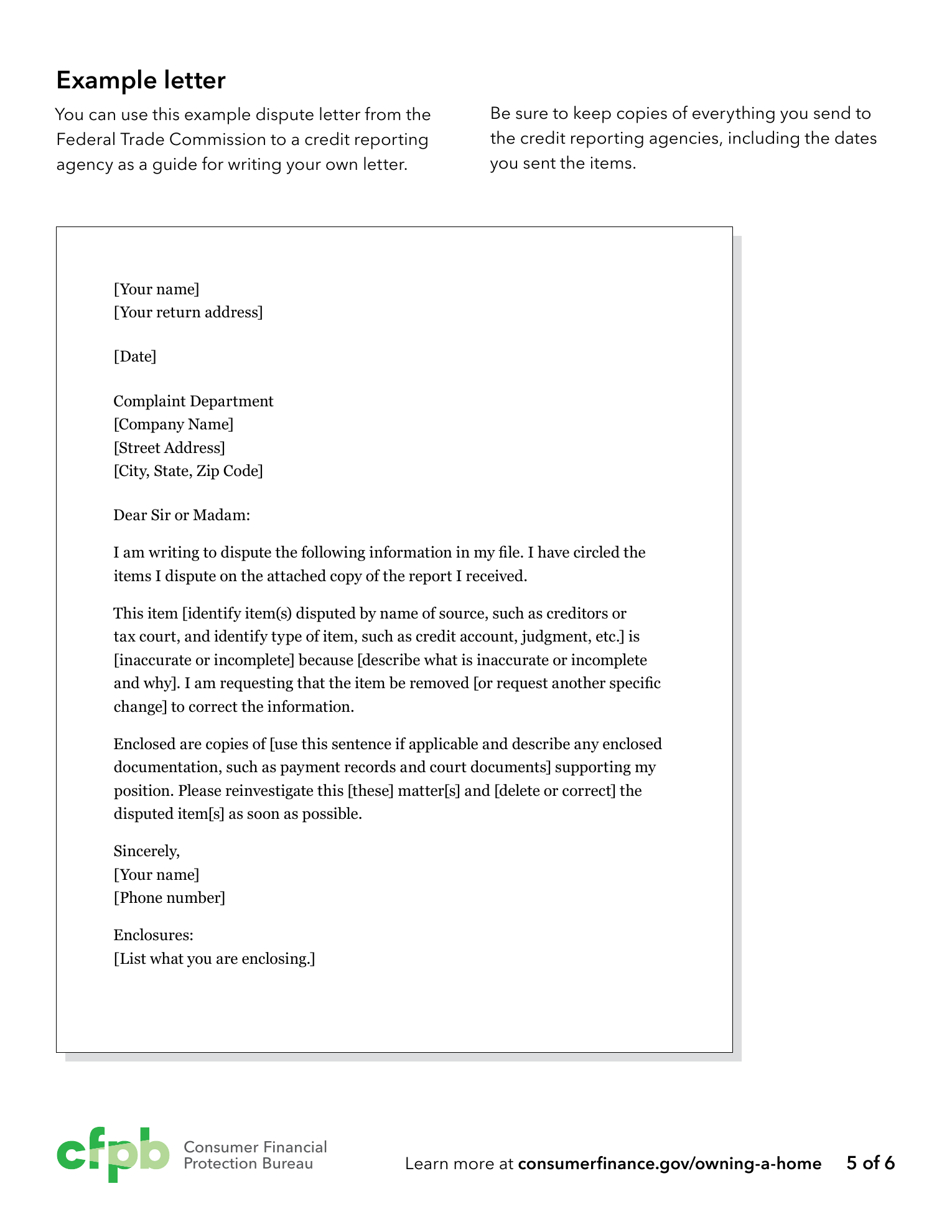
The original CFPB checklist includes this example letter.
Protect your information while asking for help
Use the company’s established secure channel for documents containing sensitive information. Supply what that channel requires for identity verification and investigation. Before sending a large attachment, review whether it includes unrelated account details or information about another person.
Our Privacy & Identity Protection hub provides broader guidance for handling personal information. For this task, keep the information needed for the dispute together and avoid spreading copies across unverified services simply because they promise a faster answer.
A chatbot may be useful for improving the organization of a short explanation, but your complete credit report, identifying documents and account records should not become an automatic upload. You can ask for help with a description that omits identifiers. Our guide to what not to paste into an AI chatbot explains those information boundaries in more detail. Any rewritten statement still needs your factual review before you send it.
Be wary of paid promises to remove accurate information or guarantee approval. The FTC’s guidance on fixing credit explains that accurate, current negative information cannot simply be removed by a repair company, and legitimate dispute work can be done yourself for little or no cost. A confident sales pitch does not replace a supported correction request.
Follow the investigation and the lender separately
The CFPB’s investigation-timeline guidance says a reporting company generally has 30 days to investigate. Some cases allow 45 days, including disputes following a free annual report or an extension when you provide relevant additional information during the initial period. Results generally must be sent within five business days after the investigation is completed. Keep those qualifications alongside the dates in your notes.
When the response arrives, compare it with the credit information you disputed. Read what was investigated, what changed and what remains. Save the written result and updated credit report together. If the answer addresses a different issue, identify that mismatch precisely in your next communication.
A corrected credit report and a changed lending decision are separate outcomes. After a correction, ask the lender whether it can reconsider the existing application, what updated information it needs and whether another credit application would be required. Request clarification before treating a new form or renewed application as a continuation of the original one.
Keep the outcome factual. You can say an entry was corrected when the resulting report shows it. You can say the lender reconsidered when it actually confirms a new decision. Avoid treating a complaint acknowledgment, document-upload receipt or an agent’s promise to investigate as either outcome.

Escalate the unresolved problem clearly
Match the escalation to the issue. A missing explanation for a credit decision, an inaccurate bureau entry and suspected discrimination should not be compressed into one allegation that an algorithm was unfair. State what happened, what you asked, what response you received and what remains unresolved.
For a reporting-agency complaint about inaccurate or incomplete information, follow the CFPB’s current complaint-intake conditions. They require a direct dispute first and an attestation that it was submitted more than 45 days ago or is no longer pending. This intake condition concerns those reporting-agency accuracy complaints; do not apply it as a universal waiting period for every lending problem.
For a concern about discrimination, preserve the notice and the concrete statements or treatment that concern you. The CFPB describes discrimination protections and complaint routes, including the CFPB and state consumer-protection authorities. An unfavorable result or suspected automation alone does not prove unlawful discrimination. You can describe what you observed without claiming access to the system’s internal operation.
If the consequences are serious, the response remains unclear or you need advice about your rights and deadlines, consider qualified legal help. Keep your file ready for that conversation. A concise account with the relevant documents is more useful than a demand that someone reverse engineer the model before addressing an identifiable problem.
What to do now, and after the response
Today, save the credit denial notice and locate its reasons or instructions for requesting them. Record the dates, obtain the named credit report and identify the record you want checked. If there is a deadline you do not understand, ask about it directly instead of waiting until the last day.
Before submitting a correction, check the recipient and keep a copy of your explanation and attachments. After submission, save the acknowledgment and follow the stated process. Put the next expected response date in your notes, with the event that starts the clock.
After a response, record the actual outcome and any remaining issue. Ask the lender separately about reconsideration if that is what you want. Keep report accuracy, application information and the lender’s decision visible as separate parts of the same case. This makes the next conversation specific even when the technology behind the decision remains unfamiliar.
Conclusion
The most useful response to a credit denial is a clear document trail: the notice, the actual reasons, the relevant credit report or application entry, and evidence supporting any correction you request. Knowing that trail gives you practical next steps without requiring you to diagnose an AI system first.
Work on the problem you can identify, keep the deadlines distinct and record what each company actually does. For more practical guidance on protecting personal information and handling unfamiliar digital risks, subscribe to Quantum Cyber AI.
FAQ
Does an instant decision prove AI denied my application?
No. The speed of the response does not establish which process was used. Start with the lender’s explanation and ask about the actual reasons. If the company discloses automation, preserve that information, but do not substitute a technology label for the factual issue you want investigated.
Can I demand a human review or the model’s source code?
The notice and dispute rights described here do not establish a general entitlement to either. Ask whether the lender offers reconsideration or another review process. Keep that request distinct from obtaining the principal reasons and correcting information. A voluntary review option is not a promise of approval.
Should I dispute a score that differs from my app?
A different number alone does not identify an error because scores can use different formulas, products and reporting sources. Review the report and the information associated with the lender’s decision. If you find an inaccurate item, identify that item and its supporting evidence rather than demanding a particular score.
What if I missed the deadline for requesting the reasons?
Ask the creditor what information it can still provide and address any inaccurate information you discover. Do not assume an expired reasons-request window automatically eliminates every other remedy, and do not assume another process extends that window. If the timing affects a serious dispute, obtain advice about your particular circumstances.