
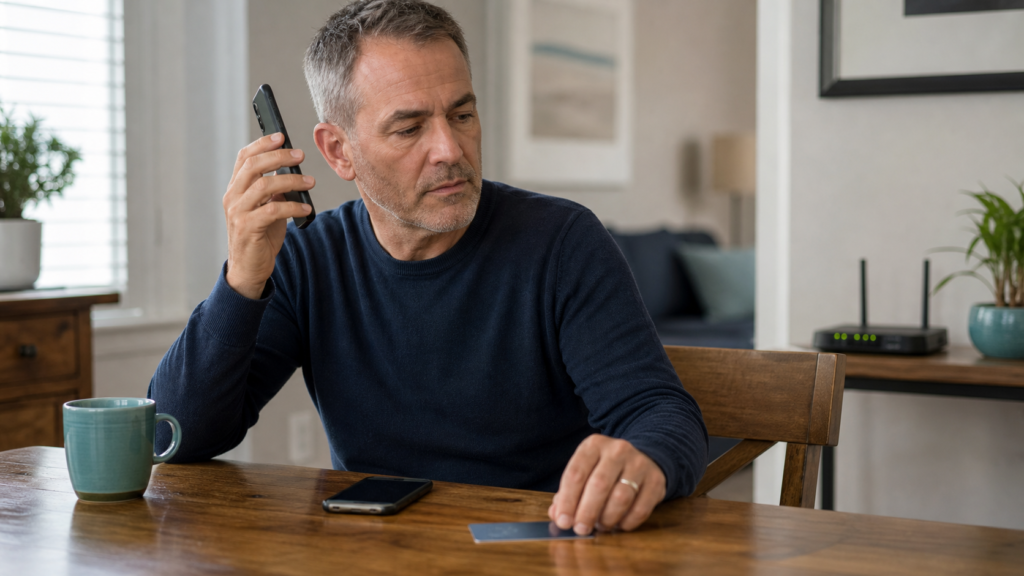
An unexpected call or text says your bank account has been hacked. The person sounds calm, knows your name, and offers to move your savings before a thief can reach it. Stop there. In bank impersonation scams, the request to move money for protection is not the solution. It is the moment the theft begins. The Federal Trade Commission says never to transfer bank, investment, or retirement funds to “protect” them, never to share a verification code, and never to call a number supplied by the person who contacted you.
You do not need to prove that the caller is fake while they are still on the line. End the contact, switch to a channel you selected independently, and ask your real bank whether anything is wrong. That pause defeats the fear, isolation, and speed the scheme depends on.
Key Takeaways
- In bank impersonation scams, anyone who tells you to move money to keep it safe is giving you a reason to stop, not a reason to transfer.
- Do not share a one-time verification code, approve a login prompt, install remote-access software, or show your account on screen for an unexpected contact.
- Verify a fraud alert through the bank’s official app, the number on the back of your card, or a recent statement.
- A second caller claiming to represent the government, the Federal Reserve, or another bank may be part of the same coordinated story.
- Never hide the real reason for a withdrawal or transfer from a teller or fraud analyst.
- If you already sent money or shared access, contact the bank immediately, secure the affected accounts and devices, preserve evidence, and report the incident.
Why Bank Impersonation Scams Can Feel Real
Bank impersonation scams often arrive disguised as help. A message may ask whether you approved a purchase. A caller may say the fraud department stopped an outgoing transfer. An email may claim that a new device signed in. These are situations a careful account holder is trained to take seriously, so the opening does not necessarily look like a request from a stranger.
The scale of the problem reflects how effective this framing can be. FTC data released in June 2026 show $3.5 billion in reported losses to imposter scams in 2025. Nearly one in three fraud reports involved impersonation, and bank impersonators produced the highest reported losses among business impersonators. The agency noted that some of the costliest cases start with a fake bank security alert and continue until the target’s available funds are gone.
Those figures are reports, not a measure of every incident. They still make one point clear: bank impersonation scams are not a minor nuisance built around a single clumsy text. They can be extended operations designed to look like a fraud response.
Personal knowledge is not proof of authority
A caller may know your full name, address, phone number, bank, or a fragment of another personal record. That information can come from a breach, a public record, an earlier phishing attempt, a social media profile, or a data broker. It can make the story more convincing, but it does not authenticate the person.
The FTC’s current guidance for unexpected calls about money at risk warns that a caller’s knowledge does not make them trustworthy. It recommends hanging up and verifying through an official app, a recent statement, or the number on the back of a card. It also warns against using a top search result to find a bank’s phone number because a fraudulent paid result may appear above the real institution.
Treat any detail the caller volunteers as part of the claim. Proof comes from an independent conversation with the institution through a channel you already know.
Urgency is used to close the verification window
The story frequently presents a shrinking deadline. The caller may say a transfer is processing now, the account will be frozen, the next ten minutes are critical, or another department is waiting. You may be told not to hang up because doing so will interrupt the protection process.
That continuous contact has a practical purpose. It keeps you inside the caller’s version of events. It also makes it harder to read the bank’s real alerts, call a relative, or reach the institution independently.
The safest response is not to move faster. It is to create a break. A legitimate account problem can be checked after you hang up. A legitimate institution can still help when you call through its published channel.
How the Scam Moves From Alert to Transfer
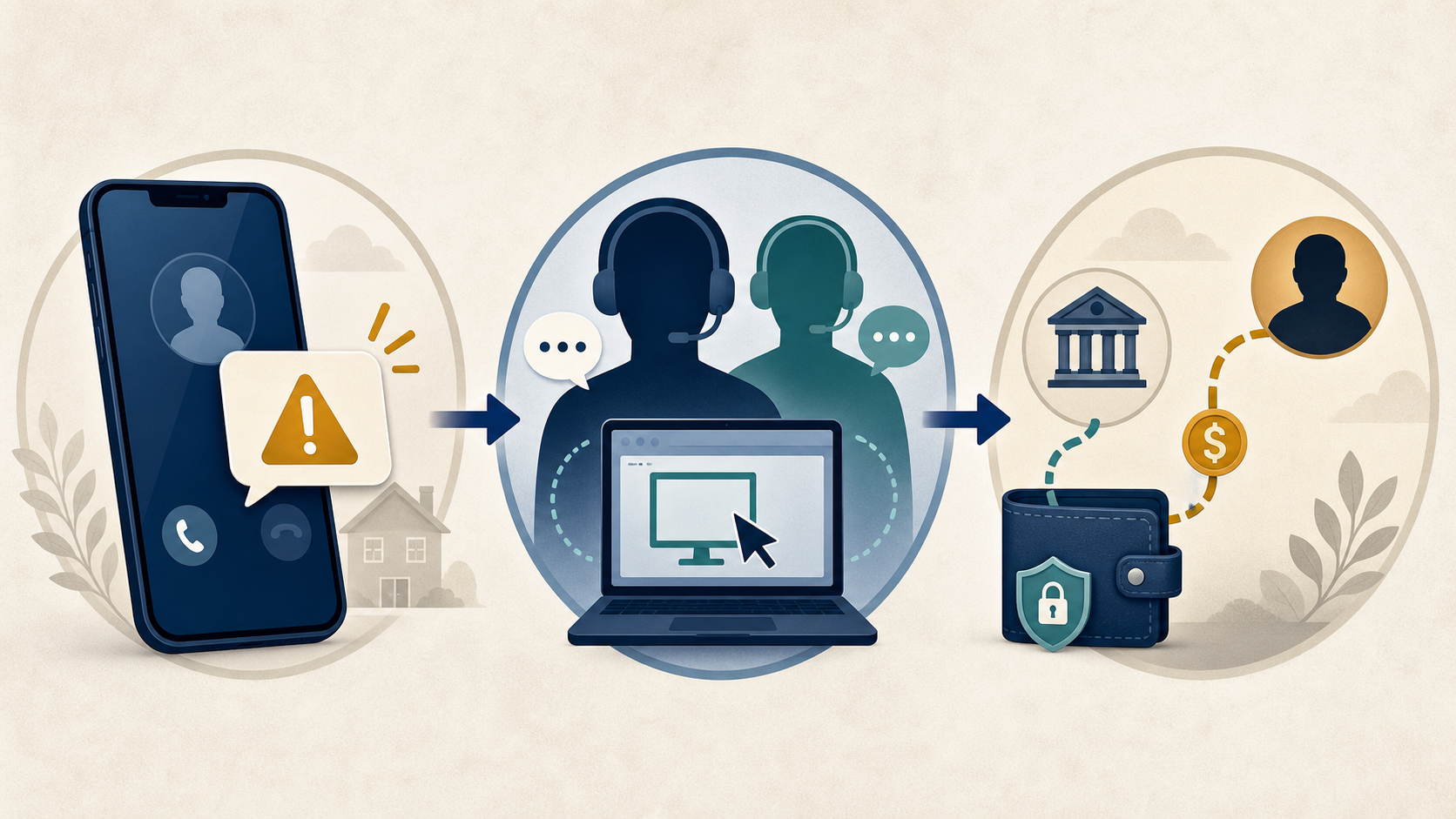
Understanding the sequence makes the scheme easier to interrupt. Not every case includes every stage, and the order can change, but the underlying path is consistent: attract attention, establish authority, increase fear, block outside checking, and direct the target to move value.
A fake bank warning
The first message may look like a bank fraud alert and ask you to confirm a purchase or transfer. Replying “no” can trigger a call from a supposed fraud specialist. A phone call may begin with an automated menu that sounds like a bank system. An email or pop-up may provide a number to call.
The FDIC’s guidance on bank impersonation scams describes a common version in which a text asks about a large purchase and a later caller requests personal or financial information. The FDIC advises consumers not to click the message link and to call the bank using a familiar number, such as the one on a debit or credit card. It also warns that criminals build fake bank sites and misuse the FDIC name or logo.
At this stage, do not reply, click, or call the supplied number. Open the app you normally use or use the physical card or statement you already have.
A supposed fraud specialist takes control
Once you engage, the person may ask you to “verify” yourself. The request can include a one-time code, an approval prompt, a password reset, a screen share, or remote-access software. They may ask you to open several financial accounts so they can identify which one is supposedly at risk.
A bank verification code is not a conversational credential. It may authorize a login, password change, payment, or device enrollment. Read the message that delivered the code. If it says not to share it, keep it private. If an unexpected login prompt appears, deny it rather than approving it to make the alert disappear.
Remote access creates a wider risk. A person who can see or control the screen may observe balances, account numbers, email, saved passwords, and security messages. Do not install a support tool for someone who initiated the contact. If remote access was already granted, use a different trusted device for the first recovery calls and password changes.
The money is moved to a “safe” account
At this point, the caller says the existing account is unsafe. The proposed remedy might be a wire to a “protected account,” a transfer to another bank, a payment-app transaction to yourself, cryptocurrency in a new wallet, cash placed in a package, gold collected by a courier, or several smaller transactions.
Bank impersonation scams may describe the recipient as an alias account in your name. The caller may promise that the money will be returned after an investigation. What matters is not the label. If the destination was selected through the unexpected contact, you do not control the protection process.
Some callers claim the funds are going to a personal Federal Reserve account. That account does not exist. The Federal Reserve explains that individuals cannot hold accounts at Federal Reserve Banks; those banks provide financial services to banks and government entities.
The phantom-hacker handoff
Some bank impersonation scams use a handoff to make the story look independently confirmed. This phantom hacker scam may begin with a tech-support representative who claims the computer is compromised. A second person from the “bank” says savings are exposed. A third person claims to work for a federal agency and supplies a badge number, case number, or official-looking letter.
The FBI’s phantom-hacker warning describes this three-part structure and says victims may be directed to transfer money by wire, cash, or cryptocurrency, sometimes through several transactions over days or months. The supposed officials may tell the target not to reveal the real reason for moving the funds.
Several people agreeing does not create independent verification when every introduction came from the same chain. End all of those contacts and start a new one with the real institution.
Warning Signs That End the Conversation
You do not need to score every detail. One decisive warning sign is enough to stop. The following requests should end the call or message immediately.
“Move the money so we can protect it”
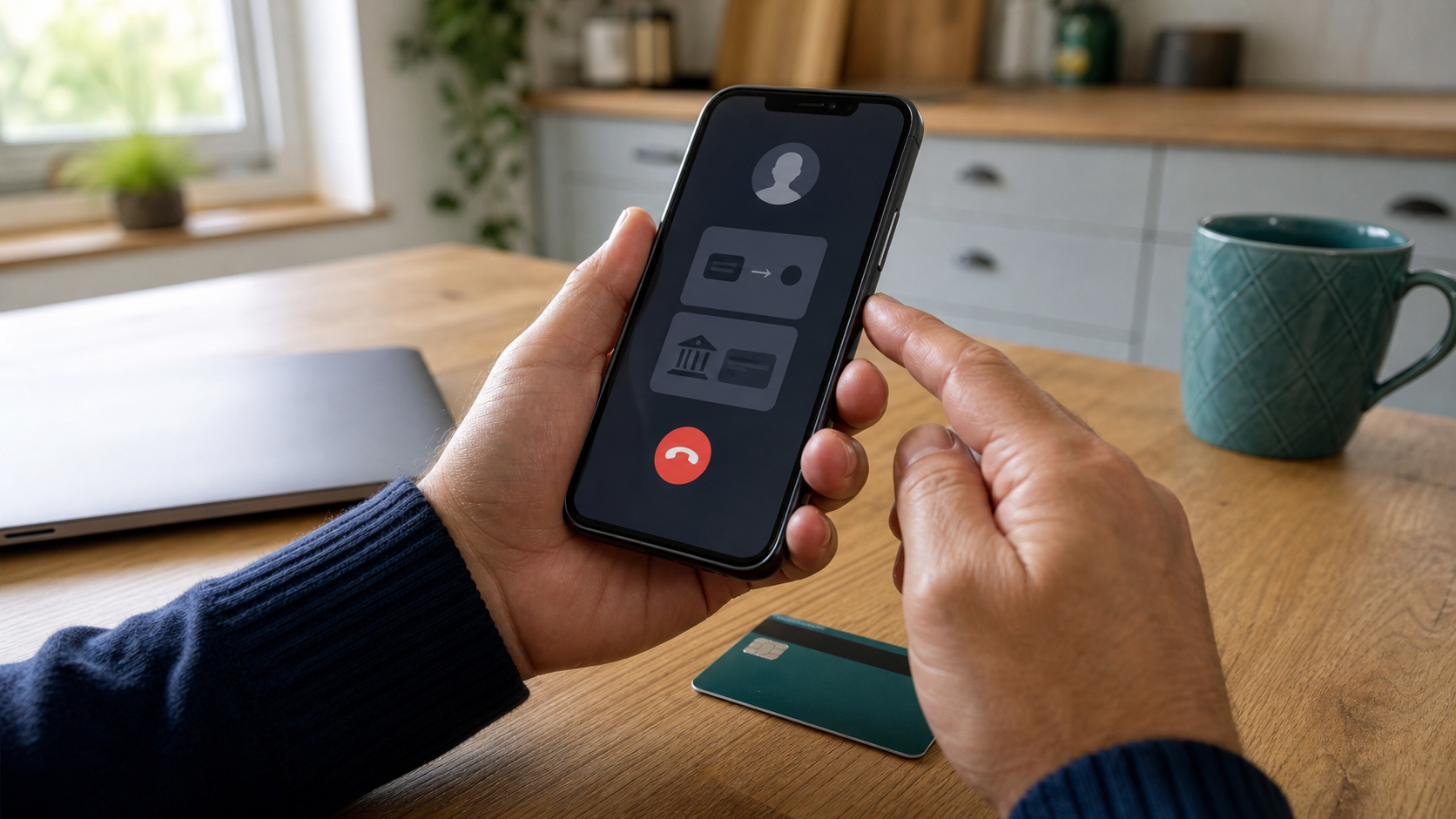
This is the central stop sign in bank impersonation scams. Do not transfer savings, investments, retirement funds, or borrowed money to solve an emergency described by an unexpected caller. Do not move the money even if the destination appears to use your name.
“Read me the verification code”
The code may give the other person authority to log in or act as you. A caller claiming to work in fraud prevention does not need you to defeat the bank’s own security control.
“Install this app so I can secure the device”
The contact does not become legitimate when the caller requests remote access. Do not open your bank, email, investment, or retirement accounts while that person can view the screen.
“Stay on the line and do not tell anyone”
Secrecy blocks outside advice. A real fraud response does not become invalid because you speak with a spouse, friend, relative, lawyer, accountant, or bank employee you contacted yourself.
“Tell the teller this is for a home purchase”
The caller may coach you to use a cover story so an employee does not interrupt the transfer. The lie protects the scam, not your privacy. Tell the employee exactly what you were told and show the message if you can do so safely.
“Use this number, link, or search result to verify me”
That sends you back into a channel the scammer may control. Use the bank app already on your device, type a saved official address, or call the number printed on your card or statement.
“Move it by crypto, cash, gold, gift card, or a new payee”
An unusual payment method does not turn an unexpected contact into a security process. It moves value quickly and can make recovery harder. Stop before withdrawing, purchasing, shipping, depositing, or transferring anything.
“Your caller ID proves this is the bank”
Caller ID is not an identity check. The FTC’s imposter-scam guidance explains that scammers can fake caller ID, use real employee names, invent badge numbers, and send official-looking documents. Verify through a channel you chose independently.
For a broader look at synthetic voices, fabricated documents, and persuasive impersonation, use Quantum Cyber AI’s AI Fraud & Deepfakes guide.
A Safe Five-Step Verification Routine
The purpose of this routine is not to investigate the caller yourself. It is to leave the untrusted conversation and reach the organization that can see the real account.
1. End the inbound contact
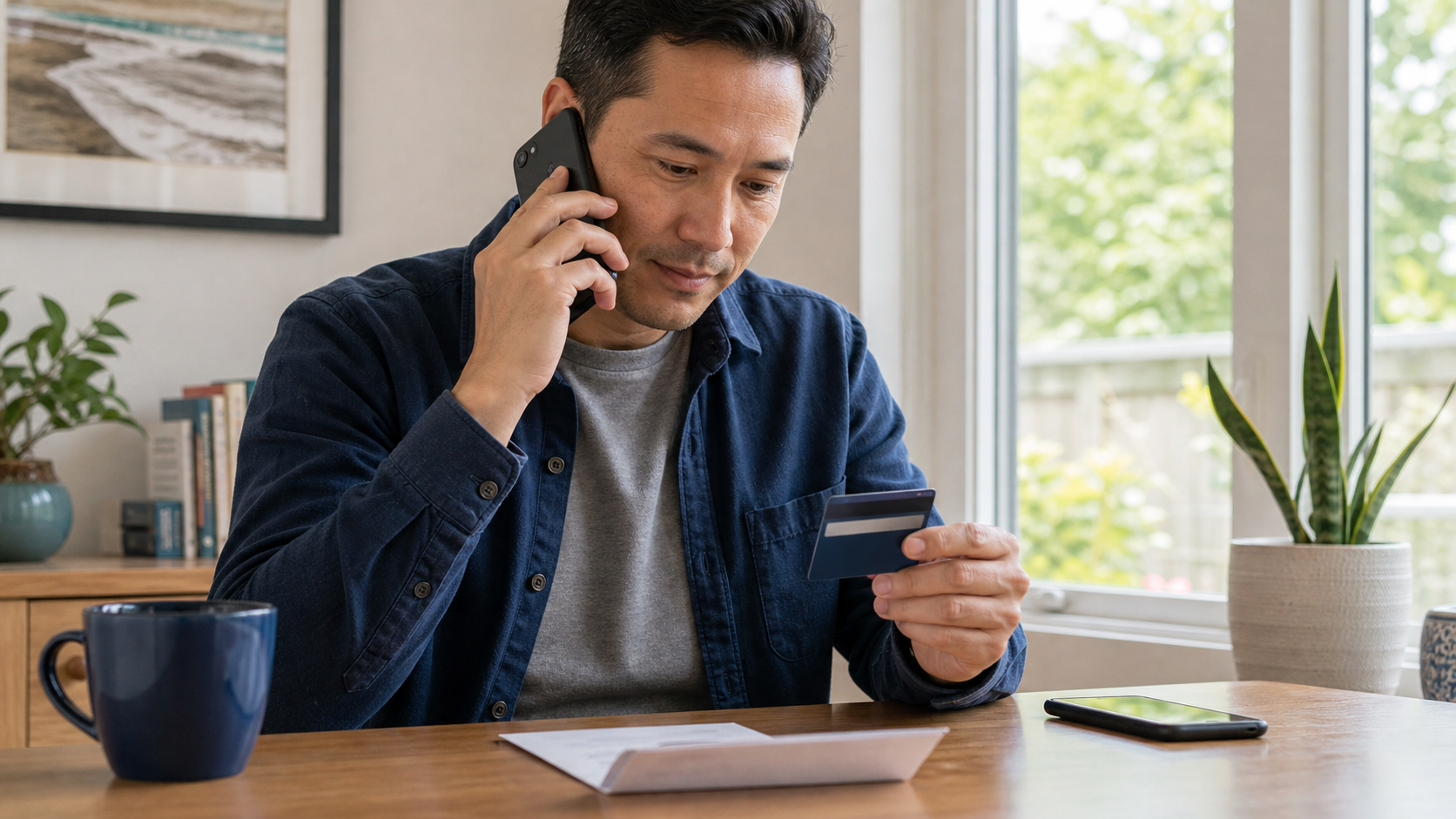
The scheme depends on keeping the conversation open. Hang up, stop replying, or close the pop-up. Do not announce which number you plan to call or give the person another chance to explain.
2. Protect the channel you will use next
If someone had remote access to the phone or computer, do not use that device for banking recovery. Disconnect it from the internet and use another device you trust. If you only received a call or text and did not install anything, open the bank app normally or use the physical card.
3. Contact the bank through a known route
Use one of these routes:
- The number on the back of the payment card.
- A phone number printed on a recent statement.
- The support or fraud option inside the bank’s official app.
- A bookmarked official website you used before.
- An in-person branch you already know.
Do not let the unexpected contact choose the verification channel. Avoid the number in the message, a link sent by the caller, or a result labeled as an advertisement.
4. Ask about specific changes
Tell the real bank that you received a possible impersonation contact. Ask whether it sees the claimed transaction or alert. Also ask whether anyone changed the account email, phone number, password, device list, transfer recipient, external account, card, digital wallet, or notification settings.
If the bank finds no issue, save the suspicious message for your report and block the contact. If it finds an issue, follow the bank’s instructions within the verified channel.
5. Bring in another person
The story loses power when you compare it with someone outside the call. Tell a trusted person what happened, especially if the caller demanded secrecy or kept you on the line. You do not need permission from the caller to ask for help.
Use this short decision table when the pressure is high:
| Claim from the contact | Safe response |
|---|---|
| “A transfer is happening now” | Hang up and check through the real bank app or card number. |
| “Move the balance to stop theft” | Do not move it. Ask the real bank whether it sees an unauthorized instruction. |
| “Share the code so I can cancel the payment” | Keep the code private and deny unexpected prompts. |
| “Your computer is exposing your accounts” | Do not grant access. Disconnect any existing remote session and call the bank from another device. |
| “A federal agent will confirm the case” | End the handoff and contact the agency through its official public channel if verification is necessary. |
| “Do not tell the teller” | Tell the teller the full story before authorizing anything. |
Practical Protections To Set Up Before a Scam Arrives
Because bank impersonation scams rely on speed, you cannot prevent every unexpected contact, but you can make a high-pressure transfer harder to complete. Choose controls that fit the accounts and household rather than copying a universal setup.
Create a household stop rule
Agree that nobody moves money because of an inbound call, text, email, pop-up, or social message. The rule applies even when the contact knows personal details. A real concern is checked through a saved channel after the first contact ends.
For large or unfamiliar transfers, consider a second-person check. This does not require another person to control the account. It can be a simple promise to pause and call someone before creating a new payee, buying cryptocurrency, withdrawing a large amount of cash, or liquidating an investment.
Turn on alerts you will actually read
Review the bank’s available alerts for logins, password changes, profile changes, new payees, external-account links, transfers, card-not-present purchases, and withdrawals. Alerts differ by institution, so choose the ones that would help you notice a change without producing so much noise that every message is ignored.
An alert is a reason to inspect the account through the official app. It is not a reason to call the number in the alert when the message itself is unexpected.
Review transfer controls with the real bank
Ask what limits, holds, callbacks, or new-recipient controls are available for wires and other large transfers. Ask how to reach the fraud team outside normal branch hours. Save the verified route in a password manager, contact list, or household emergency document.
Do not assume that a limit prevents a loss. Bank impersonation scams can split transfers, move between several accounts, or continue across several days. The purpose of friction is to create a new decision point.
Protect the accounts around the bank account
Email and mobile accounts can be part of financial recovery. Use a unique password for email, protect it with strong multifactor authentication, review recovery addresses and phone numbers, and remove devices you do not recognize. Add a carrier account PIN where the provider offers one.
Keep financial passwords unique. Do not store verification codes or account screenshots in a shared place that an unfamiliar remote-support person can browse.
Plan support without taking away dignity
Ask a parent, relative, or partner how they would like help if a caller claims their savings are threatened. Identify the card or statement number together. Agree on a phrase such as “We never move money from an inbound call.” Decide whom to call for a second opinion.
The goal is not surveillance. It is a rehearsed exit from the scheme before fear makes the choices narrower.
If You Already Moved Money or Shared Access
Act quickly, but do not let urgency push you into a second unverified contact. Use known channels and keep a written record.

Contact the financial institution first
If bank impersonation scams led you to make a payment, call the bank or provider used to send the money. Say that you were deceived by an impersonation scam. Ask for the fraud team or the team that handles the payment method. Provide the amount, time, recipient, reference number, and how the transaction was authorized.
Ask whether the payment can be held, recalled, reversed, or traced. Ask whether the receiving institution can be notified. Request a case number and the next deadline. If the first employee cannot help, ask which department owns the claim and how to submit it in writing.
The FTC warns that a transfer the account holder was deceived into making may not be recovered. It also warns targets not to lie to a teller or fraud employee when a scammer supplies a cover story. Bank protections vary by the payment method and facts, so report accurately and do not assume a familiar “zero liability” phrase covers a transfer you initiated under deception.
Use the payment method’s recovery path
The FTC’s recovery guide for scam payments recommends contacting the company used to send the money and asking for a reversal even when recovery is uncertain. This advice applies to bank impersonation scams even when the caller claimed the transfer was temporary.
- Bank wire or account transfer: If a bank transfer scam led to the payment, contact the bank immediately and ask for a recall, reversal, hold, or fraud investigation.
- Credit or debit card: Contact the issuer, identify the fraudulent charge, and ask about reversal and card replacement.
- Payment app: Report the transaction to the app. If a card or bank account funded it, contact that issuer too.
- Gift card: Contact the issuing company, keep the card and receipt, and report that the card was used in a scam.
- Cryptocurrency: Contact the exchange, wallet service, or kiosk provider used for the transaction. Cryptocurrency transfers are generally difficult to reverse, but the transaction should still be reported.
- Cash or courier: Contact local law enforcement and the delivery company immediately if a shipment may still be stopped.
Do not pay a fee to a stranger who promises that a wire or cryptocurrency transfer can definitely be recovered.
Secure accounts from a trusted device
If the contact exposed a password, verification code, login approval, or remote access, assume the incident may extend beyond the payment.
- Use a different trusted device if the original device was remotely controlled.
- Change the bank password and the email password associated with the bank.
- Sign out other sessions and remove devices you do not recognize.
- Check account profile, recovery, payee, external-account, card, and alert settings.
- Contact the mobile carrier if the phone number or SIM account may be affected.
- Remove remote-access software and obtain help from a trusted technician if you are unsure what changed.
If the contact started with a link or downloaded file, Quantum Cyber AI’s What To Do If You Clicked a Scam Link provides a device and account triage sequence.
Protect exposed identity information
If you shared a Social Security number, driver’s license, date of birth, account documents, or enough information to open new credit, expand the response beyond the bank. IdentityTheft.gov recommends checking credit reports, freezing credit, monitoring for misuse, and creating an identity-theft recovery plan when information is used.
Use Quantum Cyber AI’s Identity Theft Response Checklist to organize freezes, reports, account reviews, and follow-up records.
Preserve evidence and report the incident
Evidence from the contact can help the bank and investigators understand the transaction. Save the original text, email, voicemail, pop-up, or social message. Record phone numbers, email addresses, websites, names, aliases, case numbers, payment instructions, recipient information, cryptocurrency addresses, transaction references, dates, times, and amounts. Keep the bank’s case number and every later response.
Report the scam through the FTC’s official ReportFraud portal and the FBI’s Internet Crime Complaint Center when the incident involved online contact, remote access, or an electronic transfer. A local police report may also be useful when money, identity documents, cash, or a courier is involved. Use official sites you navigate to yourself rather than a link sent by someone claiming to recover the funds.
Expect a recovery scam
After a loss, a new caller may claim to be an investigator, government employee, lawyer, blockchain specialist, or recovery agent who found the money. That can be another attempt to collect fees and personal information.
The FBI has warned that criminals impersonate IC3 staff and falsely claim to have recovered scam losses. IC3 does not charge people to recover funds and does not refer victims to a company that demands payment. Do not send another payment or disclose a new wallet, bank account, code, or identity document to someone who found you.
What Bank Safeguards Can and Cannot Do
These scams create a painful expectation problem. People reasonably expect a financial institution to notice a strange transfer. Banks do use security systems and employees may ask questions, but no control can safely be treated as a promise that a scam-induced payment will be stopped or reimbursed.
Treat a warning as a chance to stop
When you encounter a transfer warning, pause. If an app, teller, or fraud analyst asks about a new recipient or large withdrawal, answer accurately. Contact the trusted person you planned to call. A scammer’s instruction to hide the purpose is evidence that outside review threatens the scheme.
Describe exactly who initiated each action
Different incidents can produce different transaction records. There can be an important difference between a transaction performed without your knowledge and a transaction you personally approved because someone lied to you. Do not guess which label applies. Tell the bank who entered the payment, who received the code, whether remote access was active, and what the caller said.
Ask the bank to explain its claim process in writing. Keep copies of forms, correspondence, account statements, and decisions. If you disagree with the outcome, ask what review or complaint route is available. The applicable rights can depend on the account, payment rail, transaction, timing, terms, and law.
Do not let a failed transfer restart the scam
If the bank blocks a payment, the caller may say that proves the real hacker interfered. They may provide a second recipient or switch to cash, gold, gift cards, or cryptocurrency. The blocked transfer is the moment to end contact and tell the institution the full story.
Helping Someone Who Is Under Active Pressure
When another person is speaking with a supposed fraud department, the first goal is to break the contact. Do not begin by arguing over every detail or asking how they could believe it. Shame can push the person back toward the caller, who is already offering certainty and secrecy.

Say something concrete: “Let’s hang up and call the number on the card together.” Move to another phone if remote access may be involved. Ask whether any money has moved, whether a code was shared, and whether software was installed. Then contact the real institution.
Current complaint data show why preparation matters. The FBI’s 2025 IC3 Annual Report recorded about $798 million in reported government-impersonation losses and about $2.13 billion in reported tech-support losses. People age 60 and older reported $7.748 billion in losses across cyber-enabled crime, including more than $1.04 billion to tech-support schemes and more than $413 million to government impersonation. These are reported complaints, not a count of every incident, and they do not mean bank impersonation scams only affect older adults.
Offer practical help without seizing control unless you have permission or lawful authority. Sit with the person during the verified bank call. Help write the timeline. Preserve messages. Review the next day’s account activity. Expect follow-up calls using new names.
The scheme exploits urgency and trust, not a lack of intelligence. A calm second person can restore the time and perspective the scam is trying to remove.
Conclusion
Bank impersonation scams can look like a bank protecting you because that is the role the criminal has chosen to perform. A familiar logo, a convincing voice, a correct address, and a second supposed official do not change the decision rule.
Never move money to protect it because an unexpected contact told you to. End the conversation and call the institution through the app, card, statement, or branch you already trust. Keep verification codes private. Refuse remote access. Tell the truth to the bank employee. Bring another person into the decision.
If money or access was already provided, move quickly through verified channels. Ask for a recall or reversal, secure the accounts and devices, preserve the evidence, and report the scam without assuming recovery is guaranteed.
For more calm, practical guidance on scams, privacy, and account recovery, subscribe to Quantum Cyber AI.
FAQ About Bank Impersonation Scams
Will a bank ever ask me to move money to another account for safety?
Treat that request as a scam when it comes through an unexpected call, text, email, pop-up, or handoff. Do not send the transfer. End the contact and ask the real bank through the number on your card, a statement, the official app, or a known branch. Bank impersonation scams often call the destination a safe, protected, or alias account, but the label does not make it yours.
Can caller ID show my real bank when the call is fake?
Yes. Caller ID can be falsified, so the displayed name or number is not proof. Hang up and call the bank through a trusted route. Do not call a number the person gives you simply because it resembles the number on your card.
What if the caller knows my balance or a recent transaction?
End the call anyway. Specific information may have come from stolen data, remote screen access, compromised email, an earlier phishing step, or another source. Contact the bank independently and ask it to review logins, profile changes, payees, linked accounts, cards, and recent activity. Knowledge is part of the claim, not authentication.
What should I do if I shared a verification code but did not send money?
Call the bank immediately through a verified number and explain what happened. Ask it to review logins, password resets, new devices, profile changes, payees, and transactions. Change the bank and associated email passwords from a trusted device, end unknown sessions, and keep monitoring. A code can be used even when you did not personally send a payment.
Can a wire transfer or payment-app transfer be reversed?
Sometimes a provider can stop, recall, or reverse a transaction, especially when it is reported quickly, but recovery is not guaranteed. Contact the bank or app immediately, describe the payment as connected to an impersonation scam, request the appropriate recovery action, and obtain a case number. Do not pay a third party that promises a guaranteed result.
Does the Federal Reserve hold protected accounts for individuals?
No. Individuals do not have personal accounts at Federal Reserve Banks. A caller who directs you to move savings into a Federal Reserve account, federal safety account, or Social Security-linked reserve account is describing a false arrangement.
How should I help a parent or relative who is still speaking with the caller?
Focus first on ending the contact. Suggest calling the number on the card together. Avoid blame, because the immediate job is to prevent or limit loss. Ask whether money moved, a code was shared, or remote access was installed, then help contact the real bank and document the timeline. Continue watching for follow-up and recovery scams.