
A text says your voter registration has been canceled. Another says your polling place moved. A third asks you to rush a donation through a link that uses a candidate's name and colors. Election scams can imitate legitimate outreach or exploit inaccurate third-party information to steal money or personal data. The sender's name, logo, and knowledge of your address are not enough to tell you whether the message is legitimate.
The risk is easy to miss because political texts are routine. The federal general election is scheduled for November 3, while primary dates and local deadlines vary by state and can change, according to the Federal Election Commission's 2026 election-date document. That makes urgent election scams sound plausible.
The safest response to election scams is not to solve the claim inside the message. Leave the text, open a fresh browser window, and reach the relevant election office, campaign, or committee through a source you found independently. That simple break in the chain prevents one bad link from controlling both the question and the answer.
The FBI's Internet Crime Complaint Center has documented fake political action committee solicitations, campaign investment schemes, undelivered campaign merchandise, and false voter-registration texts. Those examples show why election scams should be sorted by harm, not appearance.
Key Takeaways
- Do not use a link, phone number, or reply instruction in an unexpected election text to verify that same message.
- Check voter registration, polling locations, voting hours, deadlines, and identification rules through your state or local election office.
- A message that includes your real name, address, party, or voting district is not automatically authentic.
- A real candidate's name, logo, photo, or slogan does not prove that a donation link belongs to the campaign.
- A committee's appearance in federal records is useful evidence, but it is not a guarantee that the solicitation is honest or that money will be used as you expect.
- Election scams can involve false voting information or financial fraud, and those harms require different responses. Save the message and report it through the route that fits what happened.
- If you already clicked, paid, or entered information, move quickly. The right recovery step depends on whether the exposure involved a device, password, identity information, or payment.
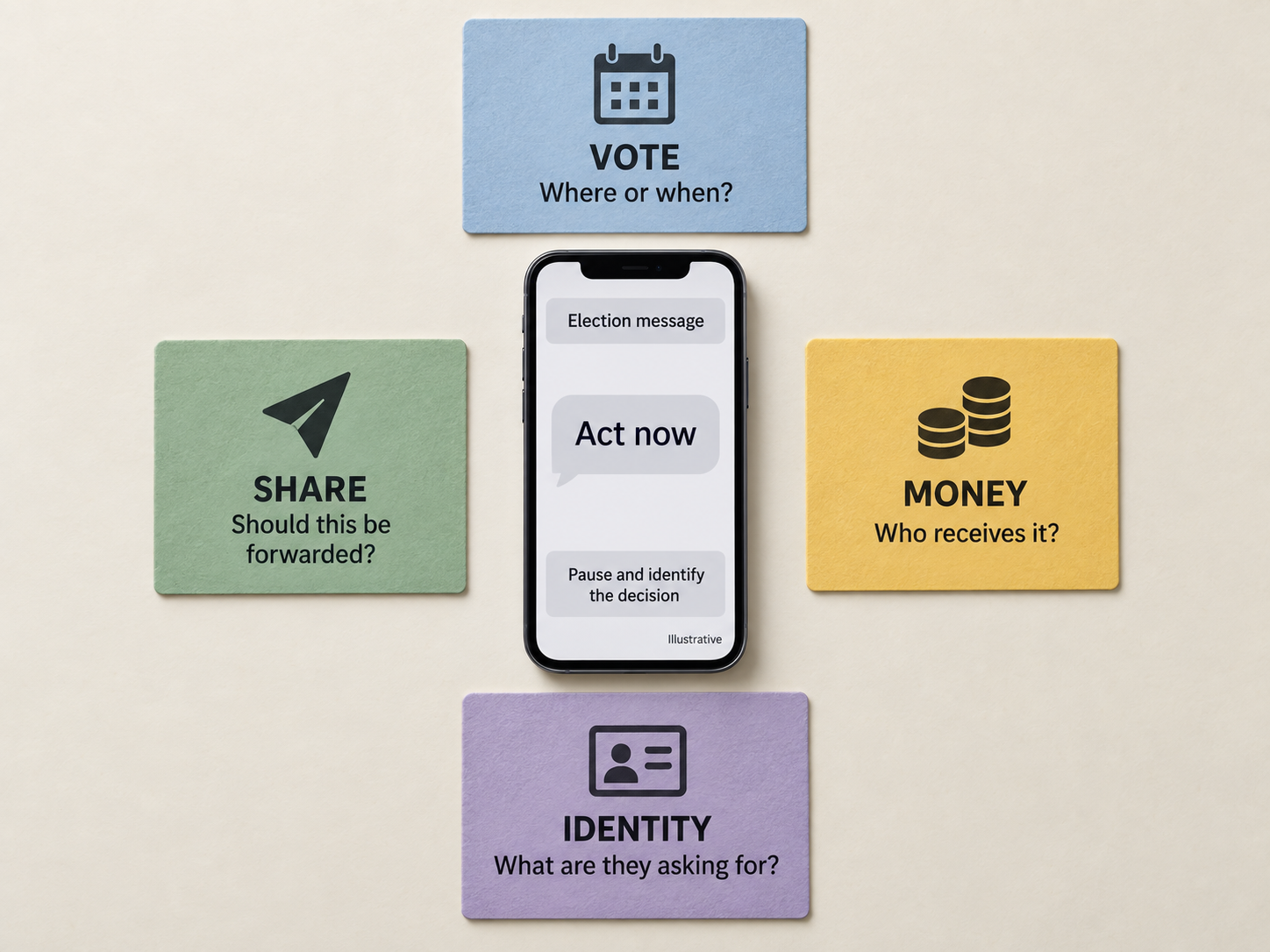
- Treat election scams as decision problems: identify what the sender wants you to do, then verify that request outside the message.
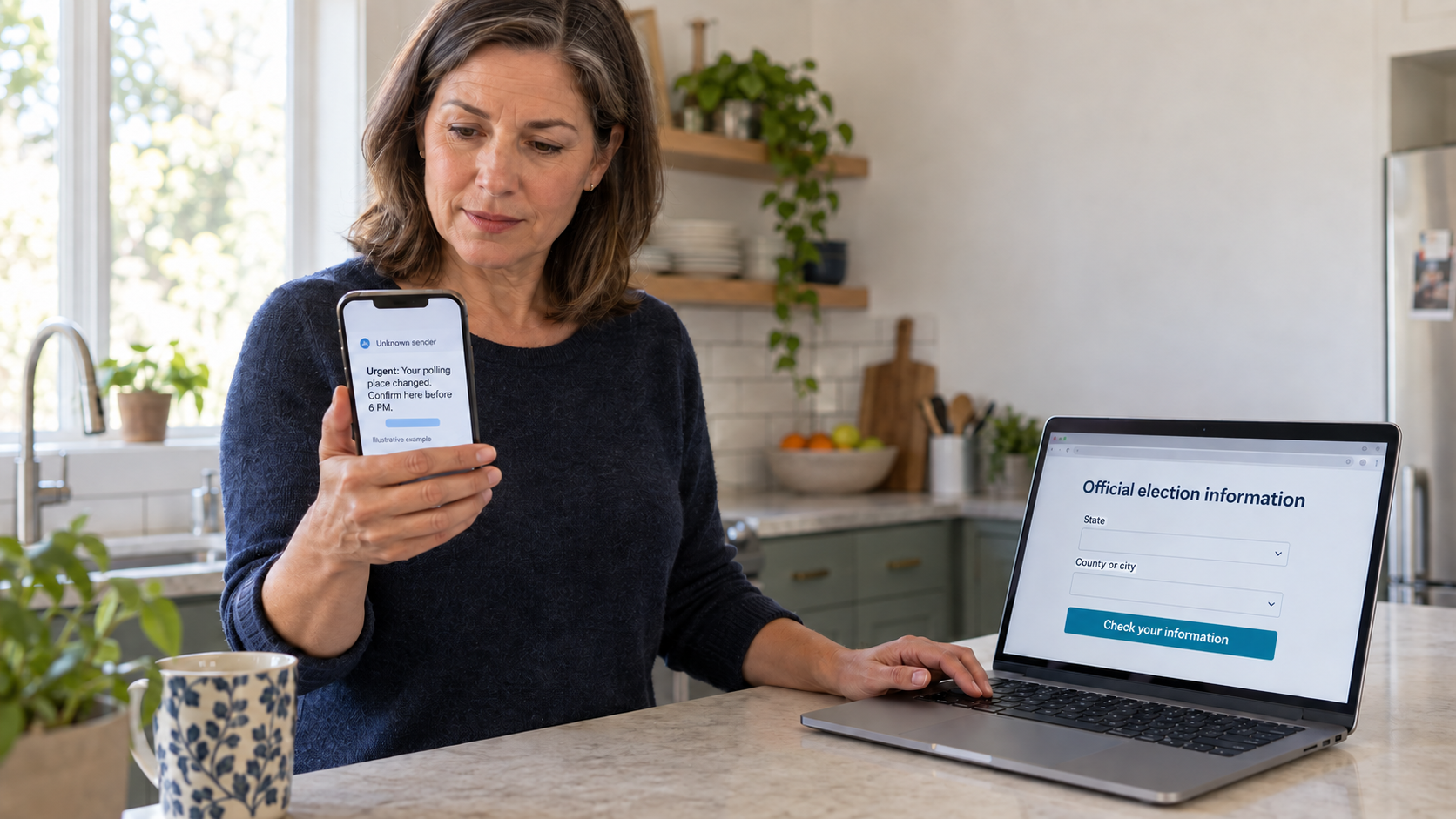
Table of Contents
Election Scams Can Cause Four Different Kinds of Harm
The phrase election scams covers more than fake donation requests. A message can take money, collect information, disrupt a person's chance to vote, or create confusion about the election process. Some messages try to do more than one of these at once.
1. Direct financial loss
The most obvious harm from election scams is a payment that never reaches its intended recipient. A scammer can copy campaign branding, build a look-alike donation page, or claim to represent a political action committee.
Another version is framed as an opportunity rather than a donation. The sender may claim that money placed in a campaign investment pool will grow and be returned if the candidate wins. IC3 states plainly that political contributions are not investments and will not increase in value and come back to the donor. A promised election-based payout is therefore a reason to stop, regardless of the candidate or issue used in the pitch.
Campaign merchandise can also be the hook. A person pays for an item that never ships, while giving an unknown operator contact, address, and payment details.
2. Identity or account theft
Identity-focused election scams can start with a text saying you are not registered, creating a strong urge to fix the problem. A fraudulent page can then request the same information a real government form might seek.
IC3 warns that fake voter-registration messages can lead to pages designed to collect personally identifiable information for identity theft and future scams. The page does not need to look crude. It may copy a state seal, use official colors, display a padlock in the browser, or already know some information about you. Those details can make the page appear credible, but they do not establish who controls it.
The same principle applies to a message that asks you to sign in to confirm a donation or retrieve a voter guide. If the page collects a password or security code, the account may be the real target. A broader message-checking routine can help, but the essential election-specific move is to verify outside the text.
3. A disrupted opportunity to vote
Election scams do not have to steal anything to cause damage. Incorrect information about an election date, early-voting period, polling location, registration deadline, identification rule, or voting method can send someone to the wrong place or persuade that person not to try.
An error and deliberate suppression are different. A group can distribute outdated information by mistake, while a malicious sender can act to prevent voting. Because intent is rarely clear from a text alone, verify the details, preserve the message, and report suspected deliberate interference.
The FBI says intentionally deceiving qualified voters about the time, place, or manner of voting in order to prevent them from voting can be a federal crime. Its guidance on voter suppression and election crimes specifically warns about false election dates and claims that people can vote by text. Voting by text is not allowed in any U.S. jurisdiction.
4. Confusion and misplaced confidence
Some election scams make a broad claim about a hacked election system or stolen voter records. Others use a person's correct information to imply that the sender must have access to an official database. Both can create false confidence in the message or unnecessary fear about the election.
The FBI and CISA caution that access to voter-registration information does not, by itself, prove that an election database was compromised because much voter information can be acquired through lawful public sources. Their joint guidance on false claims involving voter information advises the public to treat unsolicited calls, emails, and texts making suspicious election-security claims carefully and to rely on state and local election officials.
That does not make every cyber claim false. It means a voter-record screenshot, local address list, or confident narrator cannot authenticate the sender or prove the larger claim.
Why Official Election Information Is Local
U.S. elections are administered through state and local systems, which is why election scams can exploit real differences between jurisdictions. Registration deadlines, early-voting options, mail-ballot rules, identification requirements, and polling locations differ by jurisdiction. Information can be right for one county and wrong for the next, or become outdated before Election Day.
The U.S. Election Assistance Commission's state-by-state voter directory links to each state election office, local office directories, registration checks, and voting options. The EAC tells voters to confirm its summary information through those linked state and local sources so they have the current rules and timelines for where they live.
The FEC is therefore not the place to verify a polling site. It regulates federal campaign finance and publishes candidate and committee records, while state and local officials administer voting details.
Polling-place election scams can sound credible because locations may change between elections. USAGov directs voters to state or local election offices for polling-place locations and hours, and it advises checking again before Election Day. A familiar school, church, library, or community center should not be assumed to be the assigned location this time.
Match the source to the question. Use election offices for voting details, official campaign sites and FEC records for federal donation requests, and law enforcement or consumer-protection channels for suspected fraud or deliberate interference. Matching each question to the responsible source is the most reliable way to interrupt election scams without guessing about the sender.
Use the Same Verification Routine Across Every Channel
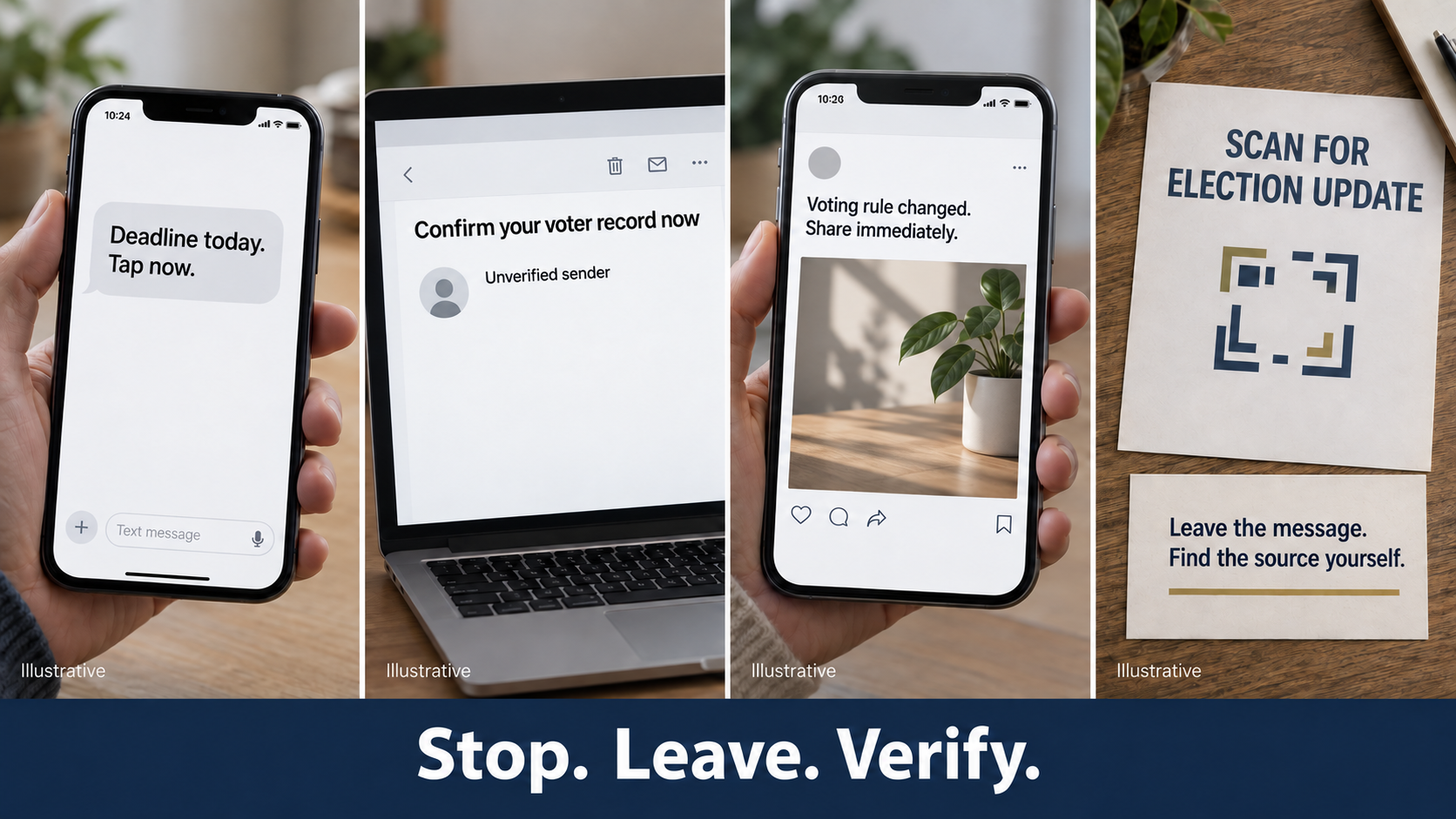
Election scams arrive by text, email, call, social post, search result, and QR code. The appearance changes, but the safest routine does not.
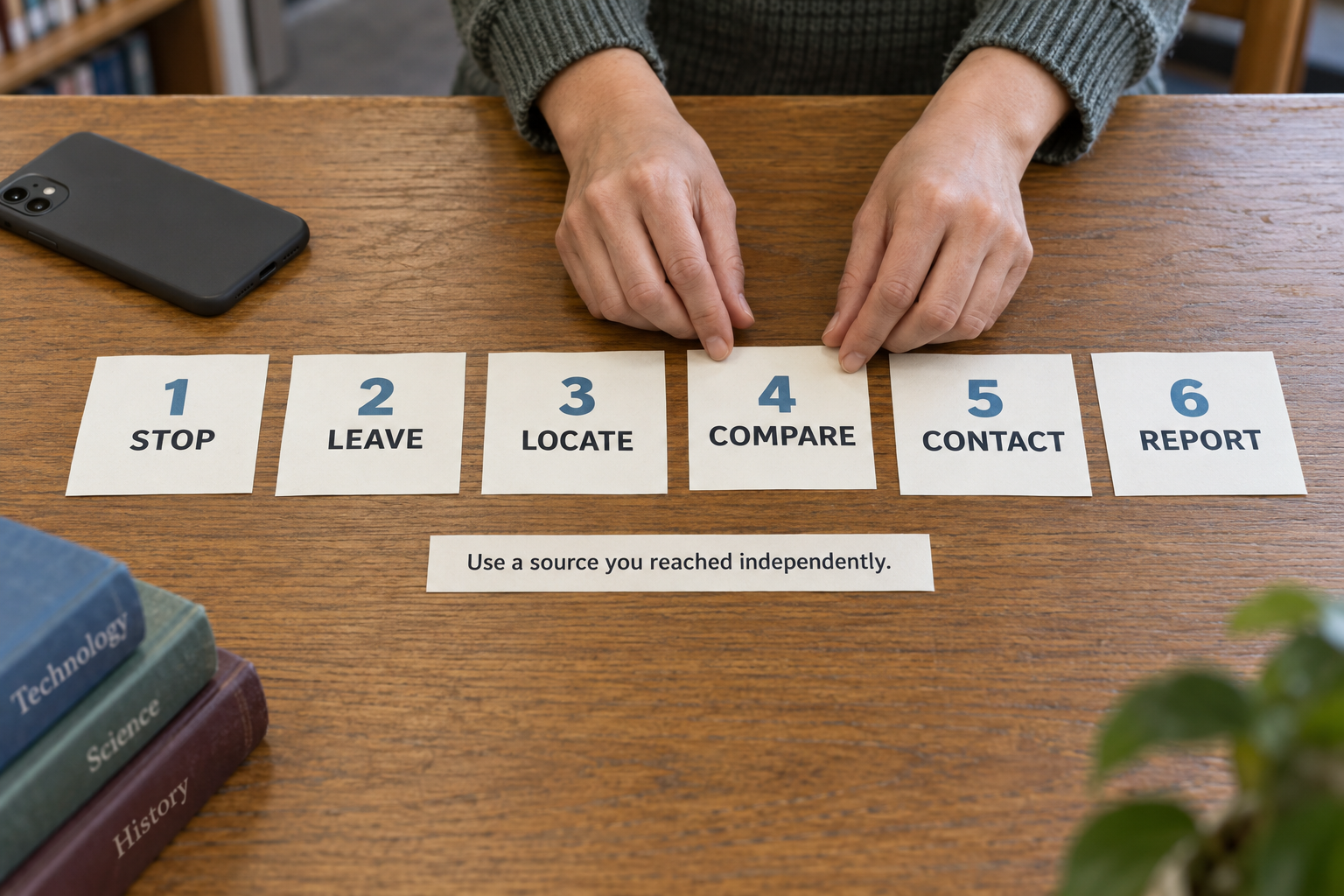
- Stop. Name the action the sender wants: vote somewhere, miss a deadline, donate, sign in, share a code, install an app, or forward a claim. Do not act while the message is setting the pace.
- Leave the message. Open a fresh browser window or a trusted app. Do not use the questionable link, callback number, reply address, QR code, or sponsored search result as your verification route. The FTC warns that QR codes can conceal spoofed sites or lead to malware. A polished code on a mailer still needs an independent check.
- Locate the right authority. Send voting questions to the relevant election office, federal committee questions to FEC records and the independently found campaign or committee, and payment questions to the verified provider or financial institution.
- Compare exact details. Check the date, address, jurisdiction, organization name, committee ID, hostname, amount, frequency, and requested credential. “Does this look real?” is too vague to settle any of those questions.
- Contact through a second channel. If the official source does not resolve the mismatch, use contact information found on that source. Do not call the number in the original message.
- Preserve and report. Save the content before deleting it, then use the reporting route that matches the harm. This is the central habit for election scams: never let the same message provide both the claim and the proof.
Typosquatting can change one letter or the domain ending while preserving the visual design. A 2025 FBI alert about spoofed government reporting sites advises typing the known government address directly and avoiding sponsored results when trying to reach IC3. The same habit is useful when election scams imitate an office, campaign, or donation processor. For a closer look at message-level clues, use our guide to spotting AI text scams.
How to Verify a Voting Text Without Trusting It
The safest way to check election scams delivered by text is to apply the six-step routine to the specific claim. Do not tap the message's link, use its phone number, reply with personal details, or follow instructions to forward a code. Even if the text names a real office, the contact path inside it could belong to someone else.
The FTC's guidance on unexpected texts recommends contacting the organization through a phone number or website you already know is real. Open a new browser window, find the responsible election office independently, and check the underlying record or rule. Compare the date, address, county, election name, voting method, and requested action. If an online lookup is unclear, call the official number published on the government site.
Election scams can also appear in search results, so placement alone is not proof that a page is official. Read the complete domain, and follow the state link supplied by a federal voter resource when possible. A secure connection protects information while it travels to a site, but it does not tell you whether the site's operator is honest. Preserve a suspicious message, including its sender, displayed link, date, and time, before reporting or deleting it.
How to Check a Polling Place or Voter Registration Claim
For a registration question, begin at Vote.gov's official registration portal. Select your state or territory and use its state process. Confirm your legal name and address, especially after a move or name change. If the result is unclear, contact the local office listed through the state site.
For a polling-place claim, verify the address, election date, hours, and whether your jurisdiction uses assigned precincts or vote centers. Check early-voting locations separately. If a text says a site changed, look for an official notice or call the office at its published number. These are the details election scams can distort without inventing an entirely new event.
A real incident shows why this extra check is worthwhile. In June 2024, the New York State Board of Elections warned that an outside group had sent unsolicited texts with incorrect poll-site information. The board told voters to use its voter lookup or contact county boards instead of relying on those texts. The release did not describe the sender as a criminal operation, so it should not automatically be labeled a scam. The broader lesson is more useful: even election outreach that appears helpful can be wrong.
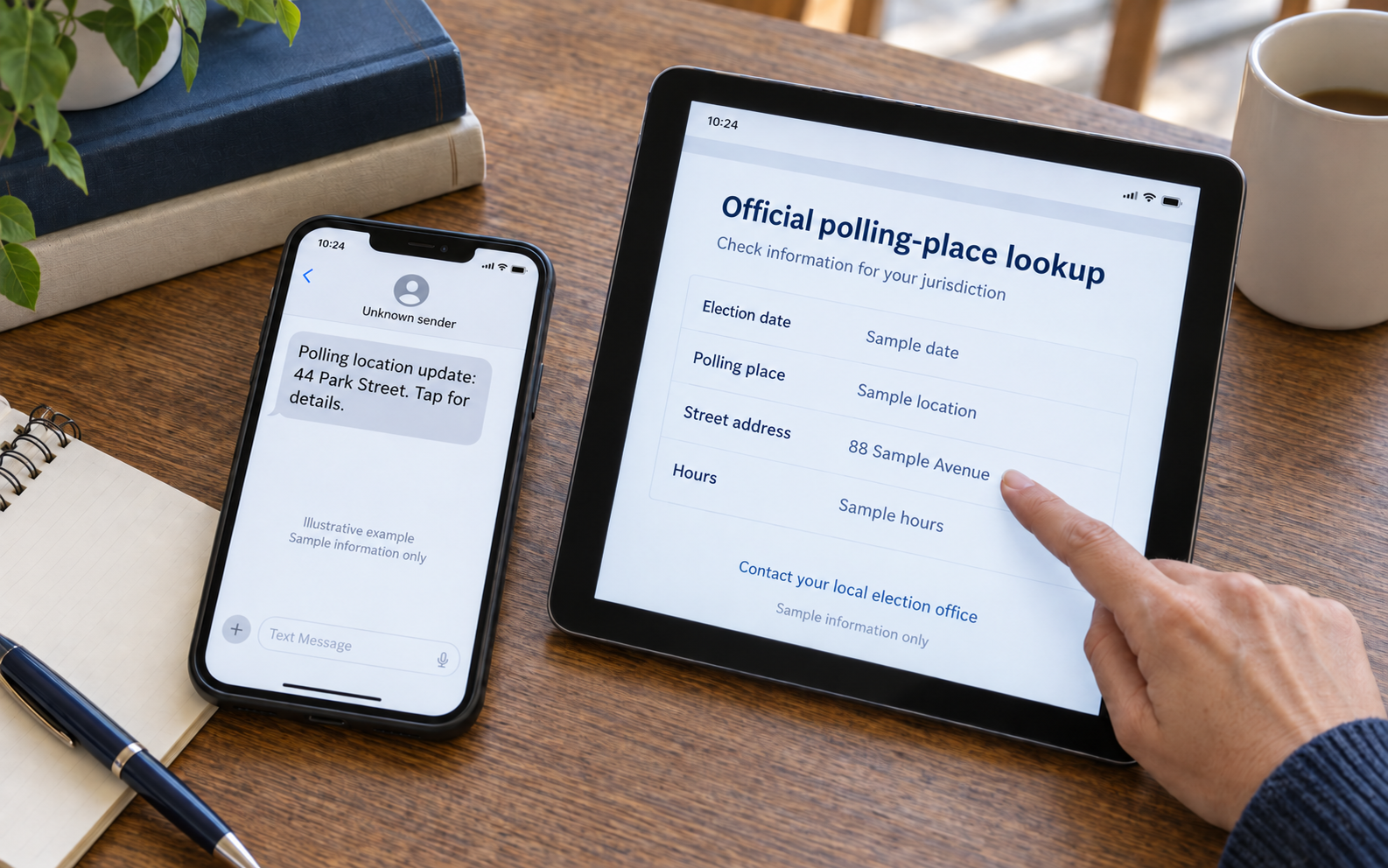
If the official lookup contradicts a text, use the official result and save the discrepancy. Contact the election office if timing permits, particularly when the message appears targeted to your area. If the text falsely says an election was canceled, gives a different day, claims your vote was already recorded, says you can vote by text, or tries to keep you from voting, preserve it for an election-interference report.
Election scams work best when one message supplies the warning, deadline, link, phone number, and supposed solution. Independent verification breaks that chain. Resolve the voting question through the responsible office before deciding what the sender intended.
How to Verify a Political Donation Request Before Paying
A political appeal may feature a real candidate and issue while sending money somewhere the reader did not intend. Donation-based election scams make the central question easy to miss: who receives the payment?
In a 2024 case, the Justice Department alleged that a fundraiser built dozens of campaign-like sites and routed contributions to a PAC rather than the candidates donors thought they were supporting. The scam-PAC case announcement notes that the charges were allegations and the defendant was presumed innocent unless proven guilty. For donors trying to avoid election scams, the lesson is that familiar branding does not identify the recipient.
Read the name at the bottom, not only the name at the top
Locate the full “Paid for by” or authorization statement and the legal name shown at checkout. The Federal Election Commission's fundraising guidance says a candidate campaign's public and online solicitations must carry an authorization and payment notice. An outside group may support a candidate without being candidate-authorized, so a different committee name is not automatically evidence of election scams. It does require you to decide whether that is the group you meant to support.
Leave the message and find the campaign or committee independently. For a federal fundraising appeal, use the FEC's candidate and committee search to match the legal name and committee ID. For an unfamiliar PAC, inspect filings and disbursements. The FBI describes scam PACs as operations that reroute contributions for personal gain, and its current election-crime guidance tells donors to research recipients. Registration confirms that a federal committee record exists. It does not certify candidate authorization or matching spending.
Read the payment screen as an agreement
Election scams can hide consequential terms at checkout. Before pressing the final button, check:
- The legal recipient, not only the candidate or cause named in the headline.
- The exact amount and processing date.
- Whether the contribution is one time or recurring, and how often it will repeat.
- Any optional tip, processing amount, or preselected choice.
- The cancellation or refund contact and the name that should appear on the statement.
- The page's full hostname and whether it matches the independently located organization.
Keep the confirmation and compare it with the first statement entry. A tax-deduction claim deserves another pause. The IRS lists political organizations and candidates among recipients whose payments are not deductible as charitable contributions in Publication 526.

How Election Scams Change Across Channels
Election scams change wording with the channel, but the sender still needs you to make a consequential decision before you verify it. A text may compress the decision into one tap. An email may imitate a receipt or registration notice. A social post may ask you to forward a supposed rule change before it disappears. A QR code may hide the destination until a phone previews it.
Voice-based election scams deserve the same independent check. A familiar voice can feel more persuasive than a strange link, but audio is not a secure identity test. The Election Assistance Commission's guidance on artificial intelligence explains that generated text, images, video, and audio can imitate election officials or other information sources. Do not spend the urgent moment trying to detect a synthetic artifact. Verify the underlying voting or donation claim through the responsible office or organization.
When election scams imitate election-office pages, inspect the complete hostname before entering personal information. A joint CISA and FBI guide to election-office impersonation describes how look-alike domains can be used to imitate voting sites. Do not guess a local office address. Start from a trusted federal directory or a bookmark you created from an independently verified official page.
What to Do Now, Before Another Message Arrives
Preparing for election scams reduces the power of an urgent message. Start by saving an independent route to voting information. The Election Assistance Commission's state directory leads to state and local resources for registration, polling information, and voting options. Bookmark the appropriate official page now, then use that bookmark when a message claims something changed.
A simple rule blocks many donation-based election scams: no unexpected political appeal gets paid inside the text, email, ad, call, or QR-code flow where it arrived. Leave, locate the organization independently, identify the recipient, and read the payment terms. This takes only a few minutes and works whether the solicitation is legitimate, misleading, or fraudulent.
Election scams can expose accounts as well as money, so protect the accounts that would matter after a mistake. Use distinct passwords for email, financial, and social accounts, and turn on multifactor authentication where available. Never give a caller or texter a one-time security code. The FBI's 2025 official-impersonation warning describes attackers using texts and AI-generated voice messages to build trust, move targets to another platform, and seek access to accounts or funds.
For family or neighbors, agree on one plain rule: “Send the verified source, not the warning.” That lets people help each other without spreading an unconfirmed polling-place claim or donation link. For more practical cyber and AI guidance, subscribe to Quantum Cyber AI.
If You Already Clicked, Paid, Replied, or Shared
Recovery begins with identifying what happened and what the election scams exposed. Do not spend time blaming yourself.
If you clicked but entered nothing
Some incidents end after a click, while other election scams try to continue the interaction. Close the page. Do not download a file, install an app, accept notification permissions, or continue chatting with someone who appears on the site. Update the device and browser. If something downloaded or installed, run an updated security scan and remove anything it identifies. Our scam-link recovery guide gives the fuller sequence without requiring you to revisit the suspicious page.
If you entered a password or security code
When a message exposes a password or security code, the people behind election scams may try to reach the real account. Open it through its saved app or a newly typed address. Change the exposed password immediately and change it anywhere you reused it. Turn on multifactor authentication, review recent sign-ins and recovery methods, and sign out unfamiliar sessions if the provider offers those controls. Contact the provider through its official support route if you cannot regain access. Do not approve an unexpected login prompt or share another one-time code with someone claiming to help.
If you shared identity information
A fraudulent page used in election scams may collect different kinds of identity information, so the response should match what you disclosed. If the information could support identity misuse, IdentityTheft.gov can create a personal recovery plan. Our Identity Theft Response Checklist can help you keep the account, credit, and documentation steps organized. A name or phone number alone calls for vigilance. A Social Security number, financial account details, identification document, or account credentials calls for a broader response.
If you paid or exposed payment details
Payment-focused election scams require quick action through an independently reached channel. The FTC's payment-specific recovery guidance tells consumers to contact the card issuer, bank, payment app, wire service, gift-card issuer, or cryptocurrency operator, depending on how the money moved, and ask whether the transaction can be reversed or refunded. The guidance does not promise recovery, but waiting reduces the available options. Replace compromised card or account credentials when the financial institution directs you to do so.
If a political contribution became recurring, first determine whether you originally authorized recurrence. Preserve the receipt and statements. For automatic withdrawals from a bank account, the Consumer Financial Protection Bureau's cancellation guidance says to revoke authorization with both the company and the bank or credit union, preferably in writing, and ask whether a stop-payment order is appropriate. Report any later debit promptly. For a card charge, use the issuer's number on the card or its verified app.
If you shared false voting information
If an election scam caused you to share false voting information, verify the claim first. When practical, correct the post or message with the official source rather than forwarding the questionable item again. Preserve a screenshot, sender details, full destination, date and time, displayed organization name, receipt or transaction record, and the actions you already took. Evidence helps an election office, platform, financial institution, or law-enforcement reviewer understand what happened without asking you to keep interacting with the sender.
Where to Report Election Scams
Report election scams according to the conduct and harm. Choose the reporting route that fits what happened:
- Report false polling-place, deadline, registration, eligibility, or voting-method information to the state or local election office. The EAC's national election reporting directory also lists federal routes for misinformation, intimidation, and voting-rights concerns.
- Report voting intimidation or suppression to the Justice Department Civil Rights Division or call 800-253-3931. Call 911 first if someone is in immediate danger.
- Report suspected online voter suppression or an election-related cybercrime through the real FBI Internet Crime Complaint Center or FBI tip portal. Type the address directly instead of searching for it.
- Report financial fraud or impersonation through the FTC's fraud reporting system and contact the payment company or financial institution immediately.
- Report an unwanted scam text with the phone's report-junk control or forward it to 7726. Add an election-office or federal report when the content tries to interfere with voting.
- Use the FEC complaint process for a suspected violation of federal campaign-finance law. State and local races may fall under a state agency instead.
One incident may need more than one report. A false registration text that also captured a card number belongs with the election office and the appropriate voting-rights channel, as well as the financial institution and fraud-reporting system.
Conclusion
The safest response to election scams starts the same way whether the message concerns a polling-place change, an urgent donation appeal, or a registration warning. Identify the action being requested. Leave the message. Reach the office, organization, or financial account through a route you found independently. Compare the exact claim, recipient, domain, amount, and payment terms.
That routine works even when election scams use a convincing voice, accurate personal details, professional graphics, or a familiar political name. You do not have to diagnose the technology or prove criminal intent before protecting yourself. You only need to pause long enough to put the right question in front of the source that can answer it.
FAQ
How can I tell whether a voting text is official?
Do not try to authenticate it from the sender name, number, logo, or writing style alone. Leave the text and open the state or local election source through an independent route. Compare the exact claim about registration, location, date, hours, or voting method. If anything conflicts, call the election office using contact information from its official page. Some offices send legitimate texts, but their practices differ, so there is no reliable national list of sender numbers.
Where should I check my polling place or voting deadline?
Start with the Election Assistance Commission's state directory, then follow its link to the relevant state or local election source. Use the jurisdiction that administers your election and confirm which election the displayed information covers. Do not use a link from the message that raised the question.
How can I verify a political donation link?
Decide which entity you intend to support, then find it independently. For a federal committee, compare its legal name and committee ID with FEC records. Read the solicitation disclaimer, destination hostname, checkout recipient, amount, recurrence setting, and receipt details. No single check guarantees safety. Together, those comparisons can reveal that the page sends money somewhere other than the donor intended.
What should I do if a political donation became recurring?
Review the original confirmation and statements to see what was authorized. Cancel through the recipient or processor reached independently, and keep a record of the request. If withdrawals come directly from a bank account, notify both the organization and bank or credit union that authorization is revoked. Ask the bank whether a stop-payment order is appropriate, and dispute later unauthorized debits promptly.
Can an AI-generated voice or video prove that a candidate approved a message?
No. Appearance and sound are not reliable proof of origin. A real clip can also be placed beside a false link or instruction. Verify the consequential claim through the appropriate election office, campaign, committee, or account using a separate contact route. The task is to confirm the request, not to win a deepfake-spotting contest.
Where should I report false election information or an election-themed scam?
Report election scams involving voting logistics or suppression to the election office and the appropriate federal voting-rights channel. Report financial fraud to the FTC and the company that moved the money. Report suspected cybercrime to the FBI's real IC3 or tip site. Report federal campaign-finance issues to the FEC. If there is an immediate threat, call 911. Preserve the message and transaction evidence before deleting it.