
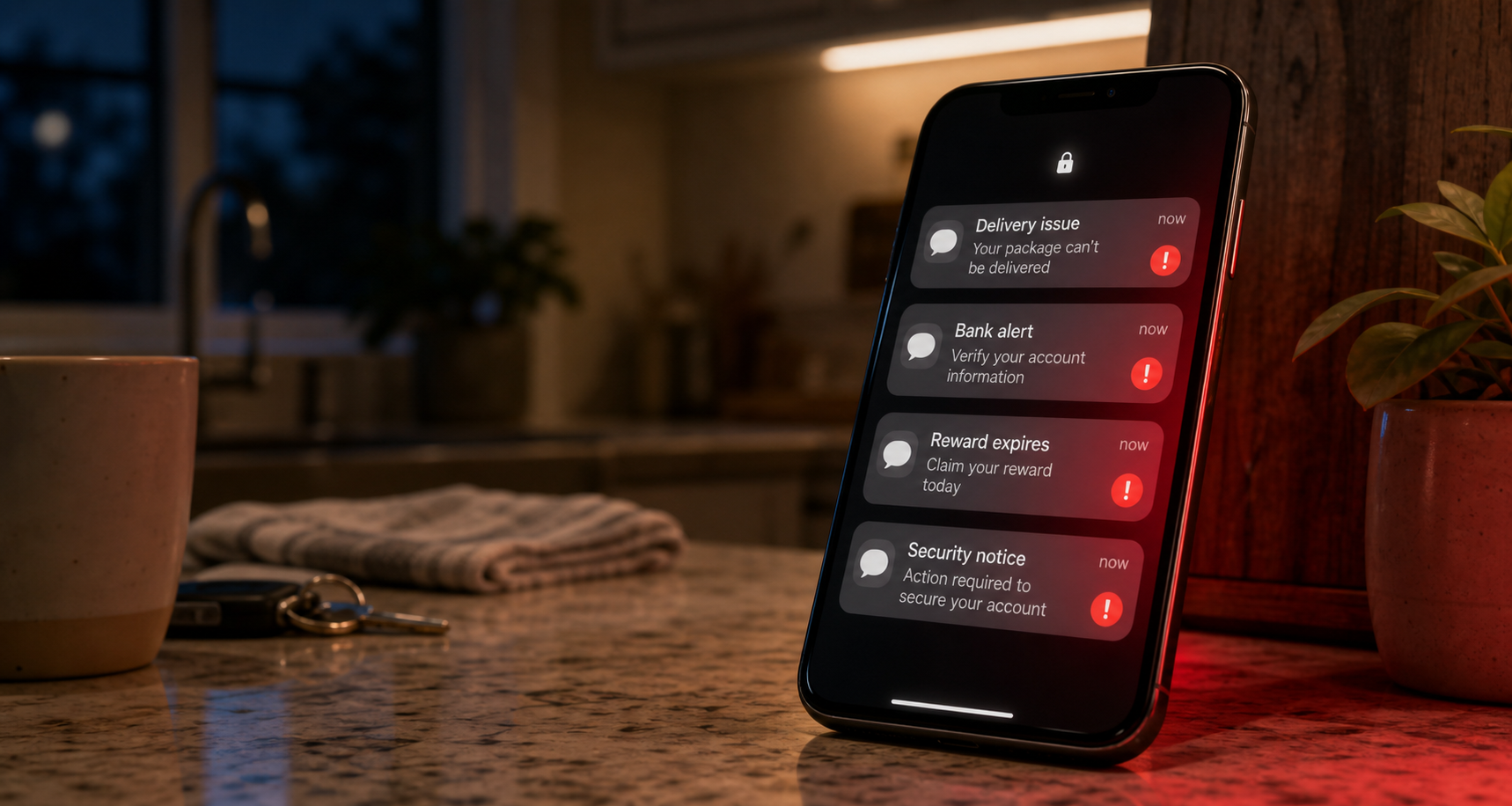
The dangerous thing about AI text scams is not that every message looks like a spy thriller. It is that the message looks normal. A package is delayed. A toll is unpaid. A bank account needs verification. A mobile carrier says your reward points are about to expire. A brokerage account supposedly needs attention. That boring little buzz on your phone can now be part of a larger AI text scams ecosystem built to move faster than your suspicion.
Smishing, the text-message version of phishing, uses SMS or similar messaging channels to push people into clicking links, replying, calling phone numbers, or entering sensitive information on fraudulent sites, according to a 2026 systematic review of SMS phishing research. What has changed is the scale and polish. Recent reporting says Google sued an alleged scam network called Outsider after the company said the group used AI-generated code and phishing templates to impersonate mobile phone companies and brokerage services in Wall Street Journal reporting on AI-assisted text scams.
This matters because AI text scams no longer have to look sloppy to be dangerous. The FBI’s Internet Crime Complaint Center reported 859,532 complaints and $16.6 billion in reported losses in 2024 in the FBI IC3 2024 Internet Crime Report. The same report listed phishing and spoofing as the top complaint category by count, with 193,407 complaints in 2024 in the FBI IC3 2024 Internet Crime Report. AI text scams sit inside that larger fraud environment, and they are becoming one of the most direct ways criminals reach ordinary people.
At Quantum Cyber AI, we have covered how AI is changing cybercrime in broader terms in AI Cybercrime: 7 Alarming Ways It Fuels Dangerous Scams. This article narrows the lens to the phone in your hand. The goal is simple: help you spot AI text scams before a fake link turns into a stolen card number, a drained account, or an identity-theft cleanup project.
Key Takeaways
- AI text scams work because they look ordinary. A fake package alert, toll warning, carrier reward, bank notice, or brokerage message can feel routine enough to bypass your suspicion.
- The biggest red flag is urgency. Any unexpected text that demands fast action through its own link deserves skepticism.
- Relevance is not proof. A scam can mention a service you actually use because the topic is common or because your contact data has already circulated.
- Do not use links from unexpected texts. Open the official app, type the known website yourself, or call a trusted number.
- Design polish is not proof. AI and phishing kits can make fake pages look professional.
- Report suspicious texts when possible. Reporting helps carriers, platforms, brands, and law enforcement connect individual messages to larger campaigns.
Why AI Text Scams Are Suddenly Harder to Spot
Older scam texts often gave themselves away. They used strange grammar, awkward brand names, obvious typos, or links that looked nothing like the company they claimed to represent. Those clues still matter, but they are less reliable now. AI text scams can be rewritten in smoother language, adapted to different brands, and paired with fake websites that look more polished than the phishing pages many people learned to avoid.
The Wall Street Journal reported that the alleged Outsider operation used AI-assisted coding to create fake websites and messages designed to impersonate mobile phone companies and brokerage services in Wall Street Journal reporting on AI-assisted text scams. The same report said the FBI attributed an estimated 3.87 million stolen credit card numbers and $1.9 billion in losses since July 2023 to that campaign in Wall Street Journal reporting on AI-assisted text scams.
That is the real shift. AI text scams do not need to be creative in the way a movie villain is creative. They need to be cheap to produce, easy to vary, and credible enough that a small percentage of recipients tap before thinking.
A 2022 smishing experiment with 265 users found that 16.92 percent of participants potentially fell for simulated smishing attacks in a 2022 smishing experiment. A 2025 study analyzing 1.35 million user-submitted mobile network reports found that text messages made up 89.16 percent of reports in the dataset and that 40.27 percent of the unique text messages identified were scam texts in a 2025 study of mobile network scam reports. That makes AI text scams a practical household risk, not just a security-industry talking point.
This is why AI text scams deserve their own mental checklist. The old advice, “look for typos,” is not enough. The better habit is to treat unexpected texts as untrusted prompts. The message may be useful, but it does not get to choose the channel where you verify it.
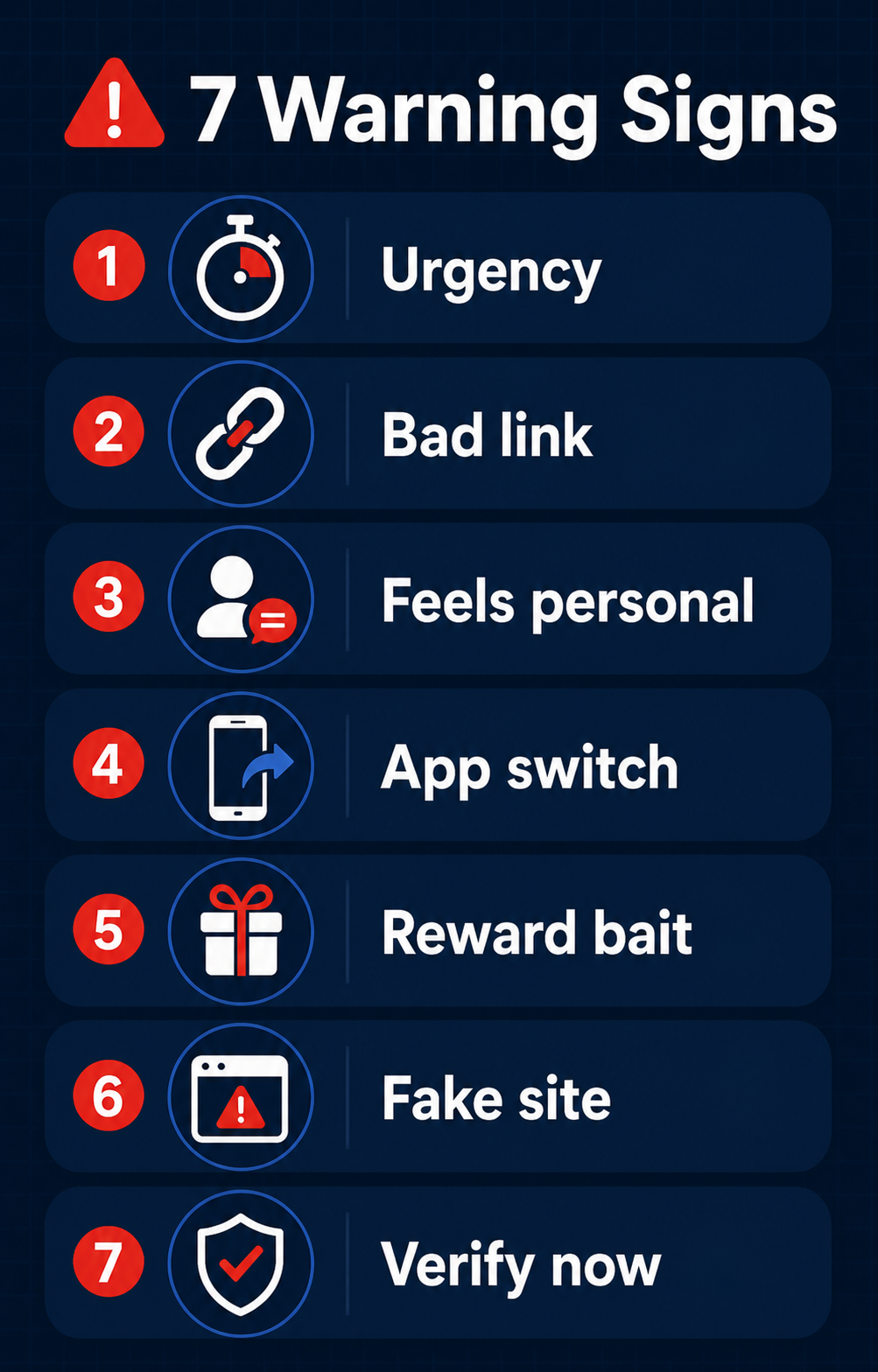
Warning Sign 1: The Message Creates a Tiny Deadline
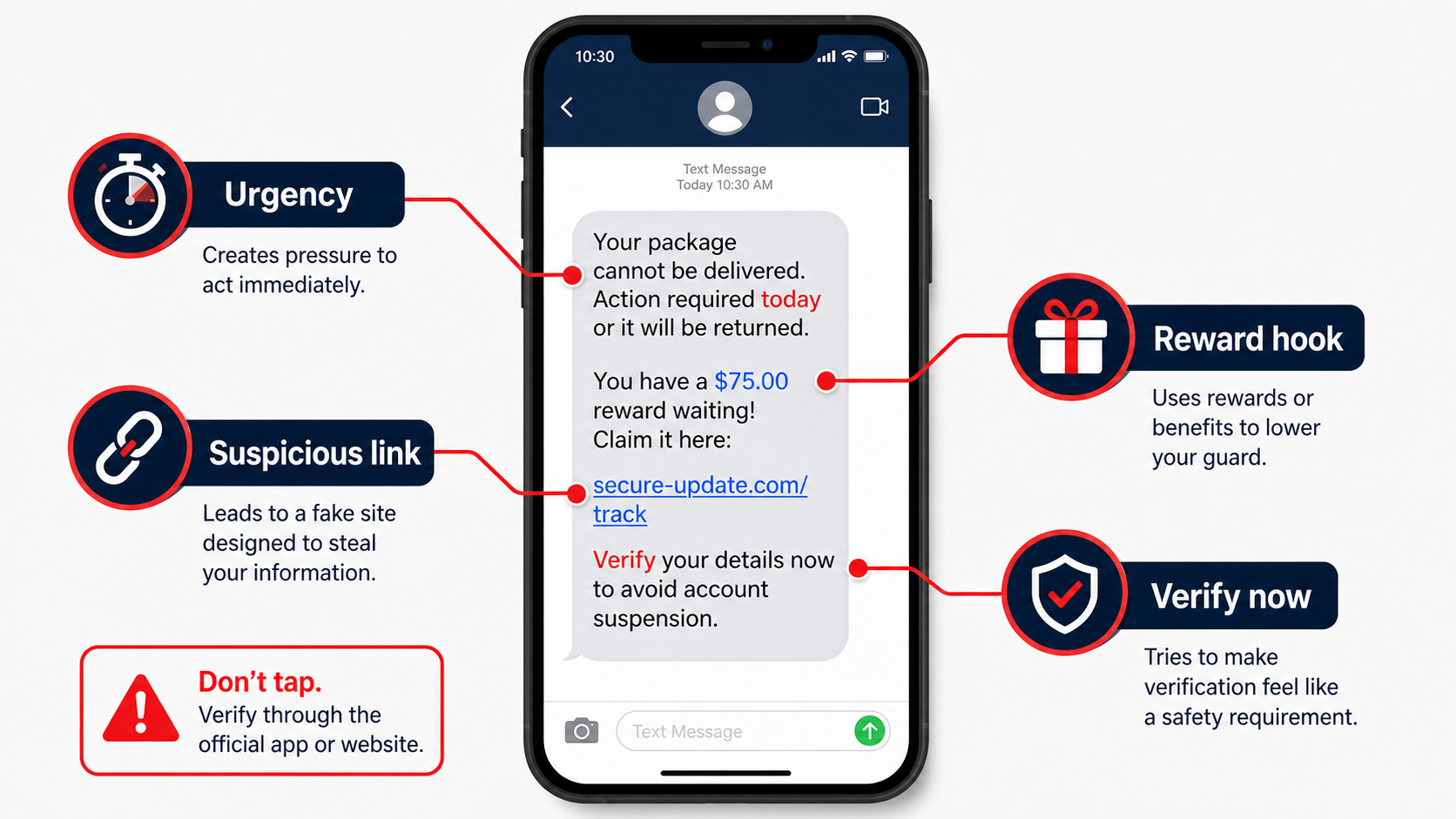
The first warning sign is pressure. AI text scams often create a tiny deadline because urgency makes people act before they verify. The message may say your reward points expire today, your package cannot be delivered, your toll balance will trigger a penalty, or your account will be locked unless you confirm information.
This pattern is not accidental. Smishing attacks are designed to make users interact with attacker-controlled links, replies, or phone numbers, according to the 2026 SMS phishing review. The pressure is the bridge between seeing the message and taking the action the attacker wants.
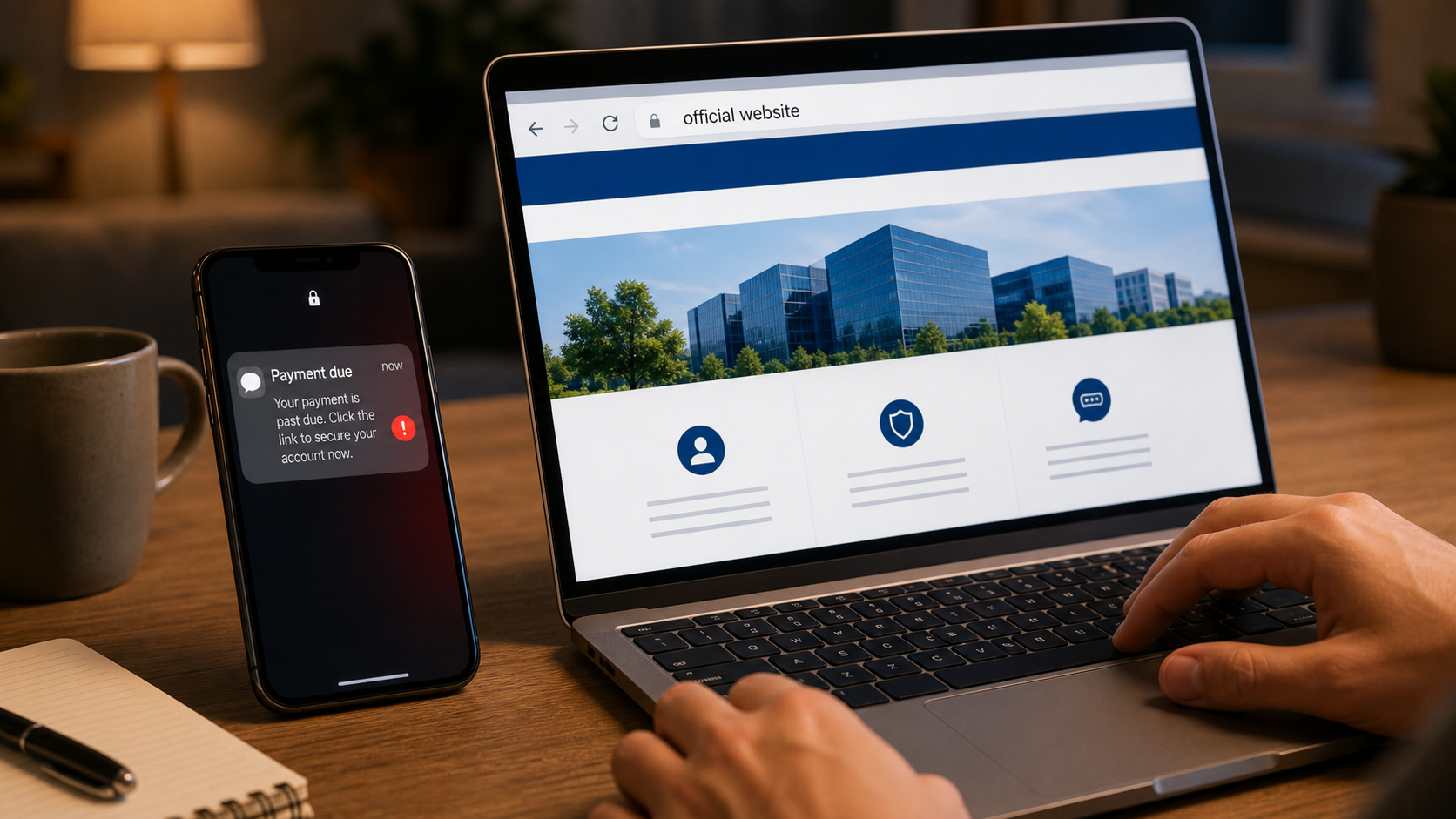
The best defense against AI text scams is to separate the alert from the action. If a text says your bank account is locked, do not tap the link in the text. Open the bank app yourself. If a text says your phone carrier reward expires, open the carrier app yourself. If a text says you owe a toll, visit the toll agency website by typing the address or using a saved bookmark.
AI text scams use speed against you. Your response should be friction. Wait. Verify somewhere else. Make the scam prove itself outside the message that asked for your trust.
Warning Sign 2: The Link Looks Close Enough to Trust
The second warning sign in AI text scams is a link that looks almost right. On a phone, a fraudulent URL can be hard to inspect because the screen is small and the browser may hide parts of the address. Attackers can use brand-adjacent words, extra subdomains, shortened links, or confusing punctuation to make a fake site feel familiar.
Package scams are a clear example. USPS and the U.S. Postal Inspection Service warn that USPS does not send customers package-tracking texts or emails unless the customer first initiated tracking with a tracking number, and those messages do not contain tracking links in USPS smishing guidance reported by Time. That is a beautifully simple consumer rule: if you did not request the tracking message and it contains a link, do not click it.
Toll scams show the same pattern. The Associated Press reported that road-toll smishing scams impersonated toll agencies, and that Palo Alto Networks found more than 10,000 domains registered for such scams across multiple U.S. states and Ontario in an Associated Press report on road-toll smishing scams. A fake toll text works because the dollar amount is usually small enough to feel easier to pay than investigate.
AI text scams benefit from that tiny calculation. A $4.80 fee looks harmless until the payment page is designed to steal the card. A delivery update looks harmless until the page asks for your name, address, phone number, email, and card details. The link is the trap door.
The safer habit is blunt: do not use links from unexpected texts. Use the official app, a saved bookmark, or a search result you inspect carefully. If the issue is real, it will still exist when you arrive through the legitimate channel.
Warning Sign 3: The Text Pretends to Know Your Life
The third warning sign in AI text scams is relevance. AI text scams often feel convincing because they attach themselves to things that are statistically common: deliveries, toll roads, banks, mobile carriers, credit cards, streaming subscriptions, taxes, student loans, and investment accounts.
That does not mean the scammer knows you. It means the topic is common enough that many people will see themselves in it. The Wall Street Journal reported that recent scam themes included mobile-phone reward points and brokerage account warnings in Wall Street Journal reporting on AI-assisted text scams. Those themes work because they feel specific without needing deep personalization.
This is also where your existing data exposure matters. Phone numbers, email addresses, names, home addresses, and account clues often circulate after breaches and data broker exposure. We have covered the broader phone and privacy side of that problem in Mobile Data Privacy Risks: 7 Shocking Facts You Did Not Know. AI text scams can use that messy data environment to sound less random.
The practical rule is simple: relevance is not proof. A scam text can mention a service you actually use. It can arrive right after you ordered something. It can guess correctly that you have a toll pass, a bank, a phone carrier, or a brokerage app. Treat the match as a reason to verify, not a reason to trust.
Warning Sign 4: It Asks You to Move Outside the Normal App
The fourth warning sign in AI text scams is channel switching. A real company usually has an official app, a secure account portal, or a known customer-service process. AI text scams try to pull you away from those channels and into the scammer’s environment.
This is why the suspicious text often includes a link, a phone number, or an instruction to reply. The attacker does not want you opening the real app. The attacker wants you on the fake page, the spoofed phone call, or the attacker-controlled conversation.
The FBI’s common fraud guidance tells consumers to be cautious of unsolicited messages and to avoid sending money or personal information to unknown contacts in the FBI’s common fraud guidance. That advice applies cleanly to AI text scams. If the message starts the conversation, the message should not control the verification path.
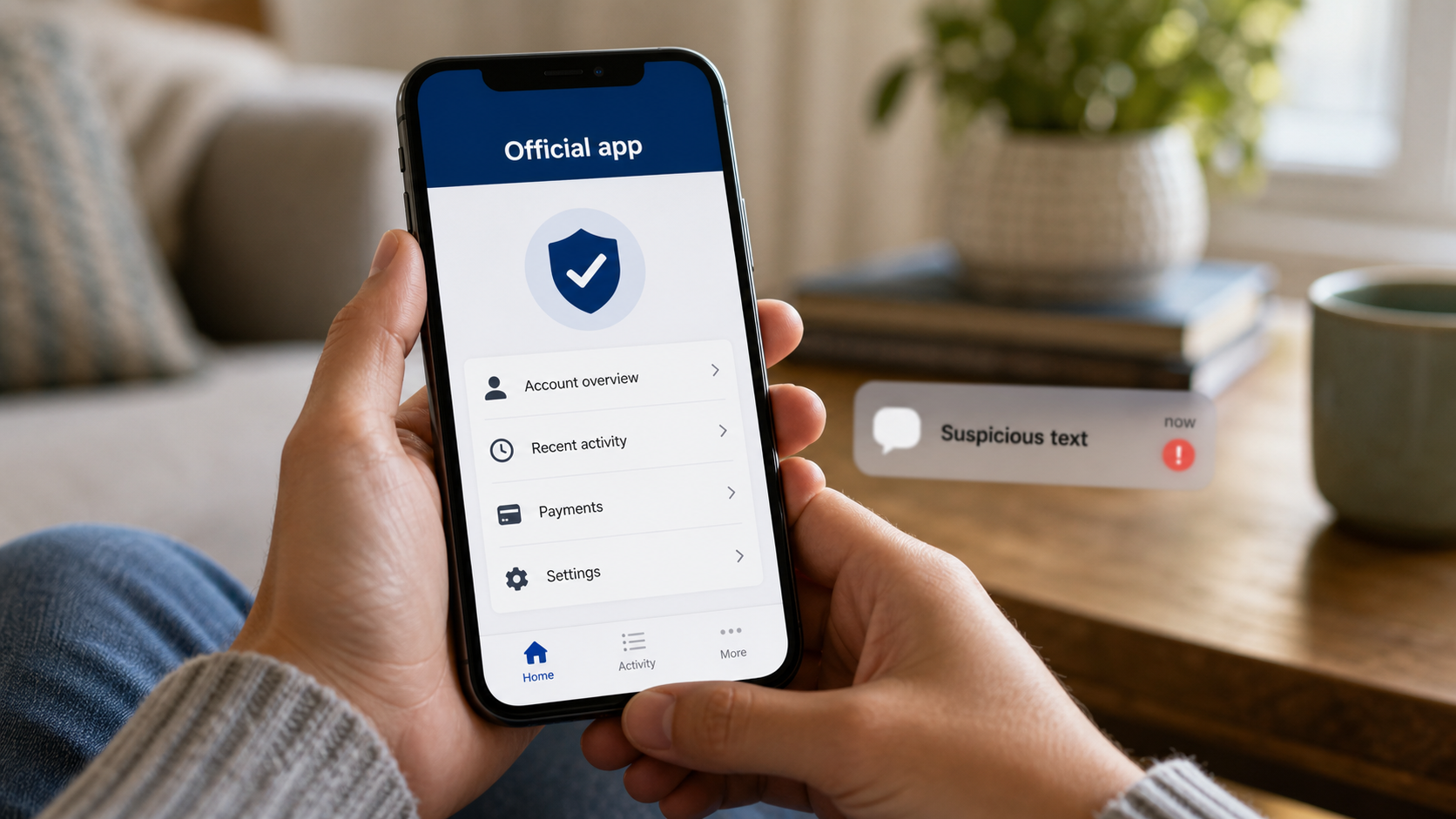
Think of it this way: a legitimate alert can notify you, but it should not force you to trust its link. Open the account yourself. Use the phone number printed on the back of your card. Use the official app you already installed. If the text claims to be from a delivery service, go to the delivery service directly. If the text claims to be from a government agency, go to the agency site directly.
The rule is not “ignore every alert.” The rule is “never let an unexpected alert choose the doorway.”
Warning Sign 5: It Uses Rewards, Refunds, or Fees to Lower Your Guard
The fifth warning sign in AI text scams is emotional framing. AI text scams often rely on one of three hooks: gain, loss, or convenience.
The gain hook promises a reward, refund, credit, prize, free device, or loyalty benefit. The loss hook threatens a fee, penalty, locked account, missed package, or suspended service. The convenience hook says the fix is easy if you just confirm, verify, update, or pay.
Those hooks are powerful because they make the action feel small. A fake reward page may ask for a card to cover shipping. A fake toll text may ask for a few dollars. A fake delivery text may ask for an address correction. A fake account-warning text may ask for a login.
The FBI’s IC3 2024 report shows why small acts of trust add up inside a larger fraud economy. IC3 reported $16.6 billion in losses in 2024 in the FBI IC3 2024 Internet Crime Report. The same report listed personal data breach losses at more than $1.45 billion and investment losses at more than $6.57 billion in the FBI IC3 2024 Internet Crime Report. A scam text may be the first step into a much larger loss category.
AI text scams are especially dangerous here because AI can help generate endless versions of these hooks. One person gets a carrier reward. Another gets a fake package fee. Another gets a brokerage warning. Another gets a tax refund prompt. The scammer is testing which emotional lever gets a response.
When a text offers money or threatens a fee, slow down. Real refunds do not usually require panic. Real fees can be checked in the official app. Real rewards do not need your card number through a surprise link.
Warning Sign 6: The Site Looks Polished but Feels Slightly Off
The sixth warning sign in AI text scams appears after the click, which is already farther than you want to go. The fake site may look polished. It may use familiar colors, logos, button styles, support language, and form fields. That does not make it legitimate.
Recent reporting said AI-assisted coding helped the alleged Outsider operation create phishing pages that impersonated mobile carriers and other services in Wall Street Journal reporting on AI-assisted text scams. That is the consumer lesson: design polish is no longer a reliable trust signal.
Look for behavior, not beauty. Does the page ask for too much information? Does it request a full card number for a tiny fee? Does it ask for a password before you have navigated there through the real app? Does the URL fail to match the actual company domain? Does the page keep pushing urgency? Does it hide ordinary navigation, legal pages, or support details?
AI text scams often pair a clean message with a clean-looking site. That combination is meant to defeat the old instinct that scams look ugly. The better question is not “Does this site look professional?” The better question is “Did I arrive here through a channel I trust?”
If the answer is no, leave.
Warning Sign 7: It Turns Verification Into Your Job
The seventh warning sign in AI text scams is the language of safety. Many AI text scams use defensive words: verify, secure, protect, unlock, restore, confirm, prevent, review. The message sounds like it is helping you avoid risk. In reality, it is assigning you a task inside the attack.
This is one of the reasons AI text scams are so effective. They do not always ask you to do something obviously reckless. They ask you to behave like a responsible account holder. They tell you the safe thing is to click, confirm, and fix the problem.
The FTC warns in the related context of AI-enhanced family emergency scams that people should verify through a known contact method before sending money in an FTC consumer alert on AI-enhanced emergency scams. The same verification principle applies to text scams. The suspicious message does not get to define what verification means.
Real verification happens through a known channel. It does not happen through the link that arrived in the suspicious text. It does not happen through the phone number the suspicious text provided. It does not happen because the page has a logo.
If a message says “verify your account,” translate that into “open the official app.” If a message says “secure your card,” translate that into “call the number on the card.” If a message says “confirm delivery,” translate that into “go to the delivery service directly.”
What to Do Before You Tap, Reply, or Pay
The best response to AI text scams is a repeatable routine. You do not need to become a malware analyst. You need a few habits that work even when the message looks convincing. The point is to make AI text scams pass through a slower, safer decision process than the one attackers designed.
First, pause. The scam is trying to compress your decision. Give yourself time.
Second, do not reply. Even a reply that says “STOP” can confirm that your number is active to a sender you do not trust. For legitimate marketing messages, STOP has a place. For suspicious texts, reporting and blocking are safer.
Third, do not click the link. USPS guidance says unexpected package texts with links are not legitimate USPS tracking messages when the customer did not initiate tracking, and USPS advises reporting smishing attempts in USPS smishing guidance reported by Time.
Fourth, verify through the official app or website. If the alert is real, the issue should appear in your account.
Fifth, call a known number if money or account access is involved. For banks and cards, use the number printed on the card or in the official app.
Sixth, report the text. USPS advises reporting smishing texts to [email protected] and forwarding suspicious texts to 7726 in USPS smishing guidance reported by Time. The FBI encourages victims of internet-enabled crime to report to IC3, and its report describes IC3 as the public reporting portal for suspected cyber-enabled crime in the FBI IC3 2024 Internet Crime Report.
Seventh, block the sender after reporting. Blocking alone will not stop every campaign, but it reduces repeat contact from that number and gives you a clean end point.
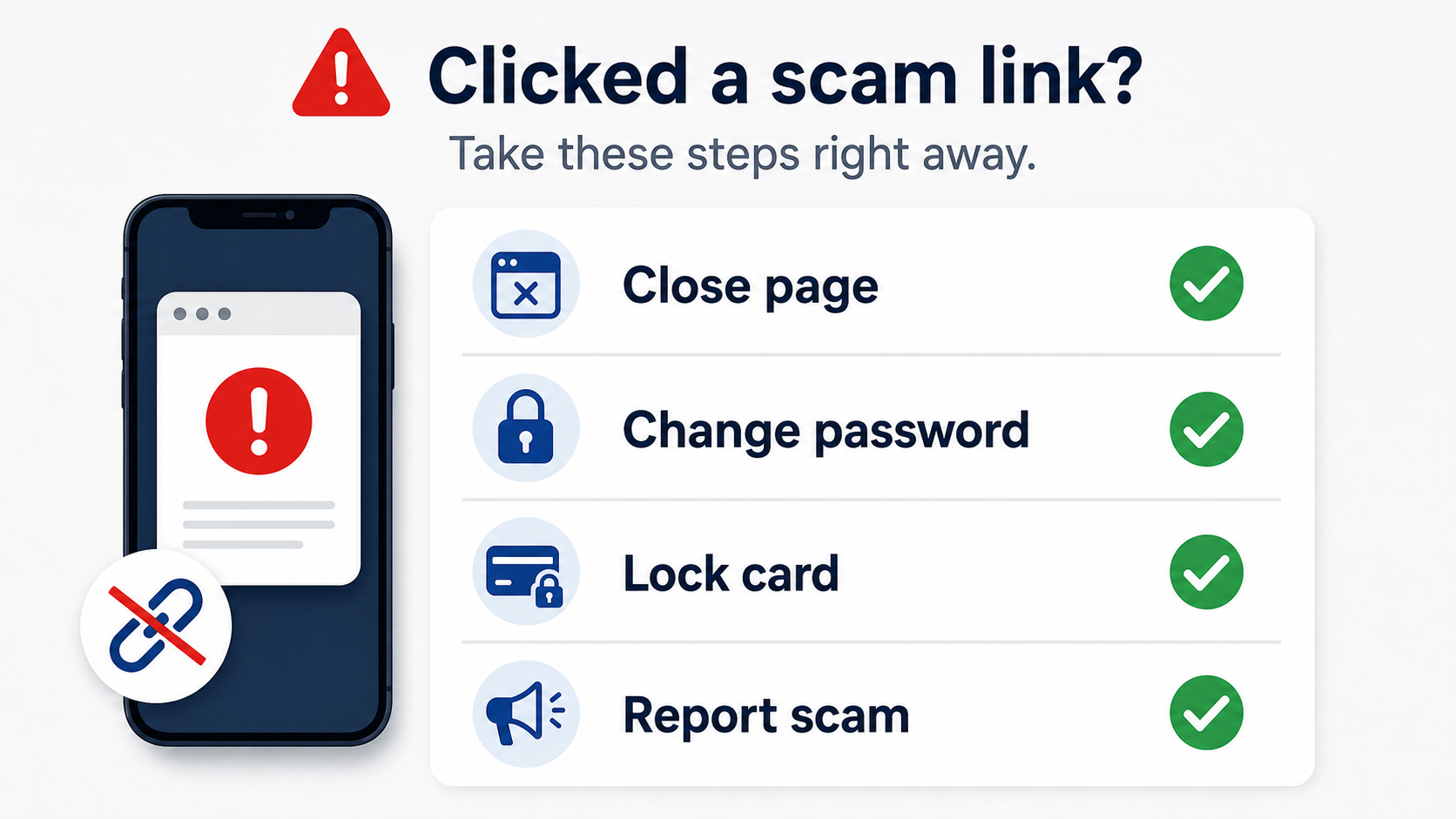
What to Do If You Already Clicked
If you clicked an AI text scams link but did not enter information, close the page. Do not keep exploring it. If you downloaded a file or installed an app, remove it and run a security scan from a reputable mobile security tool or the device’s built-in protections.
If you entered a password, change that password immediately from the official app or website, not from the text link. If you reused the same password elsewhere, change it on those accounts too. Turn on multi-factor authentication where available. If multi-factor authentication was already enabled and you entered a one-time code into the fake site, assume the attacker may have tried to use it in real time.
If you entered a card number, contact the card issuer immediately through the number on the card or the official app. Ask about locking or replacing the card, reversing fraudulent charges, and monitoring for attempted transactions.
If you entered Social Security number, date of birth, address, or other identity information, consider a credit freeze with the major credit bureaus and monitor financial accounts. The FBI’s IC3 report shows identity theft and personal data breach are tracked complaint categories in the FBI IC3 2024 Internet Crime Report, which is a reminder that stolen data can be reused beyond the first scam.
If money moved, report quickly. IC3 describes its Recovery Asset Team as a mechanism that works with financial institutions in some fraud cases, and fast reporting can matter when a transfer is still traceable in the FBI IC3 2024 Internet Crime Report. You should also report to the impersonated company, your bank, the FTC, and any relevant state consumer-protection office.
For a broader recovery checklist after a suspected AI-assisted compromise, see AI Hacking Recovery: 6 Powerful Steps to Avoid Disaster. The important thing is not embarrassment. The important thing is speed.
Conclusion
AI text scams are dangerous because they turn ordinary phone alerts into attacker-controlled decisions. The safest habit is to separate the message from the action: do not let a text choose the link, phone number, or payment page you use to verify a problem.
Use the official app, a typed website, or a known phone number whenever money, passwords, identity information, or account access is involved. If you already clicked or entered information, act quickly, document what happened, and move through trusted recovery channels.
Want more practical AI and cybersecurity guidance for everyday digital risks? Subscribe here
FAQ
Are AI text scams different from normal phishing texts?
Yes, but mostly in scale and polish. The basic crime is still text-message phishing, also called smishing, which tricks people into interacting with malicious messages or links, according to the SMS phishing review. AI can make those messages cleaner, more varied, and easier to pair with fake websites.
Can I safely reply STOP to a suspicious text?
For a legitimate marketing text from a company you recognize, STOP may unsubscribe you. For a suspicious text, replying can confirm your number is active. A safer approach is to avoid replying, report the message, and block the sender after reporting.
What should I do if I entered my card number?
Contact your card issuer immediately through the official app or the number on the back of the card. Ask whether to lock or replace the card, dispute charges, and monitor for fraud. If the scam also captured passwords or identity information, change passwords and consider additional identity-protection steps.
How can I tell if a USPS or delivery text is real?
USPS guidance says USPS does not send customers package-tracking texts or emails unless the customer first requested tracking with a tracking number, and those messages do not contain links in USPS smishing guidance reported by Time. If you did not request the tracking message and it contains a link, treat it as suspicious.
Should I report AI text scams?
Yes. USPS advises forwarding suspicious texts to 7726 and reporting USPS-themed smishing to [email protected] in USPS smishing guidance reported by Time. The FBI's IC3 receives reports of suspected internet-enabled crime in the FBI IC3 2024 Internet Crime Report.