
In 2023, ransomware affected at least 141 U.S. hospitals across 46 hospital systems, according to Emsisoft’s tracking. The following year’s Change Healthcare attack disrupted claims and payments, creating severe cash-flow pressure. At Ascension, nurses reported medication near-misses and difficulty carrying out normal safety checks during an outage. These incidents expose a gap between the safeguards hospitals are expected to maintain and the care continuity patients need.
Hospital cybersecurity is no longer just a back-office concern; it has become an urgent public health issue. In the 2024 Ponemon Institute survey sponsored by Proofpoint, 648 U.S. healthcare IT and security practitioners were surveyed; respondents reported cyberattacks at 92% of their organizations in the previous 12 months, compared with 88% in the 2023 survey. That is a survey result, not a census of every healthcare organization. The incidents and research examined below show why the concern extends beyond stolen data to interrupted treatment and patient safety.
This post explores the structural failures behind the ongoing crisis in hospital cybersecurity. Drawing on recent breaches, expert data, and real-world hospital impacts, we’ll break down what’s gone wrong, what the consequences have been, and what actionable steps hospitals, policymakers, and the public must now take. Each section will address a distinct part of the problem, ranging from ransomware attacks on hospitals and healthcare data breaches to medical device vulnerabilities and systemic failures in hospital network security.
Key Takeaways
- Hospital cybersecurity is a patient-safety issue. Disrupted records, results and medication workflows can interfere with care, even when an individual hospital’s own network has not been compromised.
- Shared-service failures can reach hospitals whose own networks remain intact. The Change Healthcare disruption affected payments and care at responding hospitals.
- Patient-safety studies raise serious concerns. Breaches and regional ransomware disruption have been associated with worse outcomes; observational evidence leaves important causal questions unresolved.
- Device and vendor risks need practical controls. Segmentation, clinically safe maintenance, access controls and tested continuity plans should reflect each system’s exposure and importance to care.
- Existing law is not the same as dependable resilience. HIPAA already imposes security duties, including on business associates. Stronger implementation, accountability and support remain legitimate policy demands.
- AI-assisted deception adds pressure. The NCSC’s January 2024 assessment warned of more effective social engineering and lower barriers to some attacks.

Before we can address the solutions, we need to understand just how widespread and systemic the hospital cybersecurity crisis has become.
Why Hospital Cybersecurity Is a Growing Crisis
The Alarming Surge in Attacks
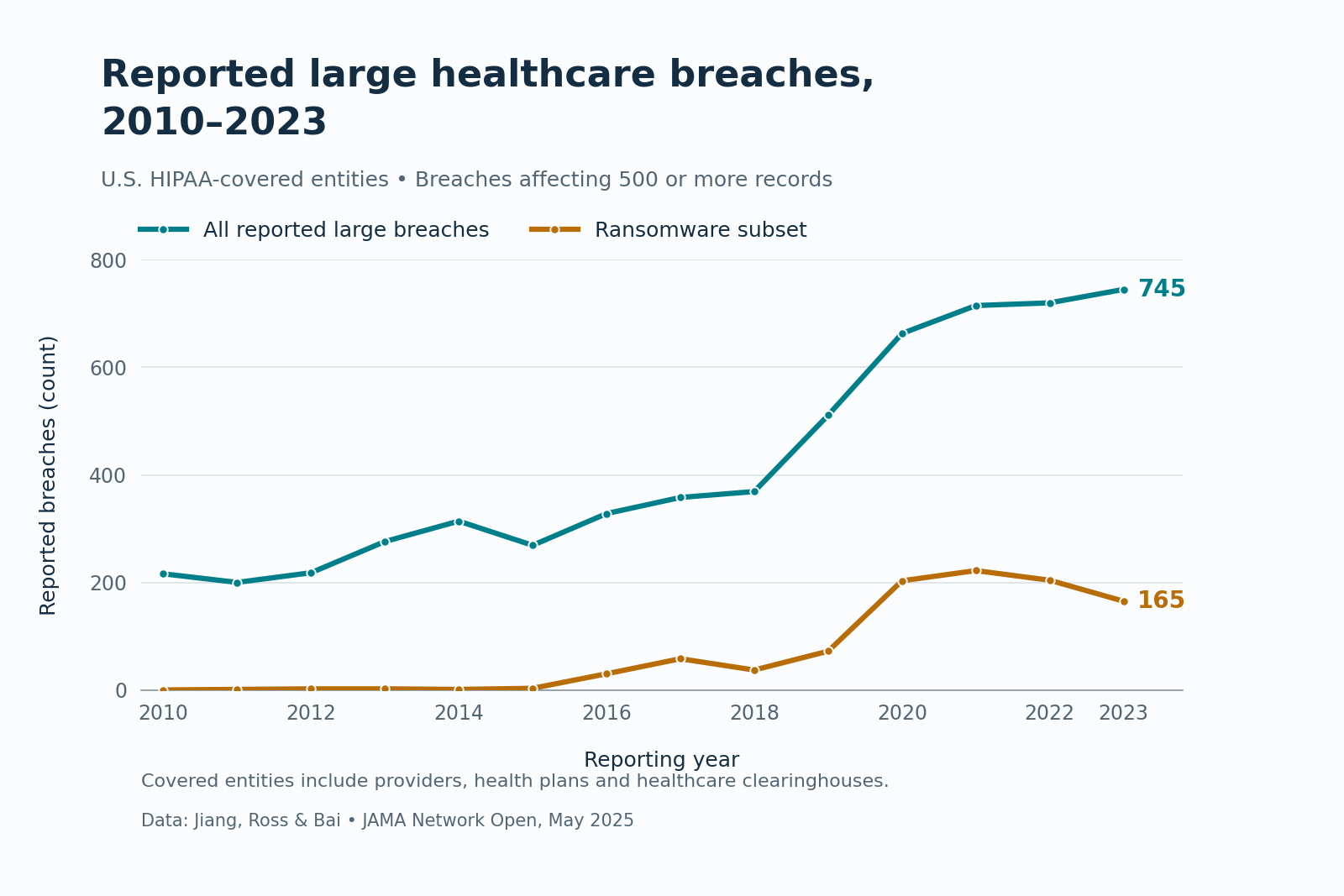
Hospital cybersecurity has reached a tipping point. A study published in May 2025 identified ransomware in 165 of 745 large healthcare data breaches reported for 2023—22% of that year’s total in its dataset. The study covered reported breaches affecting at least 500 individuals across HIPAA-covered entities, not every hospital cyber incident. Even with that distinction, the figures show that ransomware is a substantial part of the healthcare data-breach problem.
The threat is not limited to stolen records. The cases below show how unavailable electronic records, imaging, pharmacy, claims and scheduling systems can interrupt care delivery and payment. Treating ransomware attacks on hospitals solely as a confidentiality problem misses that operational dependence. Restoring a server is important, but so is making sure a clinician can obtain a result, verify a medication order and continue treatment while the server is unavailable.
Vulnerable Infrastructure and Underfunding
Hospital networks can include legacy operating systems, unsupported software and fragmented access controls. Replacing a clinical system is not as simple as replacing an office laptop: compatibility, maintenance windows and the safety of ongoing care matter. Those constraints make planning and adequate staffing essential. They do not make an indefinitely unsupported system safe, or remove the need to isolate and manage its risks.
Medical device vulnerabilities further compound the threat. Connected infusion pumps, imaging equipment and monitoring systems can introduce risks involving vulnerable software, weak access controls and insecure communications. NIST’s infusion-pump security guide documents potential risks and protective measures, including network segmentation. Hospitals need to assess those risks with manufacturers and protect the networks supporting clinical equipment.
When a compromised endpoint can reach systems it does not need, an initial intrusion can become a broader operational emergency. Incident response plans, protected backups and designated security responsibility are therefore essential. Having a policy on paper is not the same as being ready to carry out a prolonged downtime workflow. Hospitals need to know which dependencies can fail together and how clinical work will continue while systems are contained or restored.
The Cost of Inaction
The financial toll of hospital cyberattacks is enormous, but the human cost is even greater. The federal government’s proposed stronger HIPAA Security Rule put a price on additional safeguards: its January 2025 regulatory impact analysis estimated roughly $9 billion in first-year compliance costs for regulated entities and plan sponsors. Separately, HHS reported that large healthcare breaches affected more than 167 million individuals in 2023. Those reported impacts should not be read as a count of distinct Americans across all breaches or attributed to one universal security failure.
Perhaps the clearest example of the operational cost is the February 2024 Change Healthcare attack. In the American Hospital Association’s March 2024 survey of nearly 1,000 hospitals, 94% of respondents reported financial effects, 83% reported cash-flow effects and 74% reported direct impacts on patient care. Delayed claims and payments created severe pressure even for hospitals whose own networks had not been compromised. An interrupted reimbursement is not necessarily a permanently lost dollar, but hospitals still need cash to keep operating while payment systems are down.
In a healthcare environment increasingly reliant on digital infrastructure, failing to invest in hospital cybersecurity isn’t just negligent; it’s dangerous. Behind every statistic is a real-world consequence, and when hospital systems fail, it’s patients who suffer the most.
The Human Cost of Ransomware in Healthcare
Delayed and Denied Medical Care
When ransomware attacks on hospitals strike, the most immediate victims are not the IT departments; they are the patients. One of the most harrowing examples unfolded in 2024 at Ascension, a system with 140 hospitals. Ascension’s May 9 update confirmed that a cyber event had interrupted access to systems used in clinical operations. Care teams had to work through electronic-record and other service disruptions. In the KFF Health News interviews, nurses described paper workflows, delayed information and medication near-misses. Nurse Marvin Ruckle described nearly giving an infant the wrong dose during the outage. His account is a reported near-miss, not a measured systemwide medication-error rate.
These accounts show why a fallback process needs to be clinically workable, not merely available. A paper chart does not automatically reproduce the checks, shared information and alerts staff normally rely on. During a disruption, teams must still verify patient identity, medication orders, results and handoffs. The practical question for hospital network security is whether essential care can continue safely when a familiar digital service disappears.
In a digital-first healthcare system, cybersecurity is care infrastructure. When hospital cybersecurity fails, diagnoses, treatments and surgical workflows can be put at risk. A continuity plan must connect technical recovery with the people making time-sensitive clinical decisions.
Evidence Linking Disruption and Patient Mortality

While the human cost of ransomware attacks on hospitals can be difficult to measure, the research raises a serious concern. A 2019 research manuscript by Choi and Johnson, examining hospital data breaches, reported an association with higher 30-day mortality following heart attacks: 0.338 percentage points in the following year and 0.446 points two years afterward. The estimates relate to different post-breach years. The authors compared their size with roughly a year’s historical improvement in that measure, but the study did not isolate ransomware or establish the mechanism behind the association.
A 2024 study of two hospitals neighboring a ransomware-hit system found more cardiac-arrest cases and worse survival outcomes during the disruption. There were 38 arrest cases during the 28-day disruption period, compared with 21 in the preceding 28 days; the incidence per 1,000 admissions did not significantly differ. The researchers could not determine whether ambulance diversion caused the observed outcomes. Incomplete transport data and the observational design limit causal conclusions.
Healthcare systems are designed to operate in tight, coordinated units. Disruption at one provider can create pressure on nearby facilities. That is a reason to include regional partners in continuity planning, while distinguishing a plausible chain of harm from what a particular study has actually demonstrated. Patient safety deserves both urgency and accurate evidence.
Psychological and Ethical Fallout
The emotional toll on medical staff and patients during ransomware attacks is often overlooked. In the Ascension interviews, frontline providers described the stress of working without familiar records and safeguards, worried that they might miss information needed for safe care.
For patients, being transferred mid-treatment, losing access to test results or struggling to obtain an explanation can undermine trust in the institution. Healthcare data breaches add a separate privacy concern: a person may have to navigate uncertain exposure of sensitive records while also arranging care. Our Privacy & Identity Protection hub addresses that personal-data dimension. It does not replace a hospital’s obligation to explain the incident and its effect on treatment.
Medical device vulnerabilities add another layer of ethical complexity. NIST’s infusion-pump work describes potential risks such as unauthorized dosage changes or interference with operation if relevant systems are compromised. That is a risk to assess, not evidence that the hospital incidents described here involved malicious changes to patients’ devices. Clinical teams and security teams need to understand both the consequences of a compromise and the risks of interrupting a device during maintenance or response.
This convergence of hospital cybersecurity failures, data exposure and care disruption makes preparedness a patient-safety obligation. AI may intensify the pressure: the UK National Cyber Security Centre’s January 2024 assessment warned that AI would increase the volume and effectiveness of cyberattacks, particularly by improving social engineering and lowering some barriers to entry. Our analysis of the North Korean deepfake job scam examines a related deception risk. The warning is about how the broader threat may develop; these hospital cases do not establish AI as their cause.
To understand how hospital cybersecurity and care continuity break down in practice, the following seven entries examine attacks, a sector report, a technology outage and an investigated claim. They show different kinds of evidence, not seven confirmed hospital hacks.
7 Hospital Cybersecurity Incidents, Reports and Lessons
Change Healthcare (February 2024)
The February 2024 ransomware attack on Change Healthcare showed how much healthcare depends on shared transaction infrastructure. When claims and payment services stopped moving, hospitals, clinics and pharmacies could feel the disruption even if their own systems were still working. In the AHA survey described above, 94% of responding hospitals reported financial effects and 74% reported direct patient-care effects. Those percentages describe the survey’s respondents, not every hospital in the country, but the disruption was clearly much broader than one vendor’s internal IT department.
This event exposed the fragility of centralized third-party systems in hospital network security. A vendor’s importance to care delivery cannot be judged solely by whether it treats patients itself. Hospitals need to understand what happens when a shared claims, payment or pharmacy service is unavailable. Stronger vendor accountability and workable alternatives must be part of the response.
Ascension Health (May 2024)
In May 2024, Ascension experienced a cyberattack that interrupted access to electronic records and other systems used in care. Nurses described having to use manual processes without the normal flow of digital information. Ruckle’s reported infant-medication near-miss makes the patient-safety issue concrete: staff had to compensate for missing safeguards while continuing to treat patients.
The incident underscores a dangerous reality: hospital cybersecurity failures are not just about lost data; they can directly threaten lives. When ransomware attacks on hospitals freeze critical systems, patients may be treated based on incomplete or outdated information, raising serious ethical and medical concerns.

Emsisoft Report on 2023 Attacks
Emsisoft’s report on 2023 attacks, published in January 2024, tracked at least 141 U.S. hospitals across 46 hospital systems affected by ransomware. It reported data theft at at least 32 of those systems. This is a tracked minimum rather than a census of every incident. It demonstrates a substantial burden without measuring the security posture of every institution in the country.
The report also illustrates why hospital network security must address availability and confidentiality together. Restoring clinical operations does not undo the theft of patient information; protecting a record against disclosure does not by itself keep a clinical system available. The hospital’s response has to account for both kinds of harm, with different recovery and communication needs.
CrowdStrike Outage (July 2024)
Not every hospital technology disruption stems from an attacker. On July 19, 2024, a faulty CrowdStrike content-configuration update for Windows systems caused widespread disruption. CrowdStrike’s post-incident review described the defective update and a validation failure. The AHA’s hospital advisory reported varied impacts, including delays, cancellations, diversions and downtime workflows, while some hospitals were unaffected.
The outage is a warning about shared dependencies, update risk and continuity planning. It does not prove that every affected hospital had deficient redundancy. Security tools themselves can become an operational dependency, so hospitals need to include their failure in exercises and recovery plans. Planning only for hostile intrusion leaves other ways of losing critical services unaddressed.
Alder Hey Investigation (November 2024–May 2025)
In November 2024, Alder Hey Children’s Hospital investigated claims linked to a cyber incident involving a shared digital gateway. Its completed investigation, reported May 1, 2025, found no unlawful access to Alder Hey systems or the data it held, no unlawful publication of Alder Hey patient, family or staff data, and no impact on its services. The investigation resolved an important distinction between the early allegations and the hospital’s established findings.
This example carries a different but important lesson: attacker claims and an affected shared service do not establish which institution’s data was accessed. Hospitals need to investigate and communicate clearly without treating an early allegation as a confirmed outcome. Protecting trust means explaining uncertainty and then correcting the record when an investigation resolves it, especially where children’s health information is alleged to be involved.
DaVita Dialysis Clinics (April 2025)
DaVita disclosed a ransomware incident discovered April 12, 2025, that encrypted certain parts of its network and disrupted some operations. In its April 14 filing, the company said it had isolated affected systems, activated contingency plans and continued providing patient care. The full impact was still being assessed. The disclosure supported a description of disrupted operations and continued care, while leaving the extent of the incident uncertain.
DaVita’s disclosure illustrates the importance of planning to continue time-sensitive treatment during a technology disruption. Continued care and operational disruption can coexist: maintaining treatment does not mean every service is functioning normally. The useful lesson for hospital network security is to prepare and test continuity arrangements, while recognizing that this initial disclosure was not a full evaluation of which safeguards worked best.
Ireland’s HSE (May 2021)
Although not a recent case, the 2021 ransomware attack on Ireland’s Health Service Executive remains a severe example of disruption to national health infrastructure. A survey of ten cancer clinical-trial units found an 85% fall in trial-screening referrals during a four-week disruption period compared with the preceding four weeks. Separately, a national radiotherapy report recorded interrupted treatment for 513 patients.
The HSE-commissioned independent review traced the attack to a phishing email and documented weaknesses in detection, segmentation and recovery preparation. It does not support attributing the initial intrusion to medical devices. The enduring lesson is how an initially limited compromise can become a national care-continuity emergency when security and recovery weaknesses compound one another.
These seven entries do not share one technical cause or one kind of failure. They do show why hospital cybersecurity needs accurate incident reporting, accountable suppliers and tested care-continuity plans. The policy question is how to make those protections dependable across the sector, rather than assuming either that no rules exist or that compliance alone guarantees resilience.
Why Federal Policy Still Lags Behind
Existing Standards and Proposed Stronger Safeguards
Hospital cybersecurity is not operating in a legal vacuum. The HIPAA Security Rule’s existing general standards impose enforceable duties on covered entities and business associates, including protection against reasonably anticipated threats to electronic protected health information. The stronger criticism is that existing requirements, implementation, resources and oversight have not ensured dependable resilience against ransomware attacks on hospitals. A legal obligation to protect information does not by itself prove that a hospital can maintain safe clinical operations during a prolonged outage.
In December 2024, HHS proposed more specific HIPAA security requirements. Its proposed-rule fact sheet described measures including multifactor authentication and more detailed safeguards and compliance requirements. A proposed rule is not a final obligation. It should also be distinguished from voluntary sector cybersecurity goals: the proposal sought to strengthen enforceable requirements if finalized, not merely to offer another voluntary recommendation.
Hospital cybersecurity cannot rely on recommendations alone. Effective standards need implementation, enforceable accountability and the resources to meet them. The gap to close is between rules and dependable practice, including the ability to keep caring for patients while responding to an attack. Assessing readiness requires looking beyond a written policy to whether staff can carry it out.
Vulnerabilities in Third-Party Systems
The Change Healthcare incident showed how hospitals can be disrupted by a cyberattack outside their own networks. HIPAA’s Security Rule already extends to business associates as well as covered entities. Some suppliers may fall outside that definition, however, and a vendor’s operational importance does not disappear because a legal category is narrower than the hospital’s dependency on it.
This leaves a practical accountability problem in hospital network security. A hospital needs to understand which suppliers handle protected information, which support essential services and what each can do during an outage. Compliance assurances alone do not answer how payments, prescriptions or clinical information will keep moving if a shared service fails. Vendor oversight must address operational resilience alongside the applicable legal duties.
Lawmakers and regulators must confront this structural gap. Without third-party accountability, even the best-prepared hospital can be brought down by an unsecured link in the chain.
Resource Inequality Between Large and Small Providers
Large hospital systems may be able to support dedicated cybersecurity teams, testing and staff training. Smaller and rural hospitals can face tighter budgets and staffing constraints. The June 2024 announcement of Microsoft and Google assistance for rural hospitals recognized that need, offering free or discounted services to eligible providers. The existence of assistance does not establish how widely it was used or whether it met every hospital’s ongoing needs.
This inequality matters because the consequences of a local outage fall on the community that depends on the affected provider. A small hospital needs more than a product license: it needs people who can operate the tools, maintain them and integrate them into clinical response. Support should therefore be judged by whether it creates sustainable capacity, not simply by whether an offer has been announced.
Targeted funding and public-private support can help bridge this gap. They should complement, rather than substitute for, a durable staffing and maintenance plan. Assistance needs to be proportionate to the work of protecting care. Announcing a service is a starting point; its usefulness depends on whether an eligible hospital can adopt it and sustain the resulting program.
Making Threat Intelligence Useful Across the Sector
Healthcare threat-sharing capacity already exists. Health-ISAC’s report for the fourth quarter of 2024 described 229 targeted member alerts. HHS also described healthcare incident coordination and exercises in its May 2023 testimony. The task is to make existing intelligence and coordination accessible and usable by organizations with different resources.
An alert is useful only if someone receives it, understands its relevance and can act. Hospitals should identify who monitors sector warnings, how credible indicators reach the response team and how information is shared with clinical leaders when services may be affected. Participation and operational integration matter as much as the existence of a central exchange.
This is a strategic coordination problem as well as a technical one. Hospitals should not have to discover a campaign in isolation when reliable warnings already exist. The aim is to shorten the path from shared knowledge to practical protection without overstating how much any one exchange can prevent.
To prevent future breaches, hospitals must take proactive steps on their own. The next section explores concrete, immediate actions facilities can implement to improve their cybersecurity posture.
How Hospitals Can Strengthen Cyber Defenses Today
Patch Management and Device Updates
Known, unpatched vulnerabilities can leave hospital systems exposed. A risk-based patching process should cover operating systems, applications and connected equipment while accounting for clinical safety and compatibility. The ASPR TRACIE healthcare cybersecurity readiness and response guide provides a practical framework for connecting prevention, preparation and response. Maintenance should be part of that preparation, with clear responsibility for identifying exposures and following a repair through to completion.
Patch management can be difficult in healthcare because an update or restart may interrupt treatment or be incompatible with clinical equipment. That calls for scheduled maintenance, coordination between IT and clinical engineering, and a process for prioritizing serious exposures. Automated updates can help where appropriate; they should not replace clinically safe change control for systems whose failure could affect care.
Cybersecurity hygiene is not optional. In hospital cybersecurity, basic system maintenance can be the difference between business continuity and a system-wide shutdown.
IoT and Medical Device Hardening
Modern hospitals use connected devices ranging from infusion pumps and monitors to imaging equipment. These systems can improve care while adding software, network and maintenance dependencies. Security capabilities and update options differ by device. The first task is to know what is connected, what it depends on and how its manufacturer supports it.
Medical device vulnerabilities can create access, confidentiality or disruption risks. NIST’s guidance supports defenses such as segmentation and access controls. Hospitals should assess each device’s exposure and clinical importance so that protective measures match the risk, including the consequences if a device or its network connection becomes unavailable.
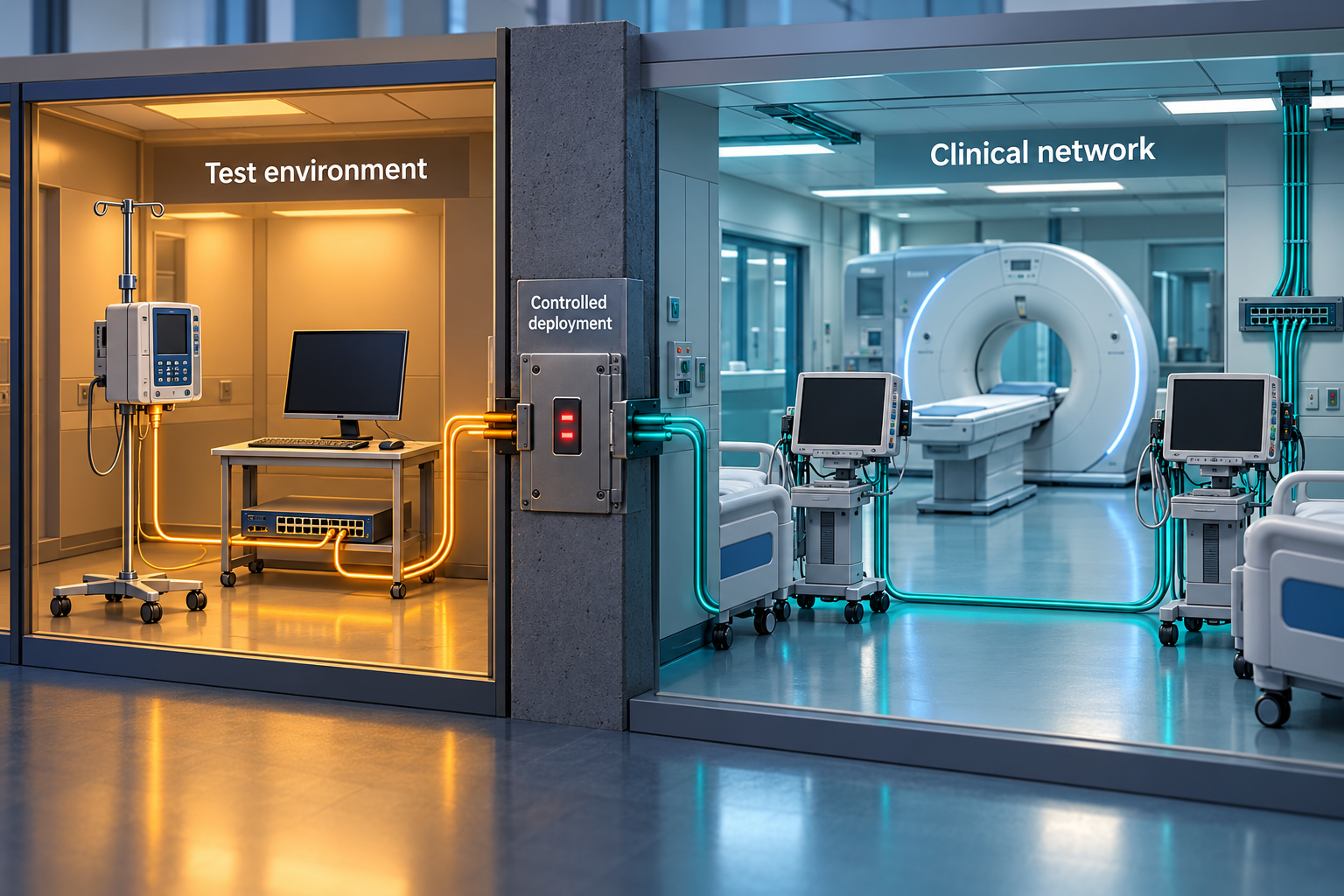
Hospitals should inventory connected devices, assess risk, segment networks where appropriate and monitor for unusual activity. Maintenance and security testing should be coordinated with manufacturers, clinical engineering and care teams. Do not subject every live clinical device to routine penetration testing: disruptive tests or unapproved changes can themselves affect patient care. Use clinically safe test environments and approved procedures, with a plan for equipment that cannot immediately be patched.
Staff Training and Incident Response Drills
Hospital staff need usable response protocols as well as security awareness. During an outage, clinicians, administrators, IT staff and external partners must make coordinated decisions with incomplete information. Training should address who declares downtime, how urgent clinical needs are escalated and how reliable information is handed over when normal systems are unavailable.
Tabletop exercises can test those decisions and expose unclear responsibilities before an incident. The healthcare readiness guide includes preparation and exercises as part of readiness. A useful drill should leave the hospital with specific changes to make—for example, a clearer escalation route or a workable way to verify medication orders. Recording attendance alone does not show that a downtime process works.
Hospital cybersecurity is a team sport. Training clinical staff, administrators and IT personnel in shared response protocols connects technical recovery to patient care. Exercises should also identify who authorizes restoration and how staff will confirm that recovered information is reliable before returning to normal workflows.
Vendor Risk Assessments and Cloud Security
Cloud providers, data processors and software platforms can create dependencies outside the direct control of hospital IT departments. Hospitals should assess those connections as part of their security and continuity plans. Outsourcing a service does not eliminate the need to understand its failure modes or the hospital’s own responsibilities.
Hospitals must perform regular risk assessments on vendors, reviewing security certifications, breach history, and incident response readiness. Contracts should include cybersecurity clauses that require prompt notification of breaches, adherence to security standards, and joint response protocols.
Hospitals using cloud-based systems should apply appropriate access controls, encryption and multifactor authentication for staff and vendor access. The arrangements should reflect both applicable obligations and operational risk. Hospital network security depends on how third-party connections are governed, monitored and recovered, not only on the controls inside the hospital’s own building.
These practical defenses can significantly improve resilience, but even the most prepared hospitals cannot solve the problem alone. To protect patients and restore trust, broader systemic action is needed, starting with demands from both the public and policymakers.
What Patients and Policymakers Must Demand
Encryption and Auditable Access Control
At the core of every hospital cybersecurity strategy should be encryption and access control. Encryption can reduce disclosure risk if protected data is obtained without the keys, but it does not keep an unavailable clinical application running or prevent misuse through an authorized account. Hospitals need both confidentiality safeguards and a plan for availability; one cannot stand in for the other.

Auditable access control is equally critical. Hospitals need to track access to patient records and investigate abnormal activity. Existing HIPAA obligations already include security safeguards; the December 2024 proposal sought to make requirements more specific, including MFA. For the underlying distinction between authentication methods, see our guide to passwords, passkeys and two-factor authentication. Hospital implementation still needs to account for clinical workflows, access recovery and emergency care.
If hospitals continue to neglect these core protections, the consequences will not just be operational; they will be personal.
Mandatory Cybersecurity Standards for Critical Vendors
Patients and advocates should push for effective vendor accountability in hospital cybersecurity. When Change Healthcare was attacked, hospitals experienced consequences through a shared service rather than a direct compromise of every hospital network. The AHA survey showed how that dependency could affect finances and care at the same time.
HIPAA already regulates covered entities and business associates handling electronic protected health information. The policy question is where coverage, enforcement or resilience expectations leave critical dependencies insufficiently protected. Lawmakers should examine those gaps precisely, rather than assume all vendors are exempt or that adding a legal requirement automatically creates a working fallback service.
Vendor accountability is not just a legal issue; it is a structural requirement for protecting care continuity and patient safety.
Greater Transparency and Breach Disclosure
Patients need clear explanations after a cybersecurity incident: what is known, what remains under investigation and whether care is affected. A vague update can make it difficult to decide what to do. The Alder Hey example also shows why clarity includes distinguishing an allegation from an established breach and reporting the investigation’s result.
Patients have the right to know when their records are compromised, how their care might be affected, and what is being done to fix the problem. Healthcare data breaches that impact millions of records should not be kept quiet behind legal and bureaucratic walls.
HIPAA already requires notification of breaches of unsecured protected health information within the rule’s scope. HHS’s Breach Notification Rule explanation states that affected individuals generally must be notified without unreasonable delay and no later than 60 days after discovery, subject to applicable provisions. Policymakers can press for better compliance, clearer notices and faster useful communication without claiming that no notification duty exists. Patients also need practical service updates during an outage, which is a different question from whether a reportable data breach has been established.
Funding for Small and Rural Hospitals
Security cannot be a luxury. Policymakers must recognize the constraints facing small and rural providers. A hospital that lacks sustained staffing and maintenance capacity cannot turn a short-term offer of tools into a complete security program on its own. Resources should be linked to the work needed to protect clinical services, not only to procurement.
Federal grants or cost-sharing programs could help bridge this gap. Similar to the funding mechanisms used in education and broadband expansion, hospital cybersecurity grants could fund upgrades for critical access hospitals, community clinics, and nonprofit providers.
This kind of policy would address the resource inequality identified above while building on assistance already announced. Its effectiveness should be assessed through practical capacity: supported systems, responsible staff, protected recovery arrangements and exercises that reach the clinical teams who need them. That is a stronger measure of progress than either announcing a program or assuming nothing has been done.
Hospitals, patients and lawmakers must align behind a shared goal: proactive defense and dependable care continuity. The incidents show why that work matters already. The prospect of more effective AI-assisted deception adds urgency to strengthening defenses and making response plans usable.
Conclusion and Future Outlook
Hospital cybersecurity is no longer a behind-the-scenes technical issue. It is part of public health, patient safety and national resilience. The examples examined here show interrupted treatment, disrupted cancer research, strained clinical workflows and exposed records. From ransomware attacks on hospitals to medical device vulnerabilities, the stakes extend beyond an IT recovery ticket.
We are at a critical juncture. HIPAA already imposes enforceable security obligations, but rules alone do not ensure tested care-continuity arrangements, adequate staffing or resilient suppliers. Stronger safeguards and accountability need practical implementation, especially for smaller providers with limited resources. Investment in hospital network security must be treated as part of investment in safe care, alongside the clinical services that depend on it.
The emerging threat landscape adds pressure. The NCSC’s January 2024 assessment warned that AI would amplify cybercrime, including social engineering, by increasing effectiveness and lowering some barriers to entry. Hospitals should take that warning seriously while distinguishing the assessment from evidence about a particular incident. Our discussion of AI-led cyberattack risks considers that broader concern; the practical priority remains reducing exploitable weaknesses and preparing teams to challenge convincing deception.
What comes next will require more than just technical upgrades. It will require a cultural shift in how we treat cybersecurity in healthcare. This includes changing how institutions train their staff, how regulators enforce compliance, how vendors are vetted, and how the public is informed. The cost of delay is measured not just in dollars, but in lives.
As the digital threats to hospitals evolve, so too must our response. If this breakdown was useful, subscribe to the Quantum Cyber AI newsletter to stay ahead of the latest threats and policy shifts impacting healthcare cybersecurity. We deliver data-driven, actionable insights every week.
FAQ
Q1: How often do hospitals experience cyberattacks?
The 2024 Ponemon/Proofpoint survey found that respondents reported at least one cyberattack at 92% of their healthcare organizations in the previous 12 months, compared with 88% in the 2023 survey. Its 648 respondents were U.S. healthcare IT and security practitioners. That measures reported experience in a survey, not the attack rate of every U.S. hospital.
Q2: Have cyberattacks on hospitals been linked to deaths?
The cited research reports associations with higher heart-attack mortality after data breaches and worse cardiac-arrest outcomes at hospitals neighboring a ransomware disruption. Those findings are serious, but observational studies have limits. The data-breach manuscript did not isolate ransomware, and the neighboring-hospital study could not establish ambulance diversion as the cause of its observed outcomes.
Q3: What weaknesses should hospitals prioritize?
Priorities include phishing resistance, risk-based patching, access controls, segmentation, protected recovery arrangements and vendor dependencies. The HSE review documented phishing and wider response weaknesses. The sources here do not establish one most common entry route across all hospitals, or that medical devices are the primary route.
Q4: Does federal law already require hospital cybersecurity safeguards?
Yes. The HIPAA Security Rule imposes enforceable duties on covered entities and business associates. The December 2024 proposal sought stronger, more specific requirements; a proposal is not a final rule or the same thing as voluntary goals. The policy debate concerns adequacy, enforcement, resources and care continuity, not an absence of all existing law.
Q5: Can small hospitals realistically afford better cybersecurity?
Smaller providers may need targeted support for staffing, maintenance and recovery preparation. Free and discounted assistance for eligible rural hospitals was announced in June 2024, but availability does not establish uptake or adequacy. Grants and cost-sharing can help when they build sustainable capacity rather than leave a hospital with tools it cannot operate.