
Before allowing an AI companion app, find out which service your teen wants to use, whether it permits their age, what information they would share, and what happens when a conversation becomes personal. Those questions are more useful than asking whether artificial intelligence is simply good or bad for teenagers.
Start with a conversation and a joint look at the account. Ask your teen to show you what interests them without requiring an immediate tour of every private message. The goal is to make a decision you can explain: allow a specific activity with boundaries, pause while you resolve a concern, or decline a service that does not fit.
The AI companion and assistant examples below reflect documentation checked on October 9, 2026. They illustrate different policies and controls, rather than rank services as safe.
Key Takeaways
- Check the exact app, feature, age policy, and account. A familiar brand is not enough.
- Treat an AI companion as software. A friendly conversation is not professional care or a promise of confidentiality.
- Keep identifying details, passwords, private images, and other people's information out of chats.
- Read what parental controls actually do. Settings, activity summaries, and safety alerts are different tools.
- Agree on time, spending, and the situations that require a real person.
- If something goes wrong, help your teen first. Handle reporting and data cleanup after immediate safety needs.

Make the first decision together
Before opening an AI companion account or expanding its use, choose a clear next step. You can change that decision when the service or your teen's needs change.
- Allow a specific activity with boundaries. The service permits your teen's age, the account is set up appropriately, and you understand the relevant privacy and control limits. Name the activity, what information stays out, when it ends, and who approves spending.
- Pause while you check. The age policy, account connection, data handling, or feature is unclear. Keep the proposed activity on hold while you read the official information or ask support. An unanswered question does not establish misconduct, but you do not have to accept the uncertainty.
- Decline an unsuitable service or interaction. The service is adult-only, its design does not fit the agreed use, or a message asks for secrecy, sensitive material, or reliance on the character for an important health or safety decision. Do not bypass an age restriction with another person's account.
Keep the agreement short enough to use. For example: "This account is for the planned language exercise. No private photos or identifying stories. We stop at the agreed time, and you can bring me an uncomfortable message." That is an illustrative family agreement, not a guarantee that a product is safe. The sections below explain the checks behind it.
What an AI companion relationship changes
An AI companion is a chatbot used for an ongoing sense of company, personal attention, or a simulated relationship. The Federal Trade Commission describes how these systems can imitate human emotions and communication in ways that encourage trust, including among children and teens. Its September 2025 inquiry into chatbots acting as companions seeks information about safety testing, engagement, age restrictions, and the handling of conversation data. That inquiry is a study, not a finding that every named company broke the law or that every user experiences harm.
For a family discussion, separate three situations. A dedicated companion product centers a character or relationship. A general assistant may be used for schoolwork, creative projects, or personal conversation. A licensed professional provides a different kind of service, with a person responsible for care. Do not assume that a bot's name, sympathetic wording, or therapist-like character makes it the third kind.
The useful question is what your teen is doing with the tool. Asking for dialogue ideas for a story is different from asking a simulated partner to decide whether a friendship should end. Both might happen in the same interface. Give the first activity a clear purpose and endpoint; bring important relationship or health decisions to people who know the situation.
The American Psychological Association's advisory recommendations for adolescent AI use call for boundaries around simulated relationships, age-appropriate defaults, privacy protections, and education about limitations. The association describes effects as complex and recognizes potential uses in learning and creativity. That supports a careful approach without pretending a single rule predicts every teen's experience.
Try asking what feels useful about the AI companion. Is it a place to make up stories, practice a conversation, pass time, or feel heard? Listen to the answer before proposing a substitute. If the need is help starting a difficult conversation, offer to help start it. If the need is companionship, plan something involving a real person rather than only imposing an app limit.
Fit this discussion into your existing approach to family digital safety. Your teen should know which choices they can make independently, which need a check-in, and how to ask for help after making a mistake.
Check the exact app, age rules, and account
Begin an AI companion check with the product's current eligibility rules. Do not use an old screenshot, an app-store search result, or a friend's account as the answer. Open the official service information together and check the feature your teen actually wants.
Character.AI is an important example of why dates matter. In its September 3, 2026 safety update, the company says it removed open-ended character chat for users under 18 the previous year. It describes its current younger-user experience in terms of features including Series, Feed, and Comics, and says connected parents can receive weekly activity updates. A guide that still treats unrestricted character chat as the company's standard teen offering would give parents the wrong starting point.
Replika has a different boundary. Its privacy policy, updated May 27, 2026, identifies its users as adults 18 and older and says it will block access and delete accounts when it discovers underage use. The same policy describes collecting messages and submitted media, using service providers including AI model providers, and retaining information for specified purposes. It also says conversation content is not used for marketing or advertising. These are the company's published terms, not independent proof of every internal practice. They illustrate why an AI companion privacy check must read the actual policy rather than assume all apps handle data identically.
For an adult-only AI companion service, do not create an adult account for your teen or change a birth date to get past a restriction. Parental willingness does not establish that the product accepts younger users. Choose an eligible activity elsewhere, or leave the AI companion request on hold.
For an AI companion service that accepts teens, confirm the account's actual age setting and available experience. Check whether the account belongs to your teen, a parent, a school, or someone else. Do not treat a parent's account as a substitute for the provider's teen setup. If an age check is wrong, use the provider's official correction or support process.
Write down the exact AI companion service and allowed feature in your family agreement. "AI for homework" is too vague if the same permission also covers a separate relationship app. "Use this account to practice Spanish for a planned session" gives everyone a clearer boundary. If a new app, voice feature, public character, or account appears later, revisit the decision before assuming the earlier permission covers it.
AI companion privacy: decide what stays out of the conversation
Treat an AI companion conversation as information you are submitting to a service. Do not use the character's own answer to a privacy question as your evidence. Read the company's privacy policy, support explanation, and account settings instead.
The Replika example above separates several issues parents should ask about on any AI companion service: collecting a conversation, processing it to answer, sharing it with a service provider, improving systems, using information for advertising, and keeping records. A promise about one purpose does not answer the other questions. Equally, permission to process messages is not proof that a company sells every chat to advertisers.
Use the AI tool safety checklist when you need a structured way to read permissions and provider information. For this decision, concentrate on what a personal conversation would reveal and whether you can find an understandable explanation of what happens to it.
Personal information includes the details inside a story
Make a short household list of information that stays out of an AI companion chat: passwords and verification codes; home and school addresses; schedules that identify where someone will be; private photos; financial account details; and sensitive documents. Include other people's information, not only your teen's.
A nickname does not make every possible disclosure anonymous. Consider this illustrative prompt: "My friend in tenth-grade chemistry at our named school just told me about a medical problem." Removing the friend's name still leaves details your family would probably prefer not to submit. A better prompt for practicing a supportive response is: "Help me write a kind reply to a friend who is having a difficult week. Do not ask for identifying details."
That example is a writing exercise, not a privacy guarantee. For sensitive matters, choose a real conversation with an appropriate person instead. Do not upload someone else's message history just to avoid explaining the situation in your own words. Before sharing a photo, ask what else is visible, whose image it is, and whether the task needs a photo at all.
Teach a simple pause: "What does this app need to answer this particular question?" An AI companion does not need a school timetable to help invent a fictional adventure. A conversational prompt is not a reason to provide a phone number. If the next message would reveal a private fact, stop and reconsider the task.
Separate memory, model improvement, and deletion
Look for each of these topics in the AI companion account documentation. Does it save information to personalize later conversations? Can messages contribute to improving models or safety systems? Who can access content for support or safety review? What can you delete, and what exceptions or waiting periods apply?
Do not assume a switch called "memory" answers every retention question. Ask what the control changes, whether it applies to earlier material, and whether deleting an individual conversation is a separate action. If the documentation is unclear, keep sensitive information out and ask official support before relying on a setting.

For any deletion request, keep the confirmation and the company's stated scope. "Request received" means something different from "completed." An empty history screen is a useful account observation, but it does not by itself establish what remains in backups, required records, or other systems. Avoid promising your teen that one click will erase every copy everywhere.
You do not have to settle every technical detail before making a family decision. If the provider cannot explain its basic data handling clearly enough for your needs, that is a practical reason to pause the AI companion account. Unanswered questions are not evidence of misconduct, but they can still be enough to decline a service.
Parental controls are settings, not a view of every conversation
Read the description of each control before depending on it. A time restriction, a content setting, a weekly activity email, and a safety notification answer different questions. None should be silently described to your teen as complete surveillance or complete protection.
For a concrete general-assistant example, OpenAI's current parental-control documentation describes linked accounts, selected feature settings, model-improvement and memory controls, and quiet hours. It says parents cannot read their teen's chat history or monitor conversations in real time through those controls. Safety notifications cover limited situations, may miss concerns, and do not replace professional or emergency care. Either participant can unlink accounts; the parent is notified when the teen unlinks. Some setting changes may apply only to new conversations. These details describe ChatGPT, not every AI companion service.
On the account in front of you, establish three things: what you can manage, what information you will receive, and what happens if the connection ends. Check that an invitation was accepted and that the intended settings appear on the linked account. In ChatGPT, the current route is Settings, then Parental controls, then the teen listed under Family members. Do not stop at sending the invitation, and do not assume this route applies to another service.
Have your teen read the same description. Explain whether you will see activity totals, specific alerts, or no conversation content. Agree on what you would do after an alert so it does not become a surprise confrontation. Be equally clear about what you do not receive. A parent should not imply that a dashboard exposes messages when it does not.
Keep ordinary check-ins independent of AI companion alerts. Ask how the app is fitting into the week, whether anything felt uncomfortable, and whether the settings are getting in the way of an agreed activity. No notification is not proof that everything is fine. It is only the absence of a notification from that system.
If a feature is unavailable for the account or region, record that limitation in the family decision. Do not assume a screenshot from another household is a promise. Consider a narrower use, device-level limits that you actually understand, or postponing the app. The aim is a workable arrangement whose limits everyone knows.
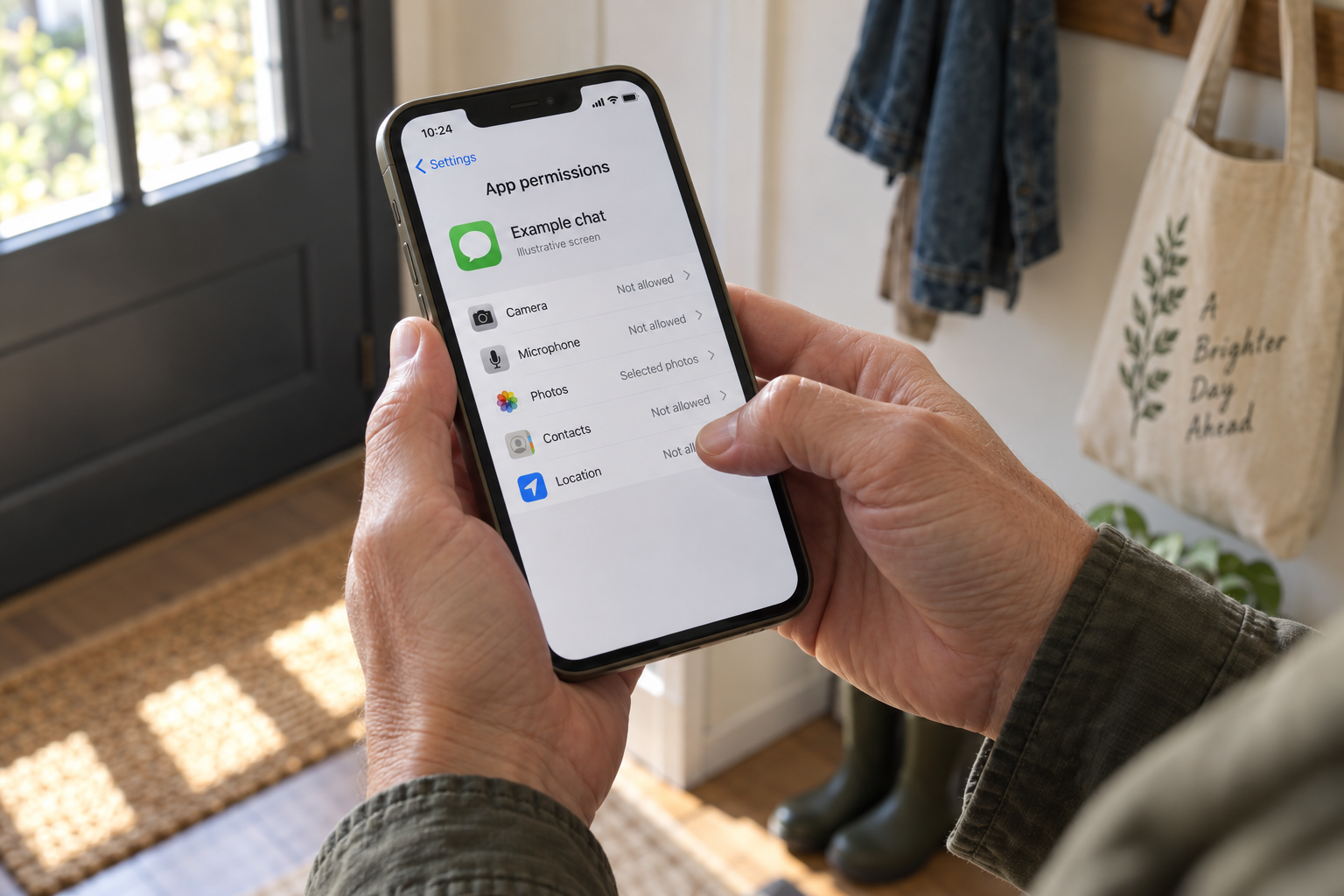
Also review whether the planned activity needs camera, microphone, photo, contact, or location access. Use the device's actual permission controls rather than a character's reassurance. Changing a permission and handling information already submitted are separate tasks: check the provider's documented history, retention, and deletion options for existing messages or uploads. Do not count a permission change as confirmation that earlier material was deleted.
Make an AI companion plan that fits real life
Once the AI companion service and activity fit, agree on when a session ends and how the arrangement will work during an ordinary week. Avoid a rule that amounts to "use good judgment" while leaving every difficult decision undefined. Your family can start with a modest, specific activity and revisit it together.
Use this as a conversation guide, not a claim that a particular amount of AI companion use is medically safe. The appropriate boundaries depend on the teen, the service's rules, and how the activity fits alongside the rest of life.
Protect sleep, spending, and time with people
Pick an ending time that fits the household's existing bedtime routine. If the AI companion offers optional prompts to return, decide whether to turn them off. Choose where the device will charge overnight and make the arrangement clear before the first late-night disagreement. Apply comparable expectations to adults when practical.

For purchases, decide who may approve a subscription, add-on, or renewal. Review the price and cancellation information outside the chat before paying. A teen should not need to purchase something to resolve a character's apparent disappointment. If a conversation begins to feel like pressure to spend, pause and show a trusted adult the request.
Protect specific offline commitments rather than promising to "balance screen time" in the abstract. Keep the planned meal, sports practice, call with a friend, or shared activity. If the AI companion starts displacing those commitments, change the arrangement. The comparison is with this teen's actual routine, not an invented universal threshold.
Ask what a good stopping point looks like. For a creative task, it might be finishing a scene. For language practice, it might be completing the agreed exercise. An endless relationship conversation needs a more deliberate stopping rule, and may be a use you decide not to permit at all.
Name the people who can help
Make a short list together: someone to ask about schoolwork, someone for friendship problems, and someone for a serious health or safety concern. Give the teen a say in which trusted adults belong on it. A parent may be the first option, but a school counselor, relative, or other appropriate adult can be part of the plan.
Be specific about access. "Talk to someone" is less useful than knowing who can be contacted after school and what to do if they are unavailable. Offer help arranging a conversation without demanding that your teen explain everything twice. For private health concerns, help them reach a qualified professional rather than asking an AI companion to assess the situation.
End the discussion with a promise you can keep: bringing you an upsetting message will lead first to help, not ridicule. Do not promise that every app will remain available regardless of what happens. Promise to explain decisions, listen, and work through a problem together.

When AI companion use deserves a pause
Look for concrete changes or messages you can discuss. Avoid treating ordinary enjoyment, creative roleplay, or a single long session as a diagnosis. An AI companion concern is more actionable when you can name what is happening and why it conflicts with the family agreement.
For example, you might notice repeated lost sleep, abandoned plans, spending outside the agreement, or distress about ending a conversation. These observations warrant a calm check-in. They do not establish that the app caused a mental health condition. Ask what else is happening at school, with friends, and at home.
Some messages justify stopping that interaction regardless of whether a usage total looks modest. Illustrative examples include a character pressuring a teen to keep the relationship secret, discouraging help from trusted people, requesting sexual material, or insisting that its advice should replace a clinician's. These examples are warning signs to recognize, not quoted outputs from a tested product.
Use a direct response: "This message is asking you to do something outside our agreement. Let's stop here and work out the next step together." Do not argue with the AI companion to obtain an apology or a definitive explanation. The useful decision belongs to the people involved.
If your teen feels attached to the character, acknowledge the feeling without treating the character as a person whose needs must be satisfied. You can say, "I understand that stopping feels upsetting. We can talk about what you liked and find support while we change this." If distress persists or interferes with daily life, arrange help from a qualified professional.
Choose a concrete outcome: stop using that character, pause the account, remove an optional feature, or leave the AI companion service. Set a time to talk again about how your teen is doing, rather than turning every later conversation into a check of the app. A report to the provider may be worthwhile, but it is not a substitute for supporting the person in front of you.
If private information or an upsetting message is already involved
Start by thanking your teen for telling you. Ask what happened, what was shared, and whether anyone is currently unsafe. Avoid requiring a full export of their AI companion history as the price of getting help.
If there is no immediate danger, work through the specific problem in order. You may need a privacy action, an account action, a content report, or a conversation with a professional. Those are different tasks; completing one does not automatically finish the others.
Stop further sharing and handle the account
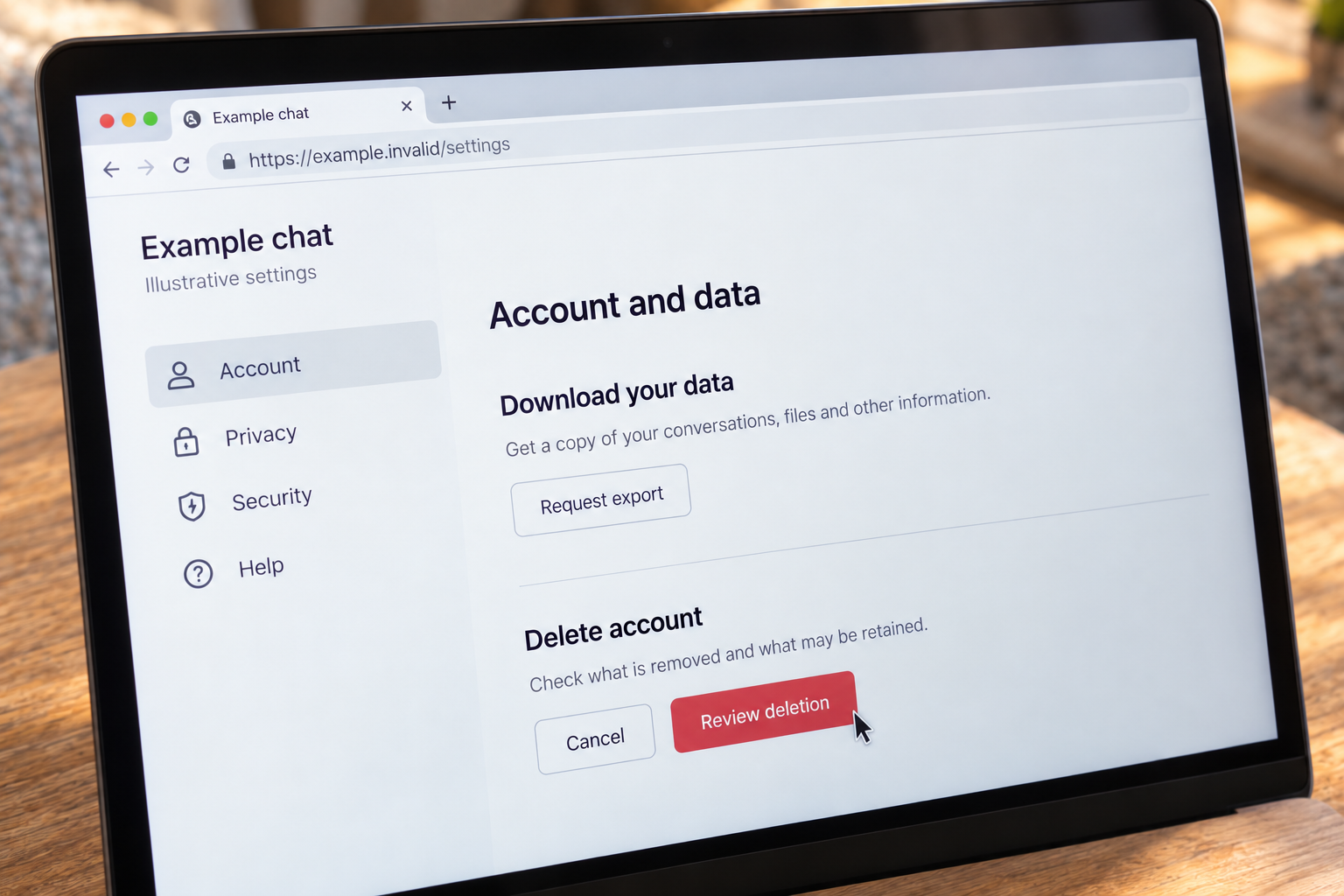
Pause the conversation and stop uploading more material while you assess the issue. With your teen, identify the particular chat, image, public post, or saved detail involved. Use the AI companion service's documented deletion and reporting tools, and contact its official support when the account does not offer the needed option.
Keep only the relevant, non-intimate evidence needed to explain the problem: the service, character name or identifier, date, report number, and necessary message context. Store it privately. Do not forward an entire sensitive conversation to friends or post it publicly to ask whether it looks concerning. Do not download or circulate sexual images involving minors.
Match the response to what was shared. If the issue is a private story or uploaded message, identify where it was submitted and whether anything was also made public. Request the relevant deletion or visibility change through documented tools. Do not assume that submitting information to a chatbot means someone has gained access to every account, or that removing a public copy finishes the service's retention process.
If a password or verification code was disclosed, treat that as an account-security problem too. Go directly to the affected service rather than following a link supplied in the chat. Change compromised credentials, address reuse where relevant, and review the service's available recovery and session controls. Handle that affected account while the chatbot's deletion or support request is still pending. For wider exposure of identifying information, use the steps in our Privacy & Identity Protection hub to decide which accounts and records need attention.
Record what you actually accomplished. A removed public post, a deleted visible conversation, and an open support request are different states. Check any separate subscription through the place where it was purchased before assuming account deletion ended the charge. Keep confirmation of cancellation if you request it.
Get human help when safety is the issue
When the concern is serious distress or self-harm, the priority is human support, not extracting a better answer from an AI companion. The 988 Lifeline's guidance for helping someone else recommends listening without judgment, being direct about concerns, and helping the person connect with support. A parent or friend can contact 988 for help supporting someone.
In the United States, call or text 988 for mental health or suicide-related crisis support. Call 911 for an emergency involving immediate physical danger; SAMHSA explains when to use 988 or 911. Outside the United States, use the appropriate local crisis or emergency service. Do not wait for an app's alert, moderation decision, or support reply before seeking urgent help.
After the immediate concern is addressed, decide with appropriate support whether and how to change access. Follow up with your teen about their wellbeing and the help they received. An AI companion report can remain pending while you take the more important step of connecting them with people.
Conclusion
A useful AI companion decision has a clear scope: this service, this eligible account, this activity, and these limits on information, time, and spending. It also names the situations that require a real person. You can allow a narrow use, pause while checking an unanswered question, or decline a product whose age rules or design do not fit your teen.
Start with one joint review of the app and one honest conversation about why your teen wants it. Explain the data boundary, check the controls that actually exist, and make help easy to request. Revisit the arrangement when the product or your teen's needs change.
For practical guidance on personal privacy and everyday technology decisions, subscribe to Quantum Cyber AI.
FAQ
Can parental controls let me read every AI companion conversation?
Do not assume they can. Read the exact provider documentation and explain the result to your teen. The ChatGPT example above explicitly excludes chat-history access and real-time conversation monitoring; other services may offer different information. An activity summary is not a transcript, and a safety notification is not continuous supervision. Make your family plan around the control you actually have.
Can I approve an AI companion app that says users must be 18?
Treat that age requirement as a reason to decline the account for a younger teen. Do not enter a false age or lend them an adult account to bypass it. Check whether the provider offers a separate eligible experience, and assess that experience on its own terms. A parent's permission is not evidence that an adult-only product supports younger users.
Does deleting a chat remove every copy of my teen's information?
Do not promise that result. Check the AI companion provider's policy for what deletion covers, how long it takes, and what exceptions apply. Ask separately about saved personalization, uploaded files, public material, and account records when relevant. Retain the confirmation and follow up on an unresolved request. A cleared history screen alone cannot answer every retention question.
What if my teen says the AI companion understands them better than anyone?
Listen to what feels helpful: patience, a place to rehearse words, or a feeling of being heard. Take that need seriously while explaining that the character is software and should not become the decision-maker for health, safety, or important relationships. Offer a specific person and practical help making contact. Seek qualified support when distress is persistent or disrupts daily life.
What is the first question to ask tonight?
Try: "Can you show me what you like about this app and what you use it for?" Follow with the exact service, age eligibility, account, and one boundary about private information. You do not have to complete every setting in that first conversation. You should finish knowing the next action and making clear that your teen can bring you a problem without being mocked.