
You may have seen a phone, messaging app, browser, VPN, or cloud service described as “quantum safe.” Those labels refer to a transition toward quantum-resistant encryption, but they can make an ordinary device suddenly feel obsolete or a costly upgrade sound urgent. For most consumers, neither conclusion is justified.
NIST has finalized its first three post-quantum cryptography standards and says they are ready for implementation. That is a real milestone, but it does not mean every app, website, device, or stored file has already changed. Quantum-resistant encryption will reach most people through normal software updates and provider upgrades. Your useful choices are to keep supported products current, identify information that must remain private for a long time, maintain strong account security, and demand specific answers from companies making post-quantum claims.
You do not need to choose a cryptographic algorithm, replace every device, or buy a product because it displays a futuristic badge. A calmer decision rule works better: act where you control a meaningful risk now, and wait where the provider still owns the technical change.

Key Takeaways
- Post-quantum standards are ready, but their rollout across consumer products is still uneven.
- Information that must stay private for many years deserves more attention than routine, short-lived data.
- Automatic updates, supported devices, secure backups, strong account protection, and precise vendor questions are useful now.
- A post-quantum feature may cover only one connection, protocol, or product mode. It does not automatically protect the whole service.
- Replacing supported hardware, assembling cryptography yourself, or paying for a vague “quantum safe” claim can wait.
- Post-quantum cryptography does not stop phishing, malware, account recovery abuse, deceptive websites, or someone reading data on an unlocked device.
Table of Contents
The Quantum Risk Is a Migration Problem, Not a Household Emergency
The practical concern is not that a quantum computer is breaking ordinary banking, shopping, or messaging connections today. NIST explains that no one knows when a cryptographically relevant quantum computer will exist. Current systems are not known to be capable of the large, stable computation needed to defeat the widely deployed public-key methods at issue.
The reason experts are moving now is called harvest now, decrypt later. An attacker could collect encrypted traffic or files today, keep the captured material, and try to decrypt it in the future if sufficiently capable technology becomes available. This matters most when the information could still cause harm many years from now. A medical history, identity document, legal record, intimate conversation, trade secret, or family archive can have a much longer secrecy life than a restaurant reservation or a routine product search.
That does not mean you should assume someone is recording everything you do. It means the lifetime of the information should shape your priority. If disclosure in ten or twenty years would still be serious, you have a stronger reason to choose well-supported services with a documented migration path. If the information loses its sensitivity next week, a quantum-specific purchase is less likely to change your risk in a useful way.
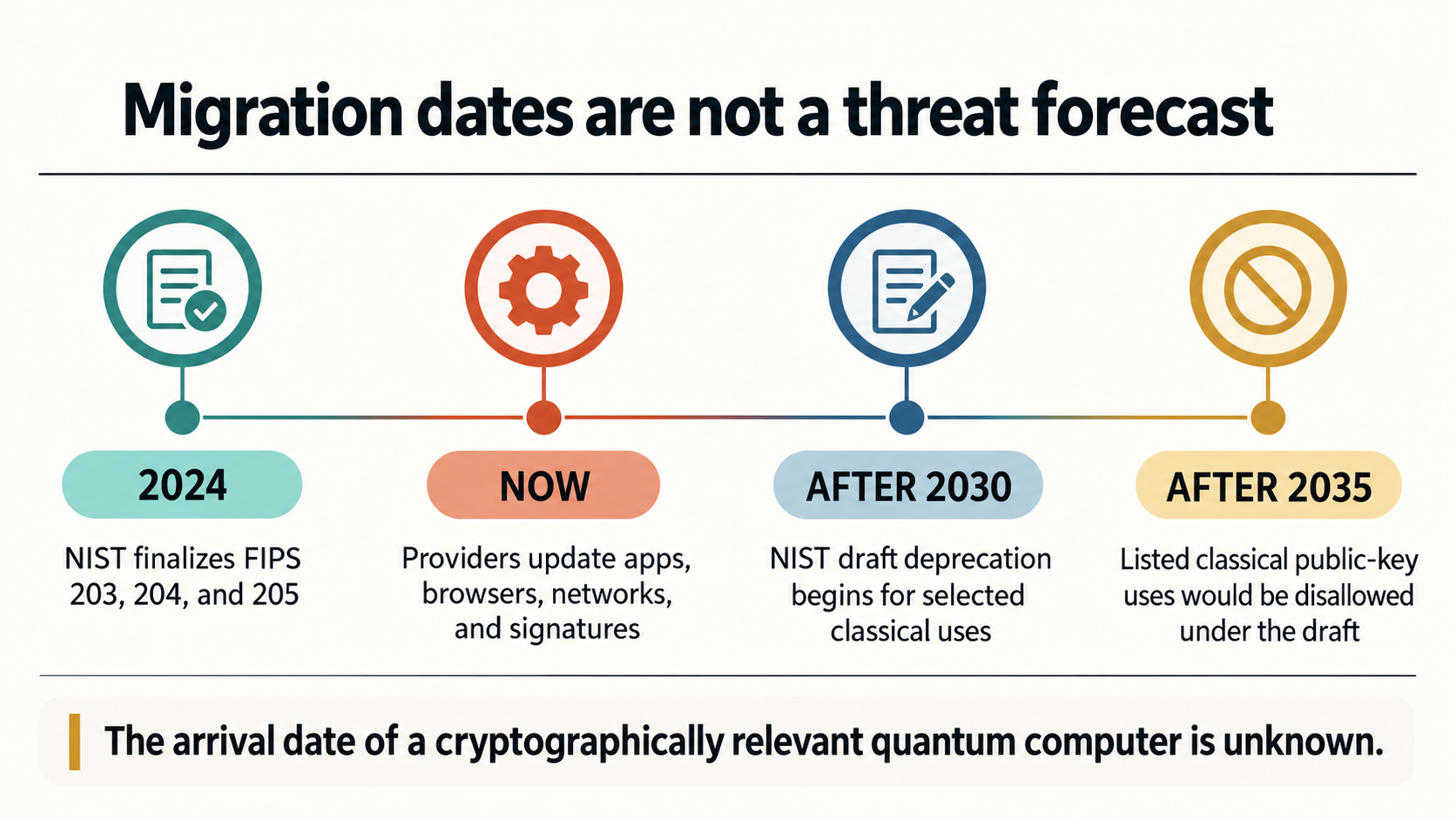
Government migration schedules can look like threat forecasts when they are quoted without context. NSA's CNSA 2.0 milestones apply to National Security Systems, not to households. Those dates show how long large organizations, vendors, protocols, and equipment fleets need to change. They do not tell you that a code-breaking computer will arrive on a particular day, and they do not create a deadline for buying a new phone.
Separate from that audience-specific NSA schedule, NIST's initial IR 8547 transition draft proposes deprecating selected classical public-key uses after 2030 and disallowing listed uses after 2035. Those are draft standards-transition markers. They are not a forecast for when a cryptographically relevant quantum computer will arrive, and they are not a household equipment deadline.
The same distinction appears in joint CISA, NSA, and NIST quantum-readiness guidance. It tells organizations to identify vulnerable cryptography, prioritize long-lived data, plan migration, and ask vendors for roadmaps. A family does not need a formal cryptographic inventory. A household can translate the advice into a short list of high-value services and archives.
For a deeper explanation of the computing risk without a countdown, see Quantum Computing and Your Data. The consumer goal is readiness through ordinary product decisions, not constant monitoring of laboratory announcements.
What Quantum-Resistant Encryption Actually Changes
Encryption is often discussed as if it were one mechanism. In practice, several mechanisms work together. Public-key cryptography can help two parties establish a shared secret across a network. Symmetric cryptography can then use that secret to protect the actual stream of data. Digital signatures can help verify who signed software or information and whether it was altered.
NIST's first three standards address two of those jobs. ML-KEM is a key-encapsulation mechanism. It helps establish shared key material across a public channel. It is not a consumer file-encryption program, and it does not directly replace every encryption operation inside a phone. ML-DSA and SLH-DSA are digital-signature standards. They support authenticity and integrity, such as checking signed software or data. A digital signature does not hide the contents of a document.
This division matters when a company says a product “uses NIST post-quantum encryption.” The claim may accurately describe a network handshake while saying nothing about software-update signatures, stored files, login credentials, backups, sharing links, or account recovery. A standardized component can be valuable without making the entire service quantum-resistant.
It is also wrong to conclude that every familiar form of encryption should be abandoned. NIST's post-quantum FAQ says applications can continue using AES with 128-, 192-, or 256-bit keys. The central migration problem concerns vulnerable public-key methods used for key establishment and digital signatures. Strong symmetric encryption still has a role, though providers must also protect, exchange, wrap, and recover its keys correctly.
Many early deployments are hybrid. They combine a well-established classical method with a post-quantum method so that a connection does not depend entirely on one new component. That does not make implementation mistakes impossible. It does provide a sensible way to add protection while protocols, libraries, devices, and services move together.
Even a correctly implemented post-quantum connection has limits. It cannot tell whether a shopping site is honest. It cannot stop you from entering a password into a convincing imitation. It does not remove malware from a device, close an exposed recovery route, fix a reused password, or prevent someone with an unlocked phone from reading a message after it has been decrypted. “Quantum-resistant” describes resistance to a class of cryptographic attacks. “Quantum-proof” implies a permanent guarantee that no responsible provider can make.
How Post-Quantum Cryptography Reaches Consumers Through Updates
For most people, quantum-resistant encryption will not arrive as a new control panel filled with algorithm names. It will arrive in an operating-system release, browser update, messaging protocol, cloud-service change, router firmware package, bank platform, or security-key standard. That is why product support and update habits matter more than learning to configure ML-KEM yourself.
Devices and Operating Systems
CISA advises consumers to install software updates promptly and turn on automatic updates. That advice addresses present-day vulnerabilities and also provides the channel through which vendors deliver new cryptographic support. Major-version updates can matter because a protocol change may be part of a platform release rather than a small emergency patch.
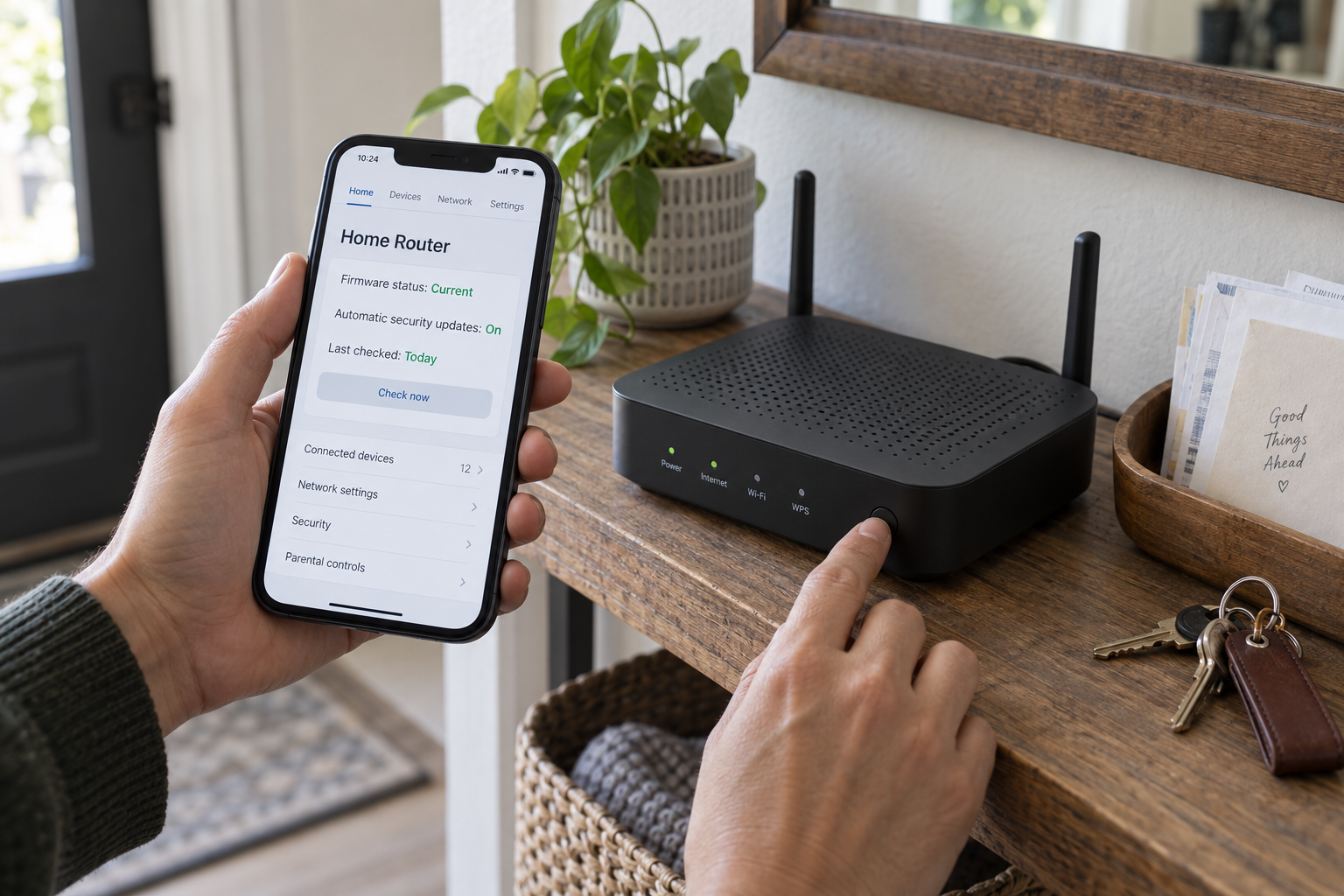
A supported device is not obsolete just because it lacks a “post-quantum” switch. Keep it updated and check how long the manufacturer promises security support. Plan replacement when support ends, when an essential service documents an incompatibility, or when your unusually sensitive data justifies an earlier change. A newer logo on a product box is weaker evidence than a clear support period and a published migration plan.
Apple's platform security documentation shows how this can work. Apple describes changes delivered in specific operating-system versions across system connections and also notes that the relevant protection requires supporting servers. The lesson applies beyond one manufacturer: your device can offer a capability, but both sides of the connection may need to negotiate it.
How ML-KEM Reaches Browsers and Websites
Browser support is another example of why “available” does not mean “used everywhere.” Google says Chrome adopted a hybrid X25519 and ML-KEM key exchange for supported TLS connections. The browser can offer the method, but the site or service endpoint must support it too.
Even when that handshake succeeds, it answers only part of the security question. It does not prove that the site is legitimate, upgrade every certificate signature, secure the account after login, or control how the service stores information after receiving it. The protection applies to a defined connection step.
Cloudflare's support matrix separates post-quantum TLS key agreement from the still-developing migration of browser certificate signatures. It also notes that some browsers derived from major codebases can lag or disable support. A consumer should use a maintained mainstream browser, keep it current, and leave its standard security defaults enabled. A special browser extension with an unclear protocol is rarely a better answer.
Messaging Apps
Messaging makes the scope issue especially visible. Apple describes iMessage PQ3 as a hybrid protocol for initial key establishment and ongoing rekeying. Supported devices move compatible iMessage conversations through that system automatically. The claim belongs to iMessage between supported devices. It does not automatically include SMS, ordinary email, an exported transcript, a notification shown on a lock screen, or every cloud-backup setting.
Signal describes its Triple Ratchet as combining its existing design with a post-quantum ratchet. Signal's rollout information supports a simple consumer action: keep the app current on every phone, tablet, and computer linked to the account. A current protocol still cannot protect a message after malware or a person with access reads it at the endpoint.
When the contents would remain sensitive for years, prefer a current end-to-end encrypted service that names its protocol, describes what devices participate, and explains whether protection applies only when a session begins or also during later rekeying. Then check the other copies: linked devices, exports, screenshots, notifications, and backups can have different protections.

Passkeys and Account Security
The future migration of public-key systems is not a reason to abandon passkeys today. The FIDO Alliance explains that passkeys are unique to the service domain and resist common phishing paths. That current benefit matters because phishing and account theft are present risks.
Keep using passkeys or phishing-resistant multifactor authentication where available. Providers, browser makers, operating-system vendors, authenticator makers, and standards bodies will need to manage future cryptographic changes. Consumers may eventually be asked to re-enroll a credential or replace an older hardware key, but a clear service notice and support limit should drive that decision. A vague quantum headline should not.
For practical account choices now, Passwords, Passkeys, and 2FA Explained covers how these controls differ and where each one helps.
When Quantum-Resistant Encryption Matters: How Long Data Stays Private
A useful review starts with data, not products. Ask how damaging disclosure would be and how long the information needs to remain confidential. Then look at where copies exist and who controls their protection.
Start with three groups:
- Long-lived or high-impact confidential information. This can include identity documents, tax records, medical records, legal files, intimate images or messages, family archives, financial histories, proprietary work, information about children, and backups or statements containing those records. These deserve the most attention when disclosure could cause harm for years.
- Sensitive information with a shorter useful life. This can include a current statement needed for reconciliation, a temporary work file, a purchase record with limited continuing detail, or a routine device backup whose contents lose sensitivity over time. Classify the record by what it reveals and how long that disclosure could matter. If a statement or backup contains long-lived sensitive material, keep it in the first group.
- Short-lived routine information. A casual search, ordinary delivery update, restaurant booking, or temporary conversation may have a short secrecy life. Protect it with normal security, but do not let it drive expensive quantum-specific changes.
Do not sort a file by whether you can recreate it. Sort it by what disclosure could reveal and how long the harm could last. Treat replaceability as a separate recovery question: a replaceable file can still be highly confidential, while an irreplaceable family archive also needs a tested backup and recovery path.
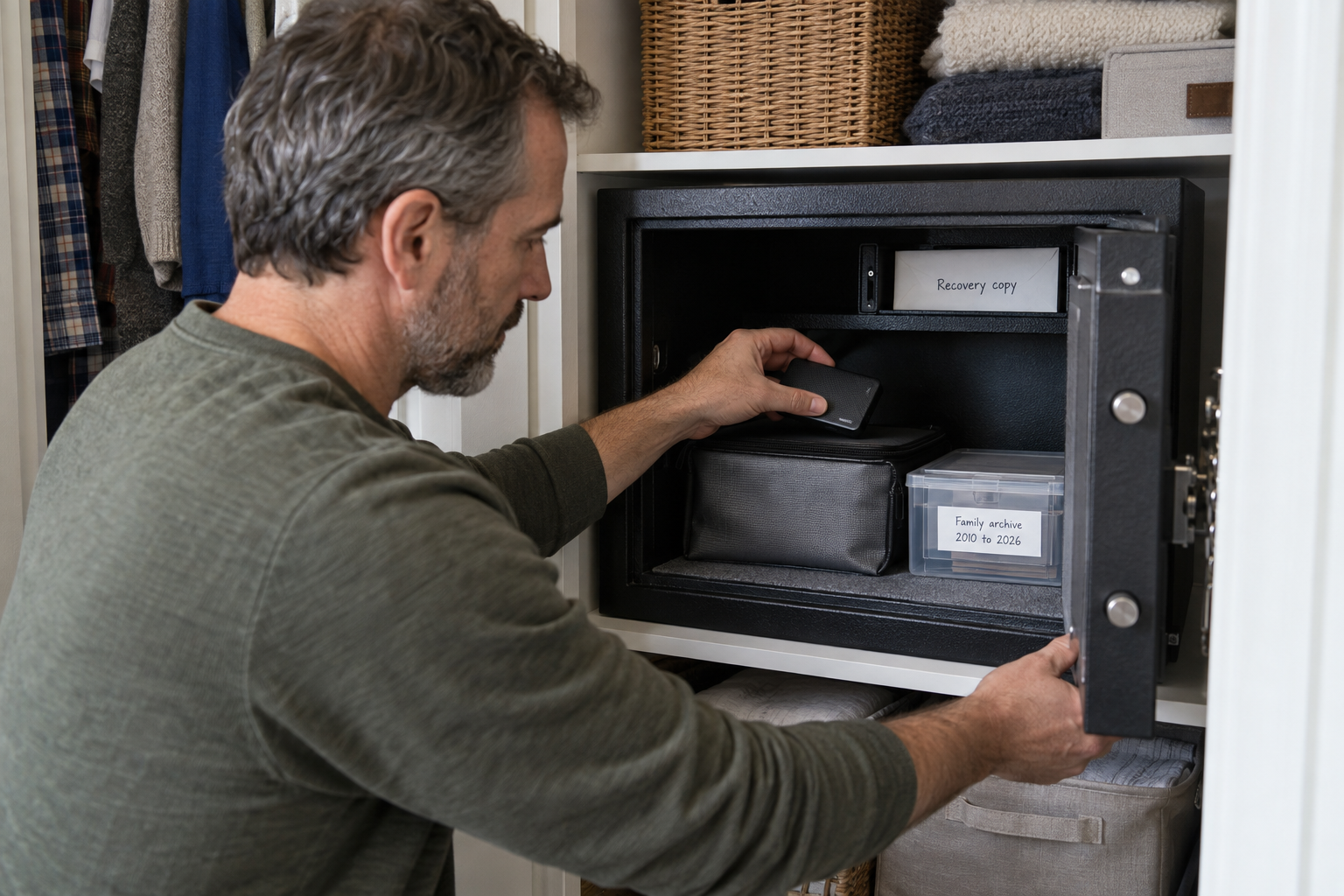
Next, map the layers for the first group. A file may be protected while uploading, encrypted while stored, wrapped under another key, available through a sharing link, copied to a second device, and recoverable through an account process. A provider could upgrade one of those layers without upgrading the others. Ask which copies and keys a claim covers.
End-to-end encryption can reduce current cloud-access risk, but it does not automatically mean post-quantum protection. Apple's iCloud security overview illustrates the need to inspect categories, metadata, and recovery separately. Its Advanced Data Protection option covers named categories, leaves others under standard protection, and shifts more recovery responsibility to the user. Other services have their own boundaries.
Before turning on a stronger storage mode, establish the recovery contact, recovery key, backup code, or other method the provider requires. Test that you understand the process. Keep a separate, protected backup when the loss would be serious. Encryption that prevents both an attacker and the owner from recovering the only copy is not a good outcome.
Reduce unnecessary duplicates of long-lived sensitive data. Delete obsolete exports, old device backups, and forgotten shared copies when doing so will not interfere with legal, tax, work, or personal retention needs. If a provider later documents a process to rotate keys, re-encrypt stored data, or upload it again, follow that process. A new connection protocol cannot retroactively change a copy that was already captured elsewhere.
What Consumers Should Do Now
A useful consumer plan for quantum-resistant encryption should be short enough to complete. It should improve current security while positioning your devices and services to receive post-quantum upgrades.
1. Turn On Automatic Updates
Enable automatic updates for the operating system, browser, messaging apps, password manager, VPN app, router, and other security-sensitive software. Check devices that do not update quietly, including routers, network storage, cameras, and older tablets. Install supported major releases, not only small patches, when the provider uses them to deliver security changes.
Do not postpone an ordinary security update while waiting for a post-quantum feature. Current vulnerabilities, malicious links, stolen sessions, and account takeovers can harm you long before quantum computing becomes relevant.
2. Know When Support Ends
Record the security-support end date for phones, computers, routers, password-manager platforms, and hardware security keys when the vendor publishes one. A supported device can usually remain in service. An unsupported device deserves a replacement plan because it is missing present-day fixes as well as a dependable route for later cryptographic changes.
At normal replacement time, compare support lifetimes and published security practices. A product that promises seven years of updates and describes its migration work may be a better long-term choice than one that uses a bold quantum label without a support period.
3. Review Long-Lived Data Once
Make a short list of the services and devices that hold your most durable sensitive information. Include cloud backups, document storage, tax or legal portals, medical systems, password managers, encrypted messaging, and any work account that contains client or proprietary records.
For each, ask whether the provider publishes a post-quantum plan, how long it supports your devices, what type of encryption applies, and who controls recovery. This is more useful than checking every app on your phone. Review the list annually or when changing a major service.
4. Protect Recovery Before Changing Encryption Settings
Store recovery codes or keys in an appropriate protected place. Update recovery contacts and remove obsolete phone numbers or email addresses. Test a backup restore before depending on it. If a provider cannot recover end-to-end encrypted data, make sure you can.
Recovery is also a security boundary. A sophisticated network protocol offers little comfort if an attacker can reset the account through an abandoned email address or persuade support to bypass the protection.
5. Keep Present-Day Defenses Strong
Continue using passkeys, multifactor authentication, unique passwords where passwords remain necessary, screen locks, device encryption, phishing checks, and tested backups. The Cybersecurity Basics guide provides a straightforward foundation for these controls.
Post-quantum cryptography protects particular mathematical operations. It does not replace judgment when a message asks for money, stop a malicious attachment, or make a weak recovery process strong.
6. Ask Providers Specific Questions
If a service stores long-lived sensitive data or charges extra for a post-quantum feature, ask for the feature name, covered layer, protocol or standard, supported versions, active status, fallback behavior, and effect on old data. Ask whether migration is automatic or requires a new session, key rotation, credential re-enrollment, or re-upload.
A support answer that names a protocol, version, scope, and verification step is useful. “We take quantum security seriously” is a statement of intent, not a technical answer.
7. Set a Review Trigger and Move On
You do not need to follow quantum news every day. Recheck when a major device reaches the end of support, a provider announces a migration, an app requests credential re-enrollment, a regulated workplace gives instructions, or you are about to buy a long-lived security product. An annual review is enough for many households.
What Can Wait
Preparing for quantum-resistant encryption also means knowing what not to do. Several expensive or disruptive responses offer little value for an ordinary consumer today.
Replacing every supported device can wait. Keep a phone, computer, router, drive, or security key that still receives security updates and meets your needs. Replace it when support ends, a required service documents an incompatibility, or a specific long-term confidentiality need justifies the cost.
Installing cryptographic libraries yourself can wait. NIST standards are building blocks for well-analyzed products and protocols. Selecting an algorithm does not solve implementation, key management, updates, interoperability, authentication, storage, or recovery. A maintained vendor implementation is the consumer path.
Abandoning sound AES-protected storage can wait. Strong symmetric encryption remains part of the security system. Focus on how keys are created, protected, exchanged, backed up, and recovered, and follow credible provider migration instructions when they arrive.
Replacing passkeys or strong multifactor authentication can wait. These controls address phishing and account takeover now. Change them when the relevant provider or authenticator gives a clear migration instruction or ends support.
Buying quantum hardware can wait. Consumers do not need a quantum network, quantum key distribution system, or special machine to use the new standards. Post-quantum algorithms are designed to run through conventional computing products and services.
Paying extra for a vague badge can wait. A label that does not name the protected feature, active version, protocol, fallback behavior, and verification method does not provide enough information for a purchase decision.
Before making a quantum-specific change, apply three gates. First, identify the information or connection you are trying to protect. Second, confirm that the proposed change covers that exact layer on the device and mode you use. Third, compare the benefit with the cost of switching, including lost compatibility, new recovery duties, cancellation fees, and the chance that a less established tool receives weaker security maintenance. If the protection cannot pass all three gates, put the decision on a later review date rather than buying under pressure.
There are reasonable exceptions. An employer, government agency, attorney, clinician, or client may require a named product or migration step because of the records you handle. A provider may announce that an older device cannot participate in a required protocol. A person protecting unusually sensitive material for decades may also accept more cost or inconvenience. In those cases, follow the specific requirement and verify the complete data path. The exception comes from a defined need, not from a general prediction about quantum computing.
Waiting should still be active. Keep the device supported, watch the providers that hold your longest-lived data, retain documentation for important purchases, and revisit the decision when a relevant product reaches normal replacement time. “Can wait” means there is no useful emergency action today. It does not mean the wider transition is imaginary or that vendors can ignore it.
One thing should not wait: ordinary updates. Delaying a security patch because the wider post-quantum transition is incomplete leaves a present-day opening without improving future protection.
How to Read a Post-Quantum Product Claim
A quantum-resistant encryption claim can be accurate and still narrower than it sounds. A VPN may protect one tunnel mode. A browser may support one key exchange when the server agrees. A messaging service may protect conversations only among updated clients. A cloud provider may offer an algorithm through one service while other storage, identity, and recovery systems remain on a longer roadmap.
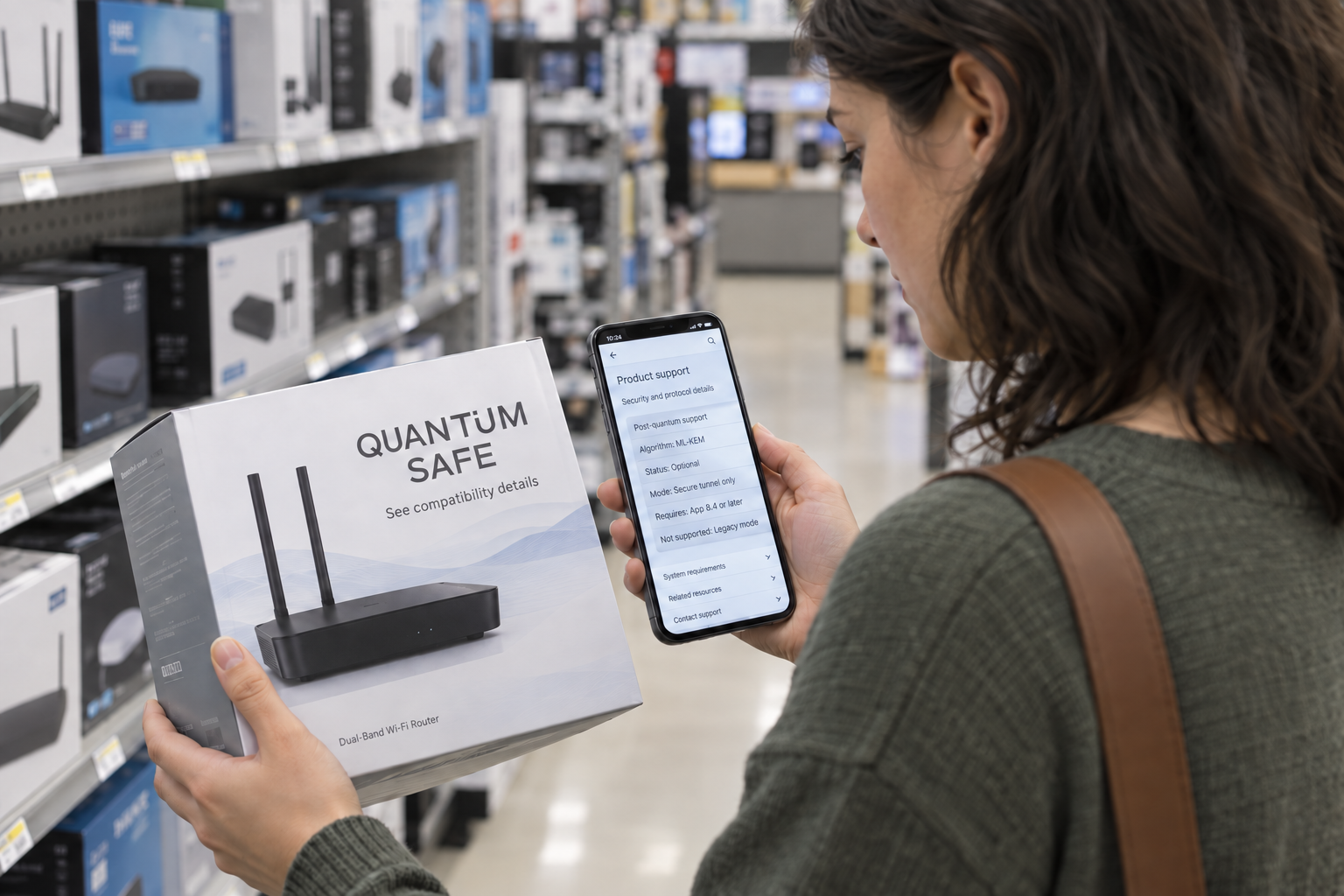
Use this checklist before paying, switching, or trusting long-lived data to the product:
- What exact layer is covered? Ask whether the claim applies to a TLS handshake, VPN tunnel, message session, stored file, encryption key, digital signature, login credential, sharing path, or recovery process.
- What standard or protocol is used? A clear answer may name ML-KEM, ML-DSA, SLH-DSA, or a documented hybrid protocol. A slogan alone is not enough.
- What is the deployment state? “Planned,” “experimental,” “preview,” “available,” and “enabled by default” describe different realities. Find out which one applies to your account and device now.
- Which versions are eligible? Check the operating system, app version, browser, hardware, region, account tier, and connection protocol.
- Who else must support it? Some protections require a compatible server, every participant's device, or a particular endpoint. One updated phone may not upgrade the whole path.
- Can you verify the active state? Look for a connection status, protocol field, technical readback, or other documented indicator. A settings toggle may be insufficient if the product falls back silently.
- What disables or bypasses it? Ask about incompatible connection modes, older devices, exports, linked apps, sharing links, recovery flows, and fallback protocols.
- What happens to existing data? A new handshake does not automatically re-encrypt old backups, rotate every key, replace saved credentials, or retrieve copies collected earlier.
- How long will support continue? A feature on a product near the end of security support may have less value than a conventional product with a long, clear update commitment.
- Is there public technical detail? Look for a protocol description, support page, version history, migration roadmap, and clear limits. Independent analysis is useful when available, but the provider should at least state what it built.
First-party VPN documentation provides a concrete illustration. NordVPN says its post-quantum feature operates with NordLynx and lists modes that are incompatible with it. This is not a recommendation for or against the service. It shows that “the VPN supports post-quantum encryption” is less precise than “this platform, protocol, and active mode use the feature.”
A good buying decision requires five answers: the protection is specific, active, relevant to your data, verifiable in use, and backed by continued support. If one answer is missing, wait or buy based on the product's ordinary security and usefulness instead of its quantum claim.
What to Do After a Misleading Purchase or Claim
If you bought a service or device because a post-quantum claim sounded broader than the technical reality, begin with evidence. Save the advertisement, product page, checkout description, receipt, order date, and any feature comparison that influenced the decision. Take a screenshot or save a copy before the wording changes. Keep support replies with the rest of the record.
Compare the promise with the provider's technical documentation and the status visible in the product. Identify the exact gap. Perhaps the feature is planned rather than active, works only on another platform, requires a different protocol, excludes the mode you use, or protects transport but not stored data. A precise discrepancy is easier to resolve than a general complaint that the product is not quantum safe.
Ask support for a written answer to three points:
- What exact feature and protocol are active on your account, device, and connection mode?
- What information is outside the protection, including old data, backups, fallbacks, sharing, and recovery?
- What step, version, or purchase would be required to obtain the advertised protection?
If the answer does not match the sales claim or your need, use the seller's available cancellation or refund process. If applicable, use the marketplace's reporting process or the payment provider's dispute procedure and submit the saved evidence. State what was promised, what the documentation or product showed, and what resolution you requested. Avoid claiming that every part of the product is insecure when the evidence shows a narrower coverage or marketing problem.
Then limit any continuing exposure. Turn off auto-renewal if you no longer want the service. Export information you are entitled to keep, remove data you no longer need under the provider's account controls, revoke unneeded permissions, and uninstall unused software through the normal device process. If you reused a password, change it and enable stronger authentication. Review linked devices and active sessions when the product had account access.
Do not delete the only copy of important data or destroy the evidence needed for a refund. If the product holds an encrypted archive, confirm that you have a readable replacement and working recovery method before closing the account. If the issue is limited to a future-facing claim and the product still serves another purpose safely, you can make a proportional decision rather than an emergency exit.
Finally, return to the present-day risk. Check for updates, suspicious logins, unexpected permissions, browser extensions, device management profiles, and recovery changes. A disappointing quantum claim may be mostly a purchasing problem, while an overprivileged app or reused credential can create an immediate security problem.
Conclusion
Quantum-resistant encryption is moving from standards into real products, but consumers do not need to manage the algorithms themselves. The sensible response is to keep supported devices and services current, give extra care to information that must remain private for years, and demand exact scope from any company selling a post-quantum feature.
Your plan can fit on one page. Enable updates. Know when important devices lose support. Review long-lived sensitive archives and their recovery paths. Keep passkeys, multifactor authentication, and ordinary phishing defenses. Ask what a quantum claim covers, whether it is active, and how you can verify it. Wait before replacing working hardware or buying a vague promise.
This transition will take years, and the details will change as providers update their products. You can subscribe for practical security updates without turning every announcement into an emergency purchase.
FAQ
Do I Need to Buy a New Phone or Computer for Quantum-Resistant Encryption?
Usually not if the device still receives security updates and runs the current versions of the services you use. Post-quantum support is often delivered through software, operating-system, browser, and protocol updates. A missing marketing label does not prove that a supported device has no migration path.
Plan a replacement when the manufacturer ends security support, an essential service documents a hardware incompatibility, or you have a specific long-lived confidentiality need that the current device cannot meet. At replacement time, compare the promised support period and the vendor's published security roadmap. Do not use a government migration date as a household shopping deadline.
Is My Password Manager Already Quantum-Resistant?
The answer depends on which part of the service you mean. A password manager can use one method for the encrypted vault, another for deriving a key from your account secret, another for transport, and separate systems for sharing, synchronization, authentication, and recovery. A post-quantum network connection does not automatically change all of those layers.
Check the provider's documentation for the exact feature, standard or protocol, supported app versions, rollout state, and treatment of old vault data. Ask whether migration is automatic or requires a new login, key rotation, re-encryption, or re-upload. Continue to use a strong account secret, multifactor authentication, current apps, and a protected recovery method while that work proceeds.
Are Passkeys Unsafe Because They Use Public-Key Cryptography?
No. Passkeys provide an important present-day benefit because they are bound to the legitimate service and resist common credential-phishing attacks. The need for providers and standards bodies to migrate public-key systems over time does not erase that benefit today.
Keep using passkeys where they are available. Maintain current operating systems and browsers, protect device unlock methods, and keep account recovery current. If a service or hardware-key maker later requires re-enrollment or replacement for a post-quantum change, follow that specific instruction instead of abandoning the protection early.
Does a Post-Quantum VPN Protect All of My Data?
No. A VPN protects traffic inside a defined tunnel between endpoints. A post-quantum feature may strengthen how that tunnel establishes keys, but it does not automatically make the destination website honest, secure your account, encrypt data after the provider receives it, protect files already stored in a cloud service, or stop malware on the device.
Check the active protocol, supported platform, compatible modes, server requirements, fallback behavior, and connection status. Decide whether that defined protection matters for your data. Do not pay solely for the label when the provider cannot show that the feature is active in the mode you use.
Should I Re-Encrypt Old Backups Now?
Begin with the backup's secrecy lifetime, current encryption, exposure, key management, and recovery. A well-protected backup using strong symmetric encryption does not automatically need emergency replacement. The more useful question is whether vulnerable public-key cryptography protects its encryption key, upload path, sharing mechanism, or recovery process.
Remove unnecessary old copies and use a supported storage system with clear documentation. Keep a tested backup and recovery method before changing anything. When the provider gives specific instructions to rotate a key, re-encrypt stored data, or upload it again, follow those steps. Do not assume a new network handshake retroactively protects a copy that was already collected.
What Is the Simplest Review I Can Do Each Year?
Check six things: whether automatic updates are on, whether important devices still receive security support, which devices are linked to sensitive accounts, whether backup recovery still works, where unnecessary copies of long-lived data remain, and whether key providers have published a concrete post-quantum migration update.
Repeat the review sooner when replacing a phone or router, changing a password manager or cloud-backup service, handling unusually sensitive long-term records, or receiving a specific migration notice. Otherwise, keep your present-day security habits strong and let providers do the cryptographic engineering.